by Meraj Zargar
A personal account traces Javed Ahmad Tak’s journey from tragedy to transformative social work, highlighting his role in redefining disability, dignity, and inclusive education in Kashmir

In 2023, soon after my transfer to the Sub-Divisional Magistrate’s office in Bijbehara, I felt a strong desire to meet Javed Ahmad Tak. Although I was already somewhat familiar with his name and work, there was an inner longing to meet this remarkable individual—the “Tak” brand’s worthy son—who is deeply engaged in an extraordinary form of social service. My two-decade-long voluntary association with the Jammu & Kashmir Yateem Trust had already introduced me to the greatness of two distinguished “Tak” sons from Sopore. The Trust’s work and my emotional attachment to it had seeped into my very being. This reference, of course, is purely incidental and has nothing to do with assessing a person’s greatness through caste or lineage.
A few days later, I had the opportunity to visit the Zeba Aapa Institute in Bijbehara, founded by Javed Sahib. Although I could not meet him that day, my heart became mysteriously attached to the institution, as if drawn by a magnetic force, purely as a human connection.
Later, I finally met Javed Sahib during a charitable program for orphaned children. Embracing him, I realised what it means for a human heart to be forged in the golden fuel of tragedy and conscious maturity. The encounter brought not only spiritual solace but also a renewed sense of purpose in life. I met him several more times thereafter and visited his institution on multiple occasions. During an educational and awareness program, I had the privilege of spending more time with him and absorbing some of his profoundly valuable thoughts, which carried an almost celestial resonance. Truly, Javed Sahib is a living miracle.

Javed Ahmad Tak, who may rightly be called an “unconquerable hero” of Kashmir, is a social activist who stands as a living symbol of the struggle for the rights of persons with disabilities. In 2020, he was awarded the Padma Shri, India’s fourth-highest civilian honour. He serves as the honorary chairman of the Zeba Aapa Institute of Inclusive Education, located in Bijbehara, district Anantnag, South Kashmir. This institution is unique in that it not only provides education but also focuses on rehabilitation, sports, arts, and the development of independence among children with disabilities.
His life story is one of pain, courage, and service, a narrative that deeply inspires anyone who has faced life’s challenges. Born in 1974 in the Saraf Mohalla of Bijbehara, Javed Sahib lost his legs at the age of 32 in a militant attack. Yet he refused to surrender to despair. Instead, he dedicated his life to serving children with disabilities. Today, his institute provides free education, physiotherapy, and social rehabilitation to more than 260 children.
Before the incident, his life was like that of any ordinary student. But fate had something else in store. While in the final year of his BSc, he was a victim of an event that changed the course of his life. Even then, he did not give up. While bedridden in the hospital, he continued his education. He earned diplomas in Computer Applications and Human Rights from Indira Gandhi National Open University (IGNOU), followed by a Master’s degree in Social Work from the University of Kashmir. He also completed a BEd in Special Education (with specialisation in Mental Retardation) and later an MEd.
His educational journey was full of hardships. Fellow students would assist him in the classroom. As he himself says, “Disability gave me a new perspective on the world.” His education shaped him into a social worker who not only teaches children with disabilities but also advocates for their rights.
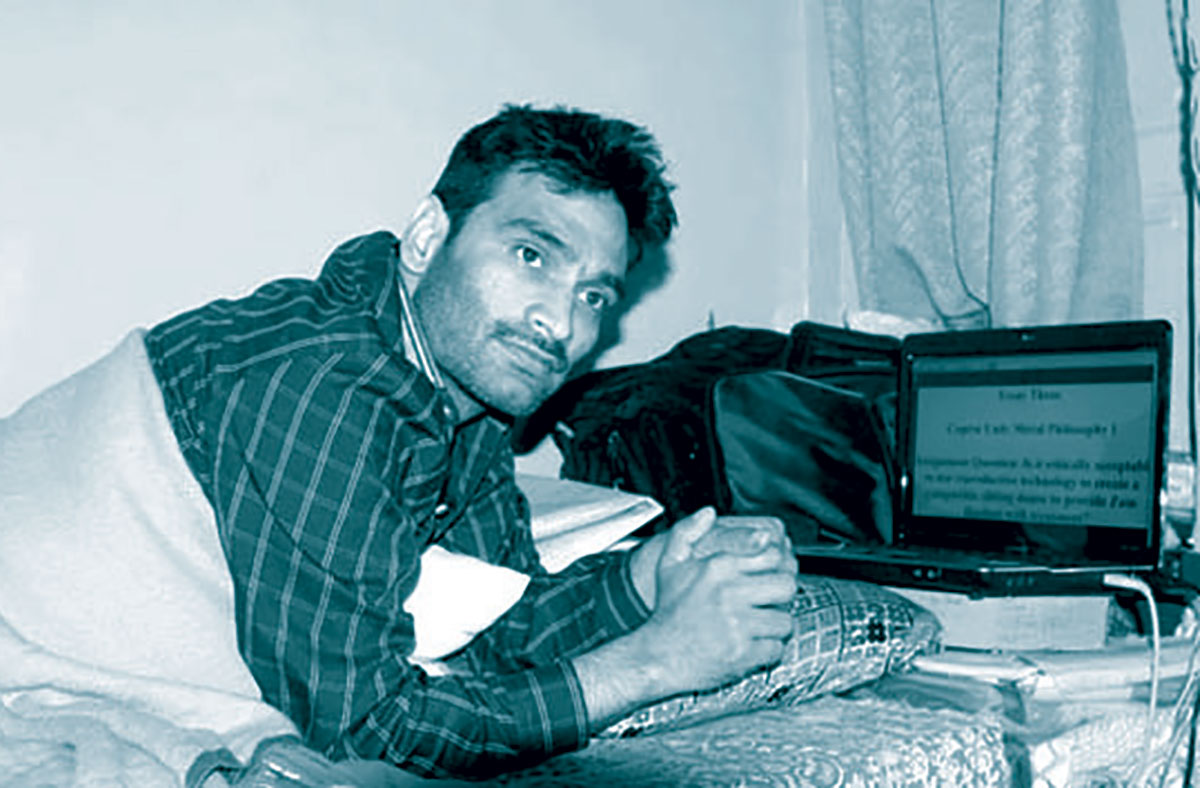
Confined to a wheelchair, Javed Sahib chose to view life positively. The tragedy transformed his direction: a man who once aspired to become a doctor became, instead, a healer of humanity. Using the compensation he received, he began providing free education to underprivileged children. His first four students—children who had dropped out due to disability—are now graduates leading dignified lives.
After the incident, he began teaching children with disabilities from his home. In 2003, he founded the Humanity Welfare Organisation Helpline, a registered charitable institution dedicated to protecting the rights of persons with disabilities, providing free education, medical assistance, and social rehabilitation. The organisation has distributed hundreds of wheelchairs, hearing aids, crutches, and smart canes. It has facilitated surgeries for children with cleft palate and organised numerous free medical camps, benefiting hundreds.
Through his efforts, the tradition of observing “World Disability Day” began at the University of Kashmir and has since spread across the region. His advocacy led to the installation of ramps in educational institutions and government offices, scholarships, fee concessions, and other facilities. Convenience allowances for persons with disabilities were increased, and they gained access to civil service opportunities.
Between 2006 and 2008, he established the Zeba Aapa Institute of Inclusive Education, the first mixed-disability school in South Kashmir. Named after his grandmother, Zeba Aapa, who used to treat people with herbal remedies free of cost, the institution began in a rented room with just four children. Today, it serves over 260 students, including those who are visually impaired, hearing impaired, speech impaired, and those affected by cerebral palsy and autism. The institute provides education in Braille, sign language, physiotherapy, music, vocational skills, and daily living skills. It also arranges transportation for students and has successfully mainstreamed many into government schools. Several students have participated in national-level sports competitions.
Javed Sahib’s struggle extends beyond education. He has filed public interest litigations, advocated for disability rights, and trained thousands of teachers in Braille and sign language. The journey was far from easy, he faced criticism, financial constraints, and social distrust. Yet he persevered. Today, his students are achieving success in various fields. He has transformed the perception of disability in Kashmir, from a matter of charity and sympathy to one of rights and autonomy. In November 2021, he was awarded the Padma Shri in recognition of over two decades of dedicated service. On that occasion, he remarked:
“I felt no one was watching me, but God was. Today I realise that people were watching too.”
To confine Javed Ahmad Tak’s work merely to the domain of social service would be to underestimate its depth. His actions represent a profound ethical and existential philosophy, one in which personal suffering is transformed into collective meaning. In Sufi thought, this may be described as the “purification of pain,” where suffering does not break a person but grants deeper insight.
There is in his personality a quiet resilience, a silent steadfastness. He does not rely on rhetoric or ideological posturing; instead, he transforms society through lived example. This quality elevates him from a social worker to what may be called a “moral architect.”
His approach is not rooted in conventional notions of charity or sympathy but in a rights-based consciousness. He views disability not as a matter of pity but within the framework of human dignity. This gives his work a philosophical coherence and continuity that transcends ordinary philanthropy, shaping a new social narrative.
Aesthetically, his life represents the “creation of meaning from tragedy.” His physical condition becomes not a limitation but a symbol, one that reflects society back to itself and challenges its hidden indifference. Another striking aspect of his character is the balance between humility and selfhood. He does not turn his achievements into personal pride, yet he possesses a strong inner self that refuses to yield to circumstances.
Javed Ahmad Tak embodies the idea that a human being is not merely a prisoner of fate but also its creator. He transformed personal loss into collective strength. His life teaches that true greatness lies not in physical power but in the strength of will and the sincerity of purpose.
From a philosophical perspective, his work suggests that social service is not merely an act but an existential responsibility. He shows us that when an individual transforms pain into awareness, it can alter the direction of an entire society. His story thus becomes an intellectual movement, one that invites us to introspect, question our social attitudes, and rediscover humanity.
Viewed through modern social philosophy, his struggle acquires even deeper meaning. He emerges not just as an individual but as a narrative, a resistance, and a possibility.
His work can be understood through the lens of power; society is shaped not only by laws and institutions but by invisible structures that define who is “normal” and who is “other.” Marginalising persons with disabilities is part of this structure. Yet Javed Sahib’s work is a quiet but persistent resistance to this invisible power. Without confrontation, he transforms the discourse itself.
At the same time, his efforts resonate with the idea of communicative action, creating a public sphere where persons with disabilities are no longer objects but active voices. His institution becomes a space of dialogue, equality, and mutual respect—a moral conversation that compels society to rethink itself.
Thus, Javed Ahmad Tak stands at a unique intersection where resistance and dialogue merge into a new social meaning. He not only challenges dominant narratives of power but also constructs an alternative vision grounded in dignity, participation, and human worth.
It is astonishing that he chose not to seek revenge or confrontation against those who wronged him, but instead turned inward, transforming himself, and then outward, becoming a source of healing for others like him.
Philosophically, his life teaches that social service is both a creative and critical consciousness, one that challenges existing meanings and generates new ones. He has redefined disability: from weakness to strength, from dependency to autonomy.
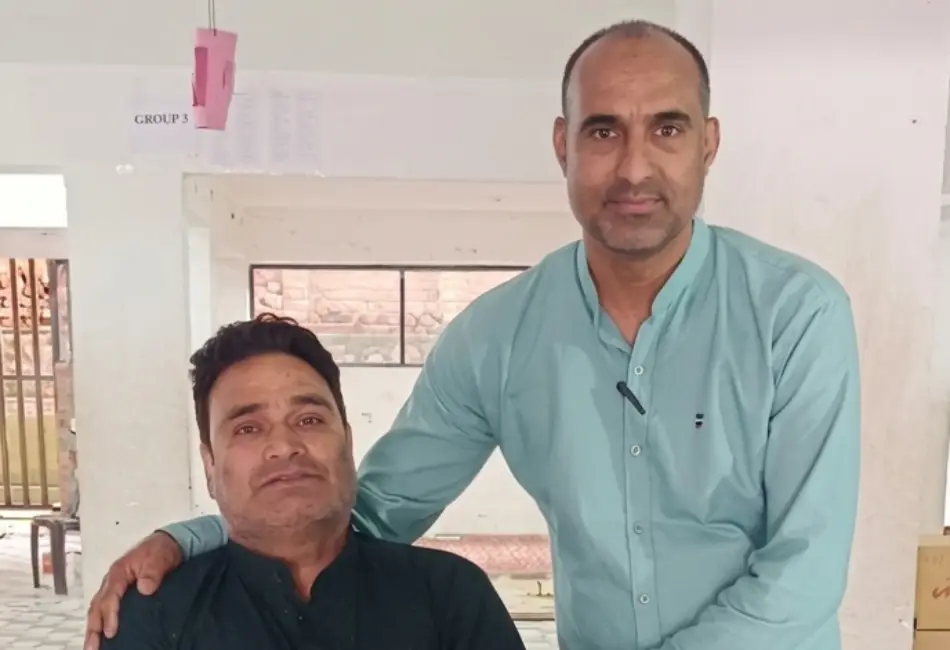
At this point, his journey transcends the story of an individual and becomes an intellectual possibility, one that suggests that real societal transformation does not emerge from centres of power, but from such silent yet resolute individuals who make their very existence an argument.
From my own two decades of social service, I can say with conviction that among the remarkable individuals I have encountered, Javed Sahib holds a distinct place. Free from pretension, he resembles a mature dervish whose heart finds joy in the happiness of God’s creation and who quietly advances along the path of service.
May Allah grant him success in his noble mission.
(The author is a Revenue Department employee from Tral, and has spent nearly two decades in social service, working closely with the Jammu and Kashmir Yateem Trust and other organisations to support the education and welfare of orphans and underprivileged students. A dedicated Urdu writer, he is the author of Yeh Jo Zindagi Ki Kitaab Hai and Dil-e-Roshan Taab, exploring the deeper dimensions of human experience. Ideas are personal.)