by Suhail Gaznavi
An examination of how social media erodes privacy, fuels digital trials, violates child protection laws, and turns grief, allegations, and human suffering into viral content.
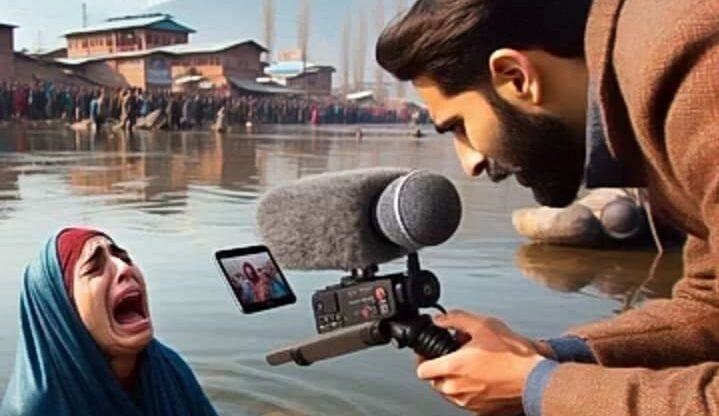
At the very foundation of this debate lies a non-negotiable principle: the right to privacy is a fundamental right. The Supreme Court of India, in the landmark judgment of Justice KS Puttaswamy (Retd.) vs Union of India, unequivocally held that privacy is intrinsic to life and personal liberty under Article 21 of the Constitution of India. This protection is not abstract; it extends to dignity in moments of grief, protection against unwarranted exposure, and the right to be left alone when life is at its most vulnerable. Yet, in today’s digital ecosystem, this constitutional guarantee is being routinely violated.
A recent incident captures this moral and legal collapse with painful clarity. A mother from Pulwama, whose child tragically slipped into a river in the Dubjan area of Shopian during a picnic, was left to endure not only unbearable loss but also the cruelty of onlookers who chose to record her agony and broadcast it online. One must ask: what public interest is served by filming a grieving mother? What purpose is achieved by converting private sorrow into viral content?
This is where the distinction between a journalist and a “Facebook hawker” becomes critical. A journalist operates within a framework of ethics, verifying facts, respecting dignity, and exercising restraint. A Facebook hawker, by contrast, is driven by speed, sensationalism, and engagement. In this race for visibility, empathy is discarded, and truth becomes secondary to virality.
The damage caused by this shift is not merely emotional; it strikes at the heart of the legal system.
One of the most fundamental principles of criminal jurisprudence is that an accused person is presumed innocent until proven guilty by a competent court of law. However, in the age of social media, the moment a First Information Report (F.I.R.) is registered against someone, digital platforms transform allegation into conviction. Photographs are circulated, narratives are constructed, and individuals are publicly branded as criminals—without trial, without evidence, and without restraint.
Such “trial by social media” is not only unjust but dangerous. It undermines due process, prejudices fair investigation, and irreparably damages reputations. Even if a person is later acquitted, the stigma created by viral misinformation often lingers permanently.
The situation becomes even more serious when children are involved.
The Juvenile Justice (Care and Protection of Children) Act, 2015, provides explicit legal protection to children in conflict with the law. Section 74 of the Act strictly prohibits the disclosure of a child’s identity, including name, photograph, address, or any detail that may lead to identification. Violation of this provision can result in imprisonment of up to six months, a fine, or both.
The purpose of this law is reform, not retribution. Children are meant to be rehabilitated, not publicly shamed. Yet, Facebook hawkers routinely publish images and details of juveniles the moment a case is registered, completely disregarding both legal mandates and basic human decency. Such actions not only violate the law but also destroy the future of children who are entitled to protection and a second chance.
It is important to clarify that this argument is not directed against free media, nor does it support censorship. A free press remains the cornerstone of democracy. Responsible journalism plays a vital role in holding power accountable and informing the public. However, freedom of expression cannot be divorced from responsibility. When expression becomes a tool for harassment, misinformation, or invasion of privacy, it ceases to be freedom; it becomes abuse.
What is urgently required is a combination of legal reform and strict enforcement.
Existing laws relating to privacy, defamation, and child protection must be implemented with greater seriousness and speed. At the same time, new legislative measures are needed to address the unique challenges posed by social media. Clear liability must be defined for those who deliberately spread unverified or harmful content. Social media platforms, as intermediaries, must also be held accountable—required to remove unlawful content promptly, strengthen fact-checking mechanisms, and cooperate with authorities in identifying violators.
Equally, there must be a societal shift. The power to record and share information carries with it a moral obligation. Not every moment is meant for public consumption. Grief is not content. Allegation is not guilt. A child’s mistake is not a life sentence.

If the line between journalism and digital exploitation is allowed to vanish, we will not just lose ethical reporting, we will lose our collective humanity. A society that watches a grieving mother through a camera lens instead of offering help, that declares individuals guilty the moment a First Information Report (F.I.R.) is registered, and that exposes children in conflict with law in blatant violation of the Juvenile Justice (Care and Protection of Children) Act, 2015, is a society in urgent need of both legal correction and moral awakening.
The Constitution, through Article 21 of the Constitution of India, guarantees dignity and privacy, not as privileges, but as rights. These cannot be sacrificed at the altar of clicks and virality. The time has come for decisive legal reform, strict enforcement, and societal introspection. Because if the law does not draw the line firmly now, the next victim of this reckless digital culture could be anyone—and the damage, once done, is often beyond repair.
(The author is an Advocate at the Jammu & Kashmir and Ladakh High Court, Srinagar. Ideas are personal.)