by Sri Varshith Kumar Reddy E
India grows impressively and imports compulsively. The exchange rate is where those two facts meet.
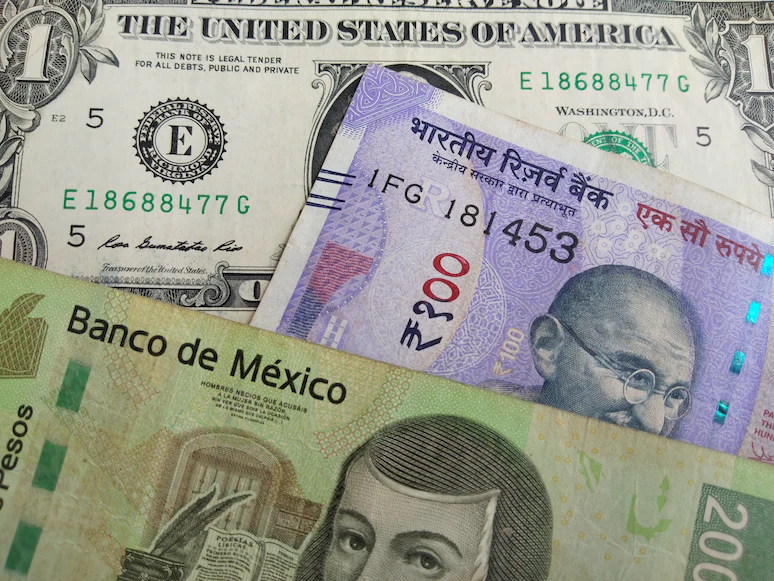
On May 19, 2026, the Indian rupee touched an intraday low of 97.27 against the US dollar, its weakest level since the currency was first floated. By May 29, it had recovered to 95.53 on news of a US-Iran ceasefire extension. Geopolitical truces are not structural reforms, and a currency that recovers on a sixty-day diplomatic understanding has not recovered at all. The slide from 89.87 at the end of 2025 to a peak depreciation of nearly 8 per cent in under five months exposes fault lines that no quarterly GDP aggregate can paper over.
The Oil Shock and Its Arithmetic
The fuel for this episode is, almost poetically, actual fuel. The deepening of the Iran-Israel conflict placed the Strait of Hormuz, through which roughly a fifth of the world’s seaborne oil transits, under genuine threat of disruption. Brent crude, which had averaged $70.3 per barrel through FY26, surged past $100 and approached $114 at its peak. India sourced 88.6 per cent of its crude requirements through imports in April–January FY26, a record high and a steep climb from 77.6 per cent in 2014, making this an energy tax imposed without parliamentary sanction.
CRISIL placed the current account deficit at 2 per cent of GDP in FY27 under a prolonged West Asia crisis scenario; HSBC estimated 2.3 per cent assuming $95 Brent, against 0.9 per cent in FY26. With crude spending much of May above $110, both projections read as cautious rather than conservative, and the merchandise trade deficit had already widened to $28.38 billion in April 2026 alone.
The Human Arithmetic
The macroeconomic costs of currency depreciation have a way of dissolving into percentages before they reach the human beings who bear them. The rupee’s fall raises petrol prices without a Budget, inflates fertiliser costs at the worst moment in the agricultural calendar, and stretches every rupee set aside for a dollar-denominated obligation. The exchange rate, for millions of households, is arithmetic before it is macroeconomics.
Prime Minister Modi’s public appeal urging citizens to moderate gold purchases, a rare act of executive intervention in household consumption, signals how seriously the import burden is being taken at the highest levels of government. When a head of government must address the contents of a family’s savings, the macroeconomic pressure behind that request deserves to be understood with full clarity.

The RBI’s Unenviable Position
Foreign exchange reserves fell from a reported high of $728.49 billion in the week ending February 27 to $688.89 billion as of May 15, a drawdown of roughly $39 billion in under three months, with approximately 2 per cent of the stockpile deployed across spot and forward market interventions. Governor Sanjay Malhotra has described reserves as “sufficient and not a matter of concern,” and intervention near the 96.20 level in mid-May is consistent with that posture.
The harder question is philosophical. A central bank that defends a specific exchange rate against fundamentals will eventually exhaust both reserves and credibility, as the histories of several emerging economies confirm. The RBI’s stated mandate of preventing disorderly volatility is the right framing. The discipline lies in recognising that “preventing disorderly volatility” and “passively accepting structural depreciation” occupy different coordinates on the policy map, and the distance between them demands constant recalibration.
The repo rate, cut to 5.25 per cent in December 2025, representing a cumulative 125 basis points of easing since mid-2024, was held through the April 2026 meeting with a neutral stance. Tightening to dampen imported inflation risks suffocating a private investment recovery only now acquiring serious momentum. Holding steady risks a depreciation spiral that outpaces any growth dividend the accommodation provides. Those who present one path as self-evidently correct are underestimating what serious central banking invariably involves.
An Economy Still Shopping from the World
India’s import basket reveals the architecture of a particular growth model. The country imports crude oil at near-total dependency because domestic production has stagnated while energy demand has grown. Electronics and semiconductors arrive from abroad because domestic manufacturing, despite the ambitions embedded in Production Linked Incentive schemes, has not generated the supply-chain depth that competitive exporters require.
Gold is imported because Indian households treat physical metal as a preferred store of value, a preference that persists regardless of what policy circulars recommend. These three categories account for roughly half of India’s total import bill, and they are structural features of the economy rather than distortions amenable to tariff adjustments.
India’s export performance has shown genuine life with merchandise exports in April 2026 reached $43.56 billion, up 13.78 per cent year-on-year, driven by electronics goods at 40.31 per cent growth and engineering goods at 8.76 per cent. A significant share of the headline growth, however, came from petroleum product exports at 34.66 per cent, meaning export momentum remains partially hostage to the same commodity cycle that inflates import costs. Services exports grew 13.36 per cent in the same period, providing a valuable cushion. A cushion absorbs shocks; it does not resolve the structural exposure that produces them.
Foreign Portfolio Investors withdrew Rs 2.2 lakh crore, approximately $26 billion, from Indian equities across the first five months of 2026, surpassing the Rs 1.66 lakh crore that exited across the entirety of 2025 and representing the largest outflow in thirty-four years. India’s continued reliance on portfolio investment for a meaningful share of external financing leaves the exchange rate sensitive to every turn in global sentiment, amplifying volatility that originates in commodity markets far from Dalal Street.
India Among Its Peers
The reassertion of dollar strength has visited hardship across emerging markets broadly, with the Indonesian rupiah, the Brazilian real, and the Turkish lira all enduring currency stress driven by elevated US bond yields. India’s experience is not exceptional in its direction; the degree of structural exposure distinguishes it.
China held the yuan relatively firm through this episode, having built a structural current account surplus over two decades of deliberate industrial policy that reduced its dependence on imported inputs. The contrast illustrates which variables determine currency resilience — tradeable-sector competitiveness, current account position, and the composition of capital inflows and on each of these dimensions, India’s position requires candid attention.
What Policy Can and Cannot Do
A near-term response should maintain the RBI’s measured intervention posture. If conditions deteriorate materially, sovereign NRI bonds, deployed with success during the taper tantrum of 2013, remain available, as do sovereign green bond issuances targeting ESG-focused, long-duration capital less prone to rapid reversal. Both instruments carry more force when deployed with restraint than when reached for prematurely.
Over the medium term, the fiscal arithmetic requires honesty. Elevated crude prices inflate the subsidy burden on fuel and fertilisers, widening the deficit at precisely the moment when capital expenditure momentum matters most. A wider deficit during currency depreciation invites higher bond yields and wider spreads, a compounding dynamic India can ill afford.
The structural work is harder and slower, but the answer resides there. India’s strategic petroleum reserve capacity needs meaningful expansion, treated as permanent macroeconomic insurance rather than emergency stockpiling after the fact. PLI ambitions need to graduate from incentive design to genuine supply-chain integration, where April’s electronics export surge suggests the foundation already exists. Rupee internationalisation, which the RBI has been advancing through bilateral trade settlement agreements, requires deep and liquid domestic bond markets as a prerequisite for any foreign counter-party to treat the arrangement as credible.
The Mirror the Market Holds Up
Equity markets can be sustained by liquidity; GDP aggregates can be inflected by base effects. The exchange rate is less forgiving. It reflects, in real time, the world’s assessment of an economy’s productive capacity and the stability of the capital flows that finance whatever external gap persists.

India’s long-term story, its large domestic market, its demographic dividend, and its expanding digital infrastructure remain intact and should be stated without apology. Potential and resilience are nonetheless different qualities. Potential describes what an economy can become when conditions are favourable. Resilience describes what it demonstrates when they are not.
The Strait of Hormuz has served notice that near-total import dependence for crude oil is simultaneously a fiscal variable, an inflation variable, a currency variable, and a geopolitical exposure. The exchange rate, in the end, is a summary statistic. What it summarises is the structure of the economy behind it, and right now, that structure is asking to be taken seriously.
(The author is a pracademic working on government policy and public institutions. Ideas are personal.)