by Umaima Reshi
SRINAGAR: The number of bank fraud cases reported in Jammu and Kashmir has fallen sharply over the past three financial years. Still, the amount involved in those frauds has surged more than fourfold, according to data placed before Parliament.
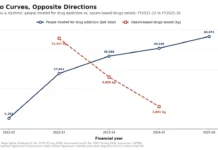
Banks and financial institutions reported 868 fraud cases involving Rs 322.31 crore in Jammu and Kashmir between 2023-24 and 2025-26. The number of cases declined from 467 in 2023-24 to 103 in 2025-26, but the amount involved increased from Rs 47.55 crore to Rs 193.49 crore.
The figures mean that while reported cases fell by nearly 78 per cent over the three-year period, the value involved increased by more than four times.
In 2023-24, J&K recorded 467 fraud cases involving Rs 47.55 crore. The following year, the number of cases fell to 298, but the amount involved rose to Rs 81.27 crore. In 2025-26, cases declined further to 103, while the amount involved climbed to Rs 193.49 crore.
The average value of a reported fraud consequently increased sharply. It was around Rs 10.2 lakh per case in 2023-24, rising to Rs 27.3 lakh in 2024-25 and reaching nearly Rs 1.88 crore per case in 2025-26.
The increase was accompanied by a widening gap between the amount involved and the amount recovered.
Against Rs 47.55 crore involved in frauds in 2023-24, banks reported recovery of Rs 3.23 crore. In 2024-25, recovery stood at Rs 2.65 crore against Rs 81.27 crore involved. In 2025-26, Rs 6.92 crore was recovered against Rs 193.49 crore involved.
Taken together, banks reported recovery of only Rs 12.80 crore against Rs 322.31 crore involved in frauds over the three years — less than four per cent of the total amount.
The recovery rate was particularly low in the latest financial year. For every Rs 100 involved in reported frauds in J&K during 2025-26, only about Rs 3.60 was reported as recovered.
The government, however, has cautioned that the recovery figures should not be interpreted as the final amount that can be recovered from these cases. Recovery proceedings can continue for years through civil courts, Debt Recovery Tribunals, proceedings under the SARFAESI Act and the National Company Law Tribunal under the Insolvency and Bankruptcy Code. There are no uniform timelines for recovery because cases can involve multiple agencies, financial institutions, courts and tribunals.
The J&K figures form part of a much larger national increase in the value of reported bank frauds.
Across Scheduled Commercial Banks, excluding Regional Rural Banks, and All India Financial Institutions, the amount involved in reported frauds increased from about Rs 11,677.86 crore in 2023-24 to Rs 32,043.21 crore in 2024-25 and Rs 47,910.05 crore in 2025-26. The three-year total was approximately Rs 91,631 crore.
The number of reported frauds nationally, however, moved in the opposite direction, falling from 293,239 in 2023-24 to 144,855 in 2024-25 and 5,997 in 2025-26.
The sharp fall in the number of cases needs to be read against a change in reporting methodology. The Reserve Bank of India’s revised Master Directions on Fraud Risk Management, issued in July 2024, changed the manner in which banks report payment-system frauds. Under the revised framework, disputed, suspected and attempted fraudulent payment transactions are reported separately to the Central Payments Fraud Information Registry.
The national data also shows that high-value lending frauds remain the dominant component of bank fraud.
Frauds associated with advances accounted for Rs 8,920.44 crore in 2023-24, Rs 29,267.42 crore in 2024-25 and Rs 40,739.74 crore in 2025-26. Advances alone therefore accounted for the overwhelming share of the Rs 47,910.05 crore involved in reported frauds nationally in the latest year.
The data covers a broad range of fraud, including credit-card, ATM and debit-card, internet-banking, deposit, cash, cheque, foreign-exchange and off-balance-sheet fraud.
A separate set of RBI data presented to the Rajya Sabha shows the scale of digital-payment fraud. Between FY 2021-22 and FY 2025-26, with the latest year covering the period up to September 2025, banks and financial institutions reported 5,83,291 digital-payment frauds involving Rs 3,588.22 crore. Against this, only Rs 238.83 crore was reported as recovered.
Credit cards accounted for 2,43,849 cases involving Rs 1,447.27 crore, while internet banking accounted for 2,42,562 cases involving Rs 1,730.14 crore. Debit and ATM cards accounted for another 94,991 cases involving Rs 401.17 crore.
The data does not provide a category-wise breakup of the Rs 322.31 crore reported in J&K. It therefore cannot be concluded from the parliamentary figures that the entire amount represents cyber or digital fraud.
The government has nevertheless been strengthening mechanisms aimed at intercepting fraudulent transactions before the money moves beyond the reach of investigators.
The National Cybercrime Reporting Portal and the 1930 helpline provide channels for victims to report financial fraud. Complaints feed into the Citizen Financial Cyber Fraud Reporting and Management System, which links police agencies with banks and financial intermediaries. The system is intended to trace the money trail and place lien holdings on defrauded funds, with frozen funds subsequently returned through the Money Restoration Module.
The RBI has also established a Central Fraud Registry and introduced MuleHunter, an AI-based tool aimed at identifying money-mule accounts. The government has said the Indian Digital Payment Intelligence Corporation is also being developed to detect, prevent and analyse fraud through artificial intelligence, machine learning and big-data analytics.
For J&K, however, the latest figures underline a growing concern: the financial value of reported fraud is rising even as the number of cases falls, while recovery remains a small fraction of the amount involved.
From Rs 47.55 crore in 2023-24, the amount involved rose to Rs 81.27 crore in 2024-25 and then to Rs 193.49 crore in 2025-26.
Against the cumulative Rs 322.31 crore involved over the three years, only Rs 12.80 crore has so far been reported as recovered.