by Umaima Reshi
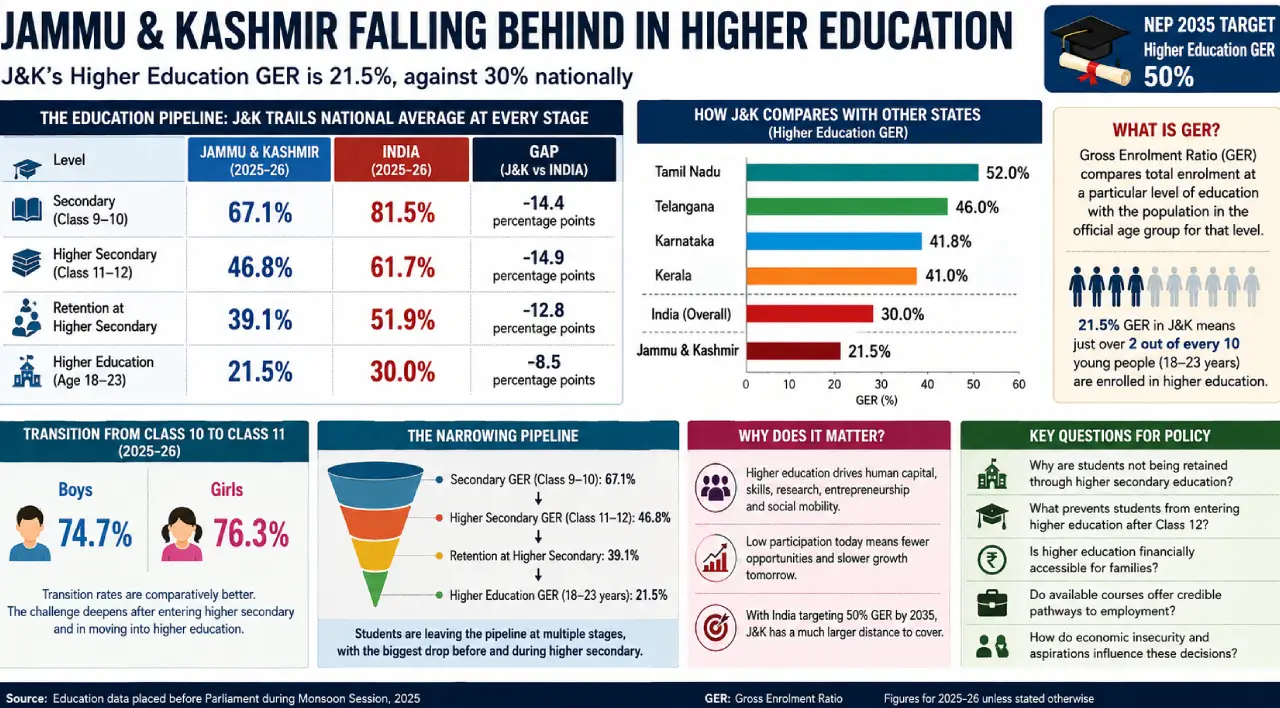
SRINAGAR: Jammu and Kashmir is falling significantly behind the national average in higher education participation, with its Gross Enrolment Ratio (GER) standing at just 21.5 per cent, against 30 per cent nationally, according to the latest education data placed before Parliament.
The figures, drawn from government information tabled in both Houses of Parliament during the Monsoon Session, show that the gap emerges well before students reach colleges and universities.
At the higher secondary level, Jammu and Kashmir’s GER stood at 46.8 per cent in 2025-26, compared with 61.7 per cent for India, a difference of nearly 15 percentage points. The retention rate at the higher secondary level was even lower, at 39.1 per cent in Jammu and Kashmir, against 51.9 per cent nationally.
The figures indicate that the narrowing of the education pipeline begins during school years and becomes more pronounced by the time students reach higher education.
GER is a statistical measure that compares total enrolment at a particular level of education with the population in the official age group corresponding to that level. For higher education, the relevant age group is generally 18-23 years.
The 21.5 per cent GER means that Jammu and Kashmir’s higher education participation remains substantially below the national level. Put simply, while the country has an enrolment ratio of three students for every ten young people in the relevant age group, Jammu and Kashmir has just over two.
The gap becomes more pronounced when Jammu and Kashmir is compared with several other states.
Kerala’s higher education GER is above 41 per cent, while Karnataka’s is nearly 42 per cent. Telangana’s is above 46 per cent and Tamil Nadu’s exceeds 52 per cent.
Jammu and Kashmir’s secondary-level GER in 2025-26 was 67.1 per cent, compared with 81.5 per cent nationally. At higher secondary level, the ratio fell to 46.8 per cent against 61.7 per cent for India.
The retention figures point to another major pressure point. Only 39.1 per cent of students in Jammu and Kashmir are retained through higher secondary education, compared with 51.9 per cent nationally.
This means that the problem of low higher education participation cannot be viewed simply as a question of college admissions. A substantial part of the education pipeline is already narrowing at the school level.
Interestingly, the transition from Class 10 to Class 11 appears comparatively stronger. In 2025-26, the transition rate was 74.7 per cent for boys and 76.3 per cent for girls in Jammu and Kashmir.
The figures suggest that the challenge may become more pronounced after the transition into higher secondary education, in retaining students through the stage and subsequently enabling them to enter higher education.
The reasons for the low participation, however, cannot be established from the enrolment data alone.
Affordability is one issue that warrants closer examination. For families under financial pressure, the cost of higher education extends beyond tuition fees to transport, accommodation, books, food and examination expenses. For some households, keeping a young person in education for another three or four years can also mean foregoing potential income from employment.
The employment situation therefore becomes relevant to the education question, particularly in a region where finding suitable employment remains a major concern among young people.
However, the available education data does not establish a direct causal relationship between unemployment, household income and J&K’s low higher education GER. It does, nevertheless, raise questions about the extent to which economic insecurity influences decisions about continuing education.
The concern is particularly significant because higher education is closely linked to human capital formation, professional skills, research, entrepreneurship and social mobility.
The low participation rate also assumes importance against the national target set under the National Education Policy of taking the higher education GER to 50 per cent by 2035.
With the national GER currently at 30 per cent and Jammu and Kashmir at 21.5 per cent, the Union Territory has a considerably larger distance to cover to reach that target.
The data therefore raises questions beyond simply increasing the number of colleges or seats. The more fundamental issues include why students are not being retained through higher secondary education, what prevents them from entering higher education after Class 12, whether higher education is financially accessible to families, and whether the courses available to students provide credible pathways into employment.
For Jammu and Kashmir, the 21.5 per cent higher education GER is therefore not an isolated statistic. Read alongside the 46.8 per cent higher secondary GER and 39.1 per cent retention rate, it points to a progressively narrowing education pipeline.
The central policy challenge is to understand where and why students are leaving that pipeline. It also needs to be understood whether economic insecurity, affordability, availability of institutions and courses, or perceptions about employment prospects are influencing those decisions.
With the national higher education system moving towards a 50 per cent GER target, the figures suggest that Jammu and Kashmir faces a particularly substantial challenge in ensuring that a larger share of its young population reaches and completes higher education.