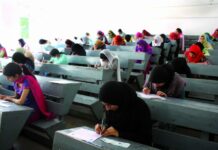
SRINAGAR: The performance of students in Jammu and Kashmir Board of School Education examinations has improved by nearly 10 per cent over the previous academic year, even as the School Education Department acknowledged manpower deficiencies and said it was undertaking teacher rationalisation, fresh recruitment and school clustering to address shortages.
According to the government’s reply to an Assembly Question tabled by Jammu West MLA Arvind Gupta, the pass percentage in Class 10 JKBOSE examinations rose from 79.94 per cent in 2024-25 to 86.36 per cent in 2025-26. In Class 12, the pass percentage increased from 75.95 per cent to 86.08 per cent during the same period.
The Class 10 enrolment remained broadly unchanged, declining marginally from 1,45,671 students in 2024-25 to 1,45,599 in 2025-26. Class 12 enrolment, however, increased from 1,03,308 to 1,10,444 students.
The department said it was implementing a range of measures through the UT CAPEX Budget and Samagra Shiksha to address deficiencies in school infrastructure and manpower, strengthen digital learning and improve student retention in accordance with the objectives of the National Education Policy, 2020.
To address subject-specific teacher shortages, the government said it was undertaking rationalisation of staff and deploying Cluster Resource Coordinators as subject-specific teachers wherever required to maintain the pupil-teacher ratio until permanent recruitment is completed.
The department has referred 594 posts of 10+2 Lecturers in 27 disciplines to the J&K Public Service Commission under the direct recruitment quota. Of these, 586 selections have been received from JKPSC, while appointment orders for 327 candidates have been issued after verification of their character and antecedents by the CID.
The department said the remaining vacancies in Higher Secondary Schools are being filled accordingly.
It also said the Cluster Resource Coordinators are being temporarily deployed to teach specific subjects on a yearly basis by the respective Directors, with their services paid for under Samagra Shiksha.
The government has simultaneously expanded the school cluster and composite school system. As many as 746 Cluster/School Complexes have been constituted and made functional for sharing teaching and other resources.
Under the system, subject-specific teachers, including Mathematics, Science and Language teachers, as well as Physical Education Teachers, are shared within clusters to address localised shortages.
The Annual Transfer Drive 2026 has also been notified through Notification No. 01-JK(Edu) of 2026 dated August 21, 2026. The government said the exercise is intended to facilitate a more equitable distribution of teaching resources, align manpower with institutional requirements, improve transparency in decision-making and ensure continuity of academic activities.
For academic monitoring, Cluster Heads have been given administrative and academic oversight. They conduct uniform pre-board evaluations and specialised remedial classes for Class 10 and 12 students, with the stated objective of improving pass percentages and overall Board examination results.
The department has also significantly expanded technology-enabled learning facilities. A Vidya Samiksha Kendra, described as a command-and-control centre for data-driven educational decision-making, was established and made operational in September 2024.
The government said 3,008 digital laboratories comprising 1,420 CAL Centres and 1,588 ICT laboratories have been established with internet facilities. Another 2,388 ICT laboratories and 4,597 smart classrooms are in the process of being established.
Scientific and experimental learning facilities have also been expanded. The department said 376 AAGHAAZ Astro Physics Labs, two in each Education Zone, have been established in 376 Higher Secondary and High Schools, while another 376 such labs are under establishment.
Ten Virtual Reality Labs have been established on a pilot basis, with another 30 proposed for establishment during 2026-27.
The department said 172 Atal Tinkering Labs have been completed, including 127 under the Atal Innovation Mission of NITI Aayog and 45 under PM SHRI. Another 500 ATLs for 2026-27 have been approved in principle by NITI Aayog, with the department having uploaded the necessary registration data on the NITI Aayog portal.
Skill education has also been introduced or approved in 2,460 Higher Secondary and High Schools for students of Classes 9 to 12.
On the proposal to make it mandatory for children of government employees to study in government schools, the government said there was no such proposal.
It said enrolment in a particular category of educational institution ordinarily involved parental choice and the educational interests of the child, and any proposal to regulate such choice would require consideration within the applicable constitutional and legal framework.
Instead, the government said its approach was to improve the quality, accessibility and learning environment of government schools so that parents, including public servants, would choose them on the basis of academic outcomes, teaching standards and institutional facilities rather than compulsion.
The department said its broader qualitative improvement programme includes expansion of pre-primary education, ICT-enabled learning, vocational education, infrastructure strengthening, teacher capacity-building, inclusive education, scientific and innovation initiatives and rational deployment of human resources.
On the implementation of the School Cluster and Composite School System, the government said the system was already being implemented according to prescribed norms and guidelines.
The department said staff rationalisation was being carried out on the basis of assessed requirements, enrolment patterns and applicable norms, with the objective of achieving a more balanced deployment of available teachers.
The improvement in Board examination results comes alongside these interventions. The Class 10 pass percentage increased by 6.42 percentage points between 2024-25 and 2025-26, while the Class 12 pass percentage rose by 10.13 percentage points.
The government attributed the broader improvement to academic monitoring, remedial interventions, better deployment of teachers and the strengthening of school-level resources, although the reply primarily sets out the measures being undertaken rather than assigning the improvement to any single intervention.
-x-