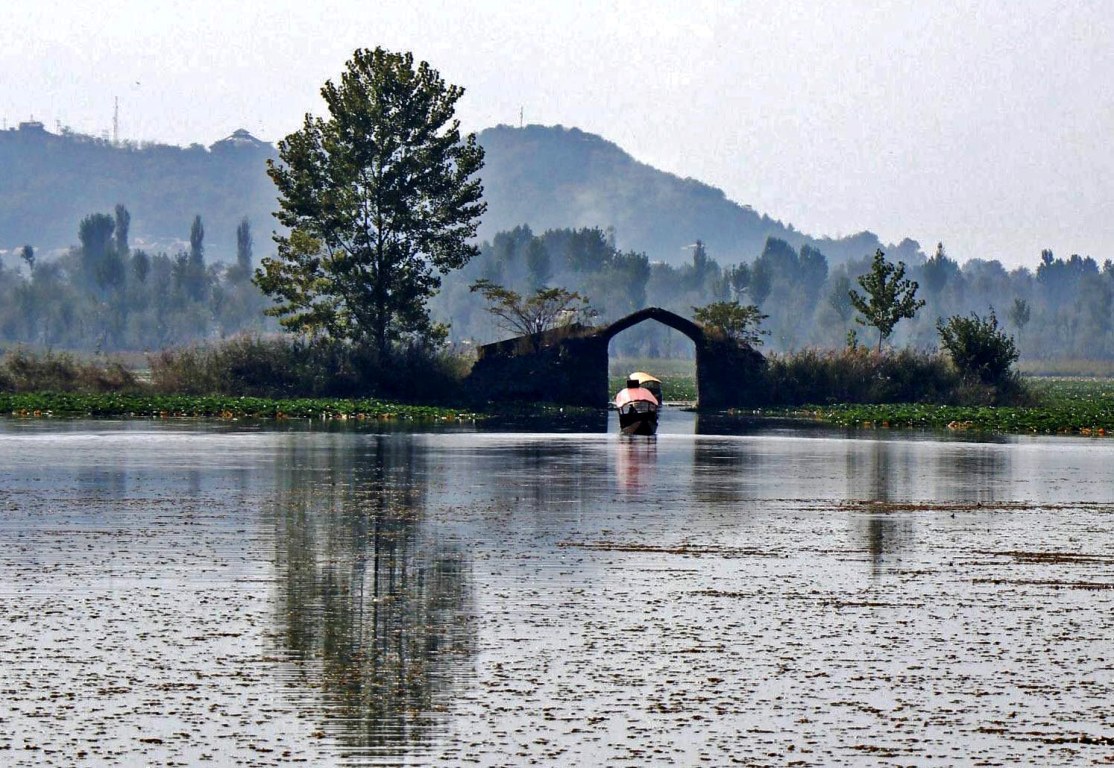
SRINAGAR: The Government of Jammu and Kashmir has launched a comprehensive program for the conservation and restoration of Srinagar’s historic water bodies, including Dal Lake, Nigeen Lake, Anchar, Brari-Nambal, Gilsar, Khushalsar, and Echnambal. The initiative was detailed in response to an unstarred question by MLA Mubarik Gul and reflects ongoing efforts by the Housing and Urban Development Department and the JK Lake Conservation and Management Authority (LCMA) to address pollution, encroachments, and ecological degradation in the Sher-e-Khas area of the city.
KL Image: Bilal Bahadur
Under the program, around 3,108 families residing inside Dal Lake have been relocated to various housing colonies to reduce human pressure on the lake ecosystem. Over the past three years, one-third of Dal Lake and 6.5 square kilometers of Nigeen Lake have been cleared of invasive weeds, increasing the open water area of Dal Lake to more than 20.3 square kilometers. Dredging operations have removed nearly 200,000 cubic meters of silt from settling basins and shoreline areas, including the first-ever dredging of the Nishat Basin shoreline, while 20 navigation channels spanning approximately 10 kilometers have been widened and deepened to improve water flow.
To manage sewage, five treatment plants with a combined capacity of 36.73 million liters per day have been constructed to treat domestic sewage from households and commercial establishments around Dal and Nigeen Lakes. Two of these plants at Brari-Nambal and Nallah Amir Khan are being upgraded under the AMRUT 2.0 program, and a new 30 MLD STP at Guptganga is under construction at a cost of 306 crore rupees to serve the northeastern periphery of the lake. Sewerage networks for 573 houseboats in Dal Lake and 48 houseboats in Nigeen Lake have been connected to these treatment plants, ensuring safe disposal of wastewater. In addition, approximately 10–12 MLD of sewage is treated through natural oxidation and detention ponds constructed along the lake peripheries, and land-based bio-digesters have been piloted in Tailbal to scientifically manage household sewage.
Waste management has also been a focus of the program. The wet biomass collected from lake weeds is being converted into compost in collaboration with the National Agricultural Cooperative Marketing Federation of India, addressing unscientific disposal while generating revenue. Solid waste from houseboats, in-lake hamlets, and commercial units is collected daily and transported to shore for disposal in coordination with the Srinagar Municipal Corporation. Advanced machinery, including self-propelled barges, weed transfer cranes, dredgers, and tugboats, has been procured to improve de-weeding and cleaning operations.
The conservation program extends to the lake catchment areas, where around two lakh trees have been planted over the past few years, vulnerable zones have been fenced, and check dams and anti-erosion structures have been constructed to reduce silt inflow. To prevent encroachments and illegal construction, lake boundaries have been demarcated using GPS and satellite imagery, and 29 ANPR/PTZ cameras have been installed around the lake periphery, with 35 more cameras under installation from Habak to Dalgate via NIT Srinagar. Violations are being addressed under the JK Control of Building Operations Act and the JK Development Act.
A detailed project report costing 273 crore rupees has been approved under the Prime Minister’s Development Plan to cover rehabilitation of Dal dwellers, catchment management, mitigation of silt load, and ecological restoration of the lake ecosystem over five years. Similar conservation measures are being extended to Khushalsar and Gilsar Lakes, including dredging, solid waste management, and installation of garland sewer networks funded through NGT grants worth 41.17 crore rupees. Officials emphasized that these initiatives represent a shift toward technologically advanced, smart management of Srinagar’s lakes while ensuring community participation and sustainable use of the city’s iconic water resources.