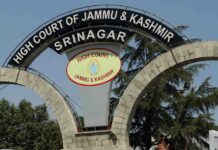
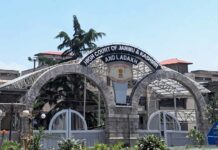
SRINAGAR: In a significant judgment reinforcing the constitutional principles governing reservation, the High Court of Jammu & Kashmir and Ladakh has directed the Union Government to appoint four Scheduled Caste candidates from Jammu and Kashmir who were denied recruitment as Constables in the Border Security Force (BSF) despite securing higher merit than selected candidates.
Justice Rajnesh Oswal, while allowing the writ petition filed by Amit Kundal and three others, held that the petitioners had been wrongly excluded because the authorities treated the physical standard relaxations available to all residents of Jammu and Kashmir as if they were relaxations granted on account of their Scheduled Caste status. The court ruled that this interpretation violated Articles 14 and 16 of the Constitution.
The judgment was reserved on June 30, 2026, and pronounced on July 17, 2026.
Appearing for the petitioners were advocates Ankur Sharma and Himani Khajuria, while the Union of India was represented by Vishal Sharma, Deputy Solicitor General of India (Senior Advocate), assisted by Karan Sharma, Central Government Standing Counsel.
The case arose from the Staff Selection Commission’s 2018 recruitment for Constable (General Duty) posts in the Central Armed Police Forces, including the BSF and Assam Rifles.
The four petitioners, all Scheduled Caste candidates and permanent residents of Jammu and Kashmir, qualified the written examination and subsequent physical and medical tests. They argued that although they had scored higher marks than several selected candidates, they were denied appointment because the authorities counted them only against the Scheduled Caste quota instead of considering them in the open merit category.
The petitioners maintained that they had not received any concession because of their caste. The only relaxation they had availed concerned minimum height and chest measurements prescribed for candidates from Jammu and Kashmir, a benefit equally available to candidates of every category from the Union Territory.
According to the judgment, while the open merit cut-off for BSF Border Guarding District posts was 57.40899 marks, the petitioners had secured between 58.11 and 59.32 marks. However, because they were treated as reserved-category candidates who had availed “relaxed standards”, they were denied consideration in the open category, where candidates with lower marks were selected.
The Union Government argued that paragraph 11(xiv) of the recruitment notice required Scheduled Caste candidates who qualified after availing any relaxed standards to be counted only against reserved vacancies. It also relied upon the Supreme Court’s decision in Union of India v Sajib Roy (2025).
Justice Oswal rejected that contention, holding that the relaxation in physical standards was not linked to caste but to domicile.
The court observed that the reduced height and chest standards applied equally to all candidates belonging to Jammu and Kashmir, irrespective of whether they belonged to the Scheduled Castes, Other Backward Classes or the unreserved category.
“The respondents have failed to demonstrate that the petitioners were granted any relaxed standards beyond those generally available to the candidates outside the reserved categories,” the court held. Consequently, it ruled, the authorities could not invoke paragraph 11(xiv) merely because the petitioners had applied under the Scheduled Caste category.
‘Grave injustice’
The judgment makes strong observations on the discrimination suffered by the petitioners.
“The petitioners have not been granted the benefit of relaxation in height and chest measurements on account of their SC category status. As such, this Court is of the considered view that the petitioners’ SC status has resulted in a distinct disadvantage to them,” Justice Oswal observed.
The court further held that “the distinction drawn by the official respondents… is discriminatory and directly contravenes Articles 14 and 16 of the Constitution of India.”
In another significant observation, the court said:
“This Court has no hesitation in holding that a grave injustice has been caused to the petitioners, who were excluded from selection despite possessing higher merit than the candidates selected by the official respondents.”
Existing recruits protected
Although the court found the recruitment process legally flawed, it declined to cancel the appointments of those already selected.
Justice Oswal noted that the selected candidates had undergone training at considerable public expense and had already served for nearly five years.
“Ordinarily, the appointment of candidates possessing lower merit must be set aside,” the judgment observed. However, removing them after five years would be “harsh and iniquitous”, especially since no fault could be attributed to the appointees themselves.
The court found that no vacancies remained from the 2018 recruitment because they had been carried forward into subsequent recruitment cycles.
To ensure that the petitioners receive the benefit of the judgment, Justice Oswal directed the Union Government to appoint them against available vacancies. If no vacancies exist, the authorities have been ordered to create supernumerary posts, provided there is no other legal impediment.
The consequential orders must be issued within three months after the petitioners furnish a copy of the judgment to the authorities.
The High Court also relied on decisions of the Gauhati High Court in Jitendra Thakur v. Union of India (2022) and the Delhi High Court in Hemant Pokhriyal v. Staff Selection Commission (2021), both of which held that region-based physical standard relaxations cannot deprive reserved-category candidates of consideration in the general merit list.
Distinguishing the Supreme Court’s ruling in Sajib Roy, Justice Oswal held that the precedent dealt with age relaxation directly linked to OBC status. In contrast, in the present case the benefit flowed solely from domicile and was equally available to candidates across all categories.