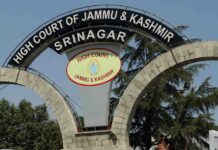
SRINAGAR: The Jammu and Kashmir and Ladakh High Court has dismissed a BSF personnel’s plea challenging his voluntary retirement following withdrawal of permission to maintain a beard, holding that the dispute arose outside its territorial jurisdiction.
Justice Rajnesh Oswal dismissed the petition filed by Khursheed Ahmad Khan, while leaving him free to approach the appropriate jurisdictional court for redressal of his grievances.
Khan had challenged a June 16, 2023 order under which his voluntary retirement was accepted and he was struck off the strength of his unit with effect from the same day. The judgment was pronounced on September 30.
The petitioner, represented by advocate Ateeb Kanth, said he had been permitted to maintain a neatly trimmed beard under an order issued on January 6, 2018. He claimed the permission was revoked with immediate effect on June 16, 2023, prompting him to seek voluntary retirement.
His retirement application was accepted the very same day.
Khan subsequently sought to withdraw his retirement request, but his application was rejected on July 5, 2023, and he was directed to draw pension instead of resuming duty. He later alleged that the cancellation of the beard permission was vindictive and had compelled him to seek retirement.
He also claimed that a representation submitted to the Director General, BSF, on July 19, 2024, was not considered and that his pension was fixed without his consent.
The Union of India and other respondents, represented by DSGI T. M. Shamsi with CGC Faizan Ali, opposed the petition and questioned the High Court’s territorial jurisdiction.
The respondents said the impugned order had been passed by the Commandant, 50 Battalion BSF, at Praharinagar, Tura, Meghalaya, and maintained that Khan had voluntarily sought retirement.
They said Khan had joined the BSF as a constable in 1998 and had subsequently been placed in a low medical category. The respondents also referred to adverse entries in his service record.
On the beard issue, the respondents said Khan had been allowed to keep a neatly trimmed beard in 2018, but was found on June 16, 2023, with a “long free-flowing beard”, which they said violated the terms of the permission and directions concerning discipline and decorum in the Force. They maintained that he had refused to trim it.
The respondents further said that after the Zero Parade, Khan himself expressed his desire to retire and was questioned by the Commandant in the presence of other officers about whether his decision was the result of any duress or compulsion. According to them, he expressly denied this.
They said Khan had cited his mother’s illness and his own medical condition as reasons for seeking retirement and that, after considering the circumstances, the competent authority relaxed the three-month notice requirement and accepted his retirement with immediate effect.
The High Court, however, did not enter into the merits of the dispute.
The court noted that Khan had submitted his retirement application outside Jammu and Kashmir and that the challenged order had also been passed at Tura in Meghalaya.
“It is evident from the record that the application was submitted by the petitioner to the respondents for voluntary retirement at a place which is situated beyond the territorial jurisdiction of this Court and the order impugned in this petition was also passed at Tura Meghalaya,” Justice Oswal observed.
The petitioner argued that the presence of the Inspector General, BSF, Kashmir, among the respondents gave the High Court jurisdiction. The court rejected the argument, noting that the IG, BSF, Kashmir, had “no nexus with the controversy at hand” and that the relevant respondent was the Inspector General, BSF, Shillong.
The court also rejected the argument that the Director General, BSF, New Delhi, being a respondent meant that the matter could be brought before any High Court.
Under Article 226 of the Constitution, the court said, territorial jurisdiction depends on whether the cause of action, wholly or in part, arose within the jurisdiction of the concerned High Court.
Referring to earlier judgments, including Rajesh Kumar Tomar v. Union of India, Zahoor Ahmad Baba v. Union of India and Shahnawaz Ahmad v. Union of India, the court reiterated that even a fraction of the cause of action must be material, integral or essential to the dispute to confer jurisdiction.
“A similar view has been taken by the Coordinate Bench of this Court,” the judgment noted, holding that merely receiving an order or communication in Jammu and Kashmir would not by itself confer territorial jurisdiction.
“In view of the above, this Court is of the considered view that this Court lacks territorial jurisdiction to adjudicate the petition at hand,” Justice Oswal held.
The petition was accordingly dismissed, with the court making it clear that Khan remained free to approach the court having jurisdiction over his grievance.