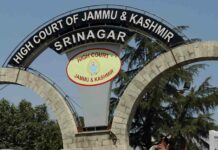
SRINAGAR: The Jammu Kashmir and Ladakh High Court has sought a detailed account of fire stations and firefighting facilities across the Union Territory, asking the government to disclose how many are required under prescribed safety norms and how many are actually functional in different risk categories.
A Division Bench comprising Chief Justice Pushpendra Singh Bhati and Justice Yash Paul Bourney directed the Jammu and Kashmir Government to submit a consolidated, category-wise chart, supported by an affidavit, detailing the availability and requirement of firefighting establishments across high-risk, medium-risk, low-risk and rural areas.
The direction was passed on October 27 while hearing a public interest litigation (PIL) filed by advocate Mohd Rahoof Khan, who appeared in person and alleged large-scale violations of the firefighting policy, claiming that its non-implementation was putting the general public at risk.
During the proceedings, Senior Additional Advocate General Monika Kohli, appearing for the government, referred the court to paragraph 7 of the reply filed on July 2, 2025, which outlined the norms prescribed by the Standing Fire Advisory Council (SFAC) under the Ministry of Home Affairs, Government of India, for establishing fire stations.
According to the policy parameters placed before the court, the establishment of fire stations is determined by population, topography, risk factors and the response time based on the distance from the nearest fire station.
The guidelines provide for one ‘D’ category fire station for every population of 50,000, while one fire station is recommended for every 10 square kilometres in urban areas. In rural areas, a fire station may cover up to 50 square kilometres, depending on local conditions and risk assessment.
The policy also classifies areas into four categories based on vulnerability. ‘A’ denotes high-risk areas, ‘B’ medium-risk areas, ‘C’ low-risk areas and ‘D’ rural or least-risk areas.
The prescribed response time for the first fire tender is a maximum of three minutes in high-risk areas, five minutes in medium- and low-risk zones and 20 minutes in rural areas.
The guidelines further stipulate one fire tender for every 50,000 people up to a population of three lakh, with an additional tender for every one lakh population or part thereof, besides a reserve of 20 per cent of the total water tenders.
For industrial towns and areas with a high fire risk, the required scale of firefighting equipment is to be determined through an actual assessment of the areas concerned.
The policy also provides for rescue tenders and specialised firefighting vehicles, including turntable ladders, hydraulic platforms, emergency tenders, advanced rescue tenders, extra-heavy water tenders and other equipment, depending on local requirements and risk assessments.
It further envisages the establishment of fire posts equipped with portable pumps, firefighting equipment and personnel, as well as fire chowkis with mini water tenders in localities where the level of risk warrants such facilities.
The court noted that the government had placed these policy parameters on record and sought clarity on their actual implementation across Jammu and Kashmir.
After considering the submissions, the Bench asked the government to provide the exact number of areas falling under each of the four risk categories in the Union Territory.
It also sought details of the number of fire stations or firefighting establishments required to be operational in each category under the prescribed norms, along with the number presently functional.
The court directed Monika Kohli, Senior AAG, to furnish a single consolidated chart containing all the particulars, supported by an affidavit.
The matter has been listed for further consideration on November 17, 2026.
Advocate Mohd Rahoof Khan appeared in person for the petitioner, while Senior AAG Monika Kohli represented the Union Territory and other respondents.