JAMMU: The government on Friday informed the Assembly that the Jammu & Kashmir Road Transport Corporation (JKRTC), long weighed down by mounting losses and liabilities, has recorded a financial turnaround, posting a surplus of Rs 70.04 Cr in 2024–25 and generating gross revenue of Rs 243.06 Cr during the fiscal.
Replying during the discussion on Budget and Demands for Grants, the government acknowledged that JKRTC had for years grappled with structural and operational challenges, including an ageing fleet, high maintenance costs, sub-optimal fleet utilisation and rising operating expenditure aggravated by difficult terrain and harsh weather conditions in parts of Jammu and Kashmir. Competition from private operators on commercially viable routes further constrained revenue potential, even as the corporation continued to service socially necessary but low-revenue routes.
Financial distress had deepened over time due to high fixed costs, salary liabilities, statutory obligations, Motor Accident Claims Tribunal cases, and regulated fare structures that did not keep pace with rising fuel and input costs. The corporation also faced work-done liabilities with various government departments, resulting in severe cash flow pressures.
As of date, JKRTC has accumulated dues of Rs 2,014.70 crore payable to the government, including Rs 1,225.15 crore on account of interest, a factor that continues to reflect as losses in its balance sheets. The government said a proposal for waiver of the said amount would be submitted.
Despite these constraints, the financial data placed before the House indicated a clear shift from recurring deficits before 2020–21 to sustained surpluses thereafter. In 2021–22, JKRTC reported a deficit of Rs 1,5.55 crore, with gross revenue of Rs 114.96 crore against expenditure of Rs 130.51 crore.
The trend reversed in 2022–23 when the corporation earned gross revenue of Rs 197.21 crore and posted a surplus of Rs 12.27 crore.
In 2023–24, the surplus increased to Rs 22.54 crore on gross revenue of Rs 216.17 crore. The financial year 2024–25 marked a substantial improvement, with gross revenue rising to Rs 243.06 crore against expenditure of Rs 173.01 crore, yielding a surplus of Rs 70.04 crore.
The government also disclosed that since 2021–22, the corporation has cleared gratuity and leave salary liabilities amounting to Rs 80.74 crore from its own resources. The pending liability on account of retirement benefits currently stands at Rs 12.20 crore. Notably, the last budgetary support of Rs 7.50 crore was released in 2022–23, and no further budgetary assistance has been extended thereafter. Cumulative budgetary support provided by the government to date stands at Rs 788.92 crore.
Revenue figures for the last three years further reflect the improved performance. Gross revenue stood at Rs 214.79 crore in 2023–24, Rs 240.33 crore in 2024–25, and Rs 179.05 crore up to the third quarter of 2025–26.
The corporation currently operates a total fleet of 923 vehicles, comprising 396 buses and 527 trucks, with an average operational fleet availability of 83 per cent and 17 per cent under detention due to maintenance. In another statement placed before the House, the physical fleet was indicated as 396 buses and 475 trucks, totalling 871 vehicles. JKRTC also holds 499.10 kanals of land at various locations within and outside Jammu and Kashmir. Against a sanctioned strength of 3,589 posts, the existing workforce stands at 932.
As part of its restructuring strategy, JKRTC has initiated asset monetisation to unlock value from underutilised land and properties under the Public-Private Partnership (PPP) mode. Six parcels, three in Jammu and three in Srinagar, have been identified, and an investor meet was held in December to attract market participation.
Two underutilised land parcels at Pampore in Srinagar and Nagrota in Jammu have been earmarked for establishing Automated Testing Stations for commercial vehicle fitness under the PPP mode. The corporation expects to earn approximately Rs 3 crore per annum as non-operational revenue from these facilities by way of commission, while also providing improved and transparent vehicle fitness testing services.
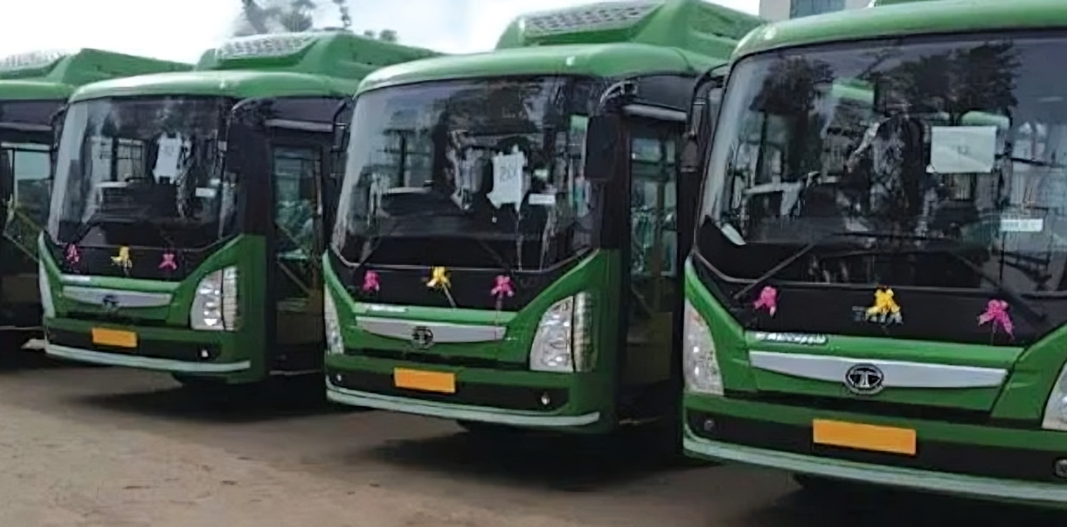
On fleet modernisation, JKRTC procured 40 electric buses in 2019 under the FAME-I scheme of the Government of India, with 20 buses each allotted to Jammu and Srinagar divisions for city operations. At present, only 20 electric buses are operational in the Jammu Division. Due to limited charging infrastructure, available only at Jammu, and a restricted operational range of around 100 kilometres per full charge, the buses are confined to city routes. The present e-bus fleet is not suitable for steep gradients and hilly terrain, making deployment on such routes unfeasible at this stage.
The corporation has proposed the procurement of 200 additional electric buses under the PM e-Drive Scheme. Upon induction, the feasibility of operating electric buses on additional routes, including in Ramgarh Assembly Constituency and other areas, will be examined.
JKRTC is also implementing an Intelligent Transport Management System (ITMS) across its fleet to modernise operations. The proposed system includes fleet tracking, electronic ticketing, passenger information systems and centralised monitoring. The government stated that once ITMS stabilises, the feasibility of introducing a unified ticketing system or single transport pass, including hop-on, hop-off services at major heritage and tourist destinations, will be examined in consultation with stakeholders to promote tourism-friendly transport services.
Regarding employee-related matters, JKRTC has constituted a committee vide Order No 37-JKRTC of 2026 dated February 10, 2026, to examine the feasibility of implementing the 7th Pay Commission for its employees. The committee will assess financial implications, recurring expenditure, existing pay structure, possible phased implementation, requirement of budgetary support and alternative revenue sources, including savings from discounts offered by M/s IOCL for consumer pumps. Its report will be placed before the Board of Directors.
On the issue of regularisation of consolidated staff engaged in 2011, 2012 and 2014, the matter was deliberated in the 87th meeting of the Board of Directors held on August 16, 2024, and subsequently examined by the Establishment-cum-Finance Committee on September 10, 2025. The committee recommended that the Managing Director prepare a roadmap for the regularisation of consolidated drivers based on seniority, availability of posts and financial position, with financial implications to be borne by the corporation from its own resources. It also recommended the implementation of the Minimum Wages Act for consolidated drivers and seeking comments from the General Administration and Finance Departments to ensure alignment with government rules. The matter will be placed before the Board in its ensuing meeting.

The government maintained that the turnaround reflects improved operational management, enhanced non-operational revenue streams and fiscal discipline, even as structural liabilities and legacy dues continue to pose long-term challenges for the corporation.