SRINAGAR: The Jammu and Kashmir government has begun work on a comprehensive Minor Mining Policy-2026 aimed at tightening regulations, curbing illegal mining and introducing a technology-driven framework for scientific and transparent management of minor mineral resources across the Union Territory.
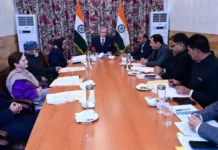
The proposed policy came up for discussion at a high-level meeting chaired by Chief Secretary Atal Dulloo on Thursday. The meeting reviewed the broad contours of the draft policy being prepared by the Department of Geology and Mining to plug gaps in the existing regulatory framework and strengthen governance of the mining sector.
Senior officials, including Additional Chief Secretary for Mining Ashwani Kumar, administrative secretaries of stakeholder departments, divisional administration representatives, the Pollution Control Committee and other agencies participated in the deliberations.
A presentation by the Centre for Innovation, Technology Assessment and Good Governance (CITaG) highlighted shortcomings in the existing mining regime and proposed reforms to establish a transparent, efficient and legally compliant system.
During the meeting, Dulloo stressed that every provision in the new policy must conform to Central laws governing minor minerals and withstand legal scrutiny. He directed officials to study best practices adopted by states such as Odisha and adapt them to Jammu and Kashmir’s requirements.
The Chief Secretary also emphasised safeguarding the interests of traditional mining communities by creating a transparent digital ecosystem that enables their participation while ensuring mining rights remain non-transferable and cannot be sublet or misused.
Expressing concern over rampant illegal mining, Dulloo asked departments to explore stronger legal deterrents against repeat offenders. He also called for extensive inter-departmental consultations before the policy is finalised and directed officials to prepare a detailed implementation roadmap specifying timelines, departmental responsibilities, technological interventions and required amendments to mining rules.
Officials identified several deficiencies in the present system, including the absence of a mechanism to prioritise mineral supply for government infrastructure projects, delays caused by multiple departmental approvals, inadequate riverbed management and the lack of a standardised bidding process. The meeting favoured introducing a single-window clearance mechanism to expedite approvals.
The proposed policy also seeks to introduce an end-to-end “mine-to-market” digital tracking system, periodic revision of penalties for violations, third-party audits for mining on private land and stronger provisions for environmental compliance.
Among the suggestions discussed were priority allocation of minerals for government projects, institutional engagement of traditional miners in dredging and desilting works, scientific assessment-based replenishment rates instead of fixed estimates and advance processing of statutory approvals, including environmental clearances, to reduce project delays.
Officials also proposed special provisions to facilitate emergency extraction of minor minerals for irrigation and flood management works, besides creating a mechanism to protect whistleblowers reporting illegal mining activities.
The meeting underscored the need to strengthen the Department of Geology and Mining by enhancing its institutional capacity, enforcement capabilities and resource management systems to improve regulation and curb illegal extraction.
It was decided that CITaG would revise the draft policy by incorporating suggestions received from stakeholder departments before the final framework is prepared.
The meeting also discussed developing an integrated digital platform featuring e-challans, geo-fencing, real-time mineral transportation monitoring and other technology-enabled tools. The government proposed associating the Bhaskaracharya National Institute for Space Applications and Geo-informatics to help develop the digital ecosystem and integrate traditional miners into the formal regulatory framework.
Concluding the meeting, Dulloo said the proposed Comprehensive Minor Mining Policy-2026 should lay the foundation for an efficient, accountable and technology-enabled mining ecosystem that balances environmental protection, ease of doing business, public interest and the welfare of local communities.