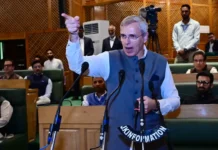
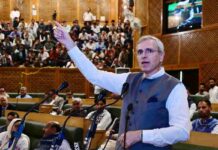
SRINAGAR: The simmering debate over reservation policy in Jammu and Kashmir took an emotional turn on Wednesday after ruling Jammu and Kashmir National Conference (JKNC) legislator Bashir Ahmad Veeri broke down in the Assembly while arguing for a bill seeking changes to the existing framework.
Veeri, known for his legislative interventions, became visibly emotional as he described personal distress and public pressure linked to the prolonged delay in the introduction of his bill. “I haven’t been able to sleep for the past three days,” he said, adding that the proposal had remained pending for nearly one and a half years. While speaking, Veeri cried, and many party members consoled him, and after his speech, his fellow legislator Nazir Gurezi went on to pat him on the back for a moment.
Speaking in support of the bill, the MLA urged the House to at least allow its introduction and refer it to a select committee if required. He pressed for a restructuring of the reservation system, calling for an increase in the share of open merit seats and a review of category-wise allocations.
“For God’s sake, let this bill be introduced, send it wherever you want, but allow discussion,” he said, before demanding that open merit be raised to “at least 65 per cent” and that a cap in line with the Indra Sawhney vs Union of India judgment be enforced.
Veeri, pressed ahead with the bill despite repeated appeals from senior ministers and colleagues to withdraw it.
The move exposed growing strains between the legislator and the party leadership, with Chief Minister Omar Abdullah eventually making it clear that the government would oppose the proposal if Veeri chose to proceed.
He further said, “I have only one son. He has left for London. He has told me that he won’t return as there are no avenues.I want to appeal to the House, for Allah’s sake allow the bill to be introduced for my children.”
Even after several National Conference legislators tried to persuade him on the floor of the House, Veeri remained firm.
Chief Minister Abdullah then rose and said the government would formally oppose the bill if the MLA insisted on moving it.
However, when the bill was put to vote, it failed to gain sufficient support. Only four legislators, three from PDP and one Independent MLA voted in favour, while ruling party members and BJP opposed it.
Responding on behalf of the government, Minister Sakina Itoo described reservation as a sensitive matter and said due procedure had been followed. She informed the House that a cabinet sub-committee, formed under the directions of Chief Minister Omar Abdullah, had completed its report after consulting stakeholders within the stipulated timeframe.
The report has since been approved by the government and forwarded to the Lieutenant Governor for a final decision. The minister reiterated that the process aims to ensure fairness for all sections without politicising the issue.
The 1992 Supreme Court ruling had prescribed a general ceiling of 50 per cent on reservations, aimed at balancing affirmative action with merit-based selection. However, in Jammu and Kashmir, the effective reservation exceeds this threshold when the 10 per cent Economically Weaker Sections (EWS) quota and horizontal reservations are included.
As per official data tabled in the Assembly, reservations in government jobs in the Union Territory currently include 8 per cent for Scheduled Castes, 20 per cent for Scheduled Tribes (ST-1 and ST-2 combined), 18 per cent for Other Backward Classes, 10 per cent each for Reserved Backward Areas (RBA) and EWS, and 4 per cent for ALC/IB categories. Horizontal reservations include 6 per cent for ex-servicemen and 4 per cent for persons with disabilities.
In professional and academic institutions, a similar structure applies, along with additional horizontal quotas for children of defence personnel, paramilitary forces, and candidates with outstanding sports achievements.
The government has maintained that the reservation framework is periodically reviewed and adjusted based on recommendations and stakeholder consultations. A Cabinet Sub-Committee constituted in December 2024 to examine grievances has already submitted its report.
On Tuesday, Social Welfare Minister Sakeena Itoo said the Cabinet had completed its role by approving the report, which has now been forwarded to the Lieutenant Governor for final decision.
She stated that multiple delegations had raised concerns over the reservation policy, and the subcommittee had conducted consultations before finalising its recommendations. Under the current Union Territory framework, Cabinet decisions require the Lieutenant Governor’s approval before implementation.
The reservation issue has remained contentious, with recent official data highlighting regional and category-wise disparities.
Figures show that over 92 per cent of EWS certificates issued in the past two years were concentrated in the Jammu division, while separate data indicates that nearly 86 per cent of total reservation certificates across categories have been issued in the same region.
Recruitment data also shows that open merit appointments in government jobs have hovered slightly above 50 per cent over the past six years, with fluctuations across categories and services.
During his speech, Veeri called for “rationalisation” of horizontal reservations and flagged disparities in categories such as EWS, ALC/IB, and others. He also sought amendments to procedural rules governing reservation implementation.
The debate is expected to intensify as the government awaits the Lieutenant Governor’s decision on the subcommittee report, which could determine the future course of reservation policy in Jammu and Kashmir.
The Assembly proceedings underscored the political and social sensitivity of the issue, with calls for balancing equity, representation, and merit continuing to dominate the discourse.