by Tahira Rafiq
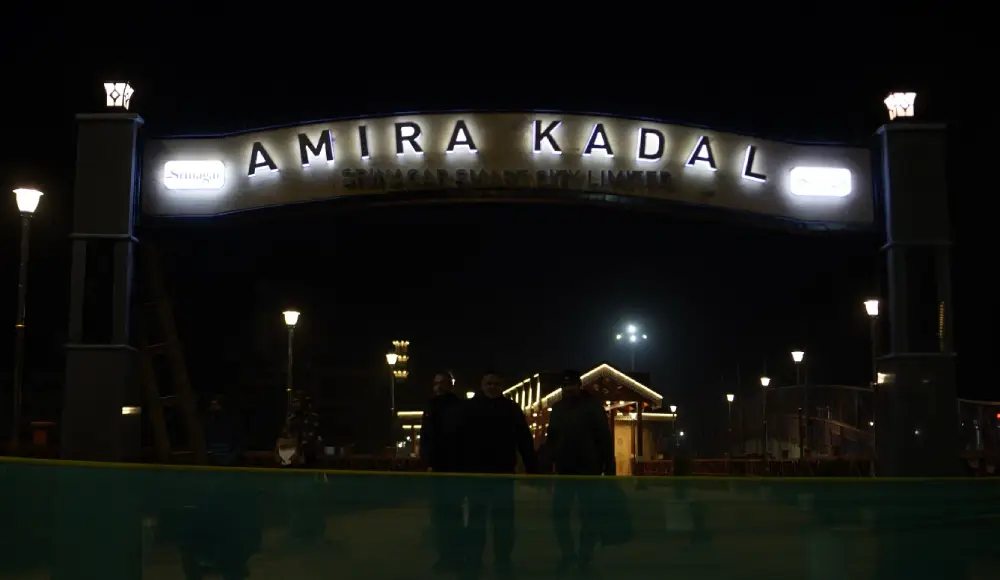
SRINAGAR: The soon-to-be-opened Amira Kadal bridge in the heart of the city will add a new market to the historic city. The abandoned bridge was redeveloped under the Srinagar Smart City Limited (SSCL) project on the existing piers of the old structure.
Located in one of Srinagar’s busiest commercial zones, the bridge becomes the third in the city over the past decade to be re-envisioned as a pedestrian-oriented heritage space, following the restoration of Zero Bridge and Habba Kadal.
The project aims to restore the historic character of Amira Kadal while easing pedestrian movement in a congested commercial area. Although the initial deadline for completion was May 2024, the work faced delays due to difficulties in relocating shops in the adjoining Goni Khan market.

For shopkeepers and residents, the reopening of the bridge carries expectations that extend beyond infrastructure, ranging from improved business prospects to the revival of memories tied to an older Srinagar.
“We only see traffic here all day. Since there is no parking space, potential customers cannot stop,” said Yasir Ahmad, a shopkeeper in the area. “We have heard that once the bridge opens, this problem will be resolved. We are excited because we have heard about this bridge and its history from our elders.”
Rohit Sahani, a cloth merchant whose shop was established before the old bridge was dismantled, said the bridge holds both emotional and economic value. “This is not a new bridge for us. Its history goes back to the era of Rajas and Maharajas, and it was dismantled due to certain circumstances,” he said, adding that increased pedestrian movement would improve customer flow.
Pointing to the existing bridge, Sahani said, “The current bridge is occupied by vendors, so it becomes difficult for people to walk, especially women. We have heard that no vendors will be allowed on the new bridge. If it remains free, it will be safer and easier to traverse.”
Historically, Amira Kadal was built not simply as a river crossing but as a bridge of political and administrative importance. It was constructed during the Afghan period by Amir Khan Jawan Sher, the Afghan governor of Kashmir, to provide direct access between the city and Shergarhi Palace, the Afghan seat of power on the banks of the Jhelum.
Shergarhi Palace, which later continued to serve as the centre of administration under Afghan, Sikh and Dogra rulers, required a reliable and direct connection to the densely populated commercial quarters of Srinagar. Amira Kadal thus functioned as a strategic artery, facilitating both administrative movement and economic exchange across the river.
Over time, as the city expanded and traffic patterns evolved, the bridge absorbed Srinagar’s distinctive urban character. Like several other bridges in the city, Amira Kadal gradually transformed into a commercial and social space, reflecting a long-standing Kashmiri tradition in which bridges doubled as marketplaces.
Having shoplines on bridges is nothing new to Kashmir. From the Sultanate and Mughal periods through Afghan and Dogra rule, bridges such as Zaina Kadal, Fateh Kadal and Habba Kadal hosted rows of shops and stalls. Colonial-era accounts describe Srinagar’s bridges as bustling bazaars suspended over water, where pedestrian traffic, river transport and commerce intersected. The current redevelopment of Amira Kadal draws from this historical precedent, seeking to reimagine the bridge as a pedestrian public space rather than merely a traffic corridor.
Currently, over a hundred vendors operate on the existing bridge, selling a range of goods, including clothing, food items, and electronic gadgets. Many of them are anxious about their future, as no formal notices regarding relocation have been issued so far.
Javid Ahmad Guru, one such vendor, said their livelihood does not depend solely on pedestrians. “Many of our customers are vehicular passengers as well. If we are not shifted elsewhere, there might not be much of a problem,” he said, though concerns remain.
Vendors and residents also expressed apprehension about safety. “This bridge was among the more commonly chosen places for suicide attempts, at least until railings were installed,” one vendor said. “We request the same be done with the new pedestrian bridge.”
For elderly residents, the reopening of Amira Kadal represents the revival of a heritage that had been lost. “The new bridge is a good thing for people here,” said Ghulam Mohammad Dabla, a resident who watches the construction daily. “It can serve as an attraction for tourists and a place where common people can sit and feel the breeze.” He suggested surveillance to prevent inappropriate activities.
Dabla also pointed to architectural differences between the old and new structures. “The old bridge was more arched, while the new one is plain,” he said. According to him, the earlier structure was sturdy, held together not with nails but with wooden pegs, and the mixture used in the piers contained egg filling instead of water. “People here were heartbroken when the bridge was dismantled.”
Young residents view the bridge as a potential space for opportunity. “I feel great about it because youth may get chances to open stalls and start small businesses,” said Farhan Qureshi, a student. “Heritage bridges like Zero Bridge are famous for outings, photographs and spending time. I expect the same kind of experience from this bridge.”
According to an official from Srinagar Smart City Limited, the pedestrian bridge is 108 metres long and has been built at an updated cost of Rs 7.50 crore. Around 50 vendors are planned to be accommodated on the bridge.
A site engineer associated with the project said around 98 per cent of the work has been completed. “The main structure is ready. Flooring and vending zones are complete. Illumination, eaves boarding, painting and polishing are in progress,” he said, adding that load testing is currently underway and is the final step before opening.
Explaining the design, the engineer said the old bridge was arched along the sides and flat in the centre due to earlier river conditions. “The topography of the river has changed over time. Keeping this in mind, we adopted a design suited to current conditions while giving it a heritage look by taking cues from other historic bridges.”
As Amira Kadal awaits its opening, the neighbourhood remains in a state of anticipation, some waiting for improved business prospects, others for the return of a familiar crossing, and many simply for a place to walk, pause, and reconnect with the river that has shaped Srinagar’s history for centuries.