Over the centuries, Kashmir evolved with its game basket, some of which were global and some endemic to the region. Physical exercise apart, these games were testing the capacities of individuals and helping them evolve a skill set that would help them be better human beings, reports BabraWani
Engineer Sidra, 29, still gets intrigued and excited by the look of small stones and pebbles. As a child, she remembers she was the master of a game involving stones, teanchan, also known as teekan or trupan. Thick books of her engineering have not led her to forget the rules involving the game and is still confident that if she plays the games even now, she will easily win it.
“I used to see my elder cousins playing this game and slowly I developed a fascination for it too,” Sidra said, “I started practising it a lot to achieve perfection.” Obsessed with the game Sidra used to carry ten small pebbles, with her everywhere. “I am sure those pebbles are still around in some corner of my room.”
Unisex, the game involving five pebbles was played by children from both genders. The stones were to be flipped into the air and had to be caught without the falling of any stone. This game involved different rounds and the one who was able to play the game till the very end was declared as the winner.
Sidra has also played saz long or hopscotch.
“I was fortunately the master of that game too and trust me I have never broken a single rule of that game,” Sidra said both excitedly and proudly. “I still remember all of the rules of the game, even though I have not played the game for more than sixteen years now because I got busy with my studies.”
The Hopscotch
Amir, 33, used to play sazz long too in his childhood and still makes time to play the game, to teach his young children, “I don’t want my children to get physically and psychologically crippled by the gadgets and online games,” he said. “I am trying to teach them the games I played when I was of their age.”
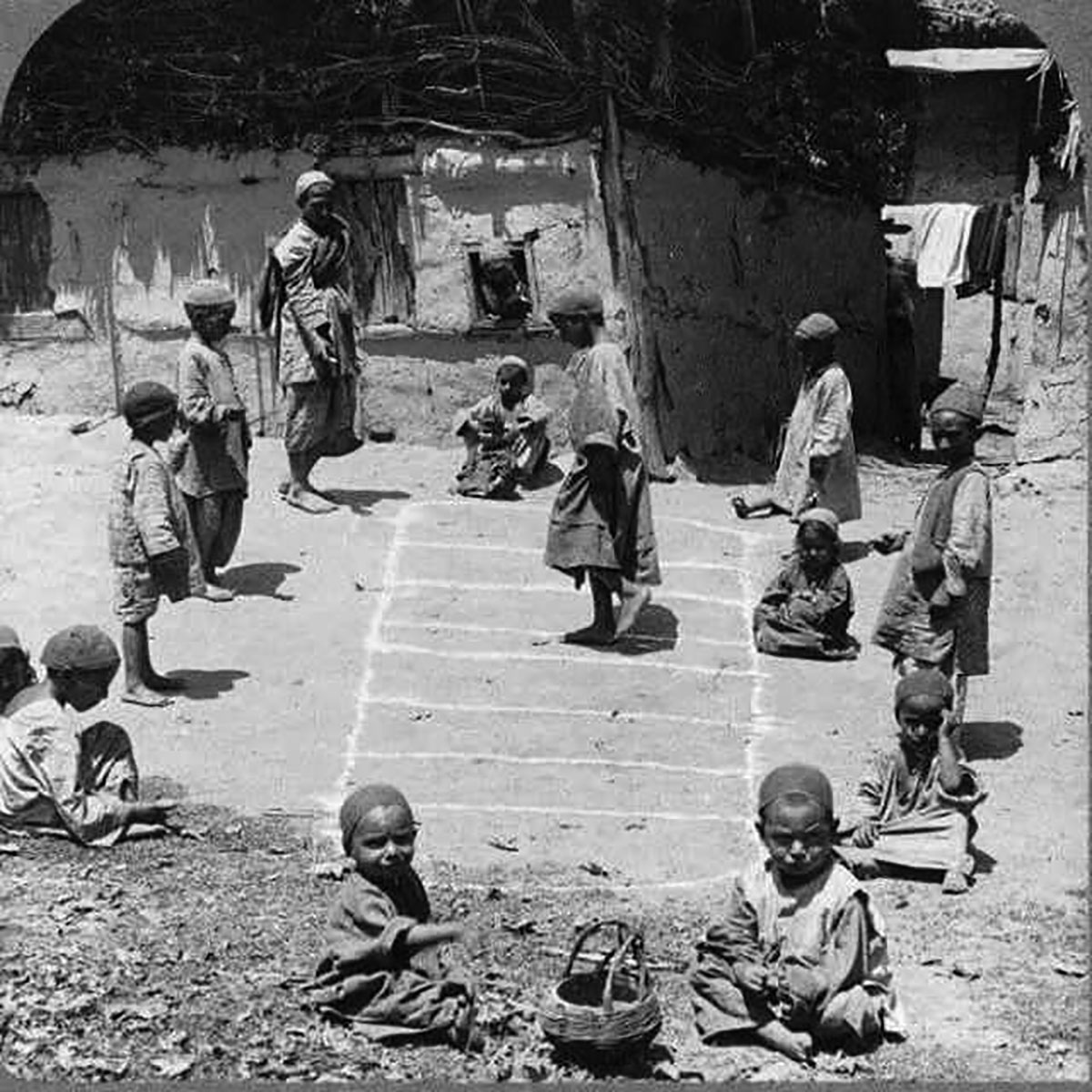
In some areas, Sazz long is known as khaanan gindun. Seemingly local, this game is a global sport. It involves rectangular boxes and a small piece of wood, rubber – but mostly clay – that is used to pass through all the boxes by the player. The player, however, is allowed to only use his or her one foot, without touching the boundaries. The game had seven rectangular boxes drawn on a flat surface.
All seven boxes had their names awal, doum, soum, jannat, samandar and jehnum. The last box which was also the winning box was called dullej or batta. After conquering all the boxes, the player aimed for the dullej. The winner was the team or the individual who had won most of the boxes and as a celebratory gift, the losers had to carry the winners on his or her shoulders, symbolically.
The Old and New
Ghulam Rasool, now 50, a resident of South Kashmir used to play a game in his childhood Latkij Lott, also known as Gilli Danda to the rest of the subcontinent.
Rasool often goes out on his days off and tries to play the game with his children. “It is a great feeling to witness that a traditional game is still being played with the same enthusiasm,” he said. “I want them to play as much as they can, later life will have its own games to play.”
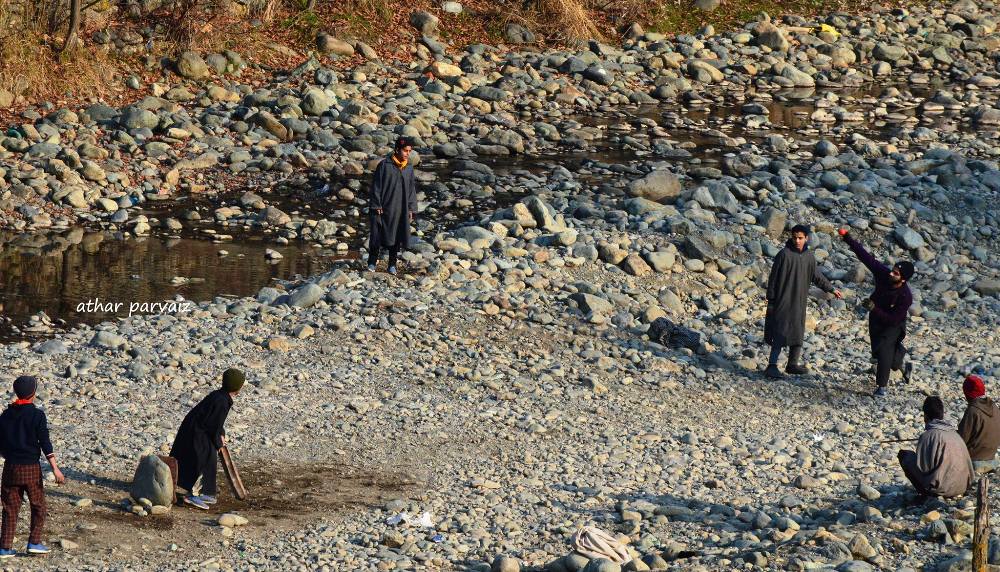
The game involves two sticks, one big and one small. The bigger stick is used to hit the smaller one. This game resembles many other games involving a ball and a stick like cricket, or baseball.
The Okus Bokus
Another game from the past that has carved its way into the present is that of okkus bokkus. Saima, 26, was sitting, scrolling down her phone, when she came across the song okkus bokkus, immediately she was taken over by the journey of nostalgia.
“I suddenly remembered the game I used to play as a child whenever all of our cousins gathered in my naanihaal (maternal grandparents’ home). All used to sit in a circle and my mamu used to play okkusbokkus with us.”
Youngest of all the cousins, Saima said she was always fascinated by the game. “I used to wonder how beautiful the rhyme was and how we used to play along the lyrics. But now I remember that it was also a playway method of teaching.”
Okkus bokkus also spelled as hakkus bakkus involves multiple players and a rhyme is read on the fingers of the different players. The rhyme goes like this,
“hukus bukus,
Telliwann chekus,
Onum batta lodum deag,
Shaal kichkich waangano,
Brahmi charas puane chhokum,
Brahmi shbatan yetekhist yakha.”
The finger on which the rhyme ends is folded, when a player’s all of the fingers get folded, the player is declared out of the game.
“I memorised this rhyme by heart and I used to play this game a lot with my cousins, then friends,” Saima asserted, “I have played these mobile and computer games too but trust me, I have enjoyed the traditional games more. My older cousins have played and led a better childhood than any of us and better than the present times.”
The Traditional Games
Another game that Saima played alongside her cousins was that of Tulthai langun.
“My naanihaal was in a village, so my cousins played all sorts of these fascinating traditional games and tulthai langun was one of those many fascinating games,” she stated, “It was more of a physical exercise, and by playing all these traditional games all of my cousins were much healthier than I was.”
In tulthai langun the players would twist and lock their arms in the opposite directions and pull each other on their backs. According to the elders, “anyone who played this game would never have back or neck issues since it was a great workout for the back and neck.”
While playing the game, the players would chant,
“Tulthai langun – tullumhai,
daaji langun – tullumhai,
draaikhai maalyun – draayashai.
The words, however, changed from region to region, in urban areas the words and sentences were a bit different and read like,
Tulaay langur tulaan chas,
makhdoom seabun khachan chaass.
Hide and Seek
Shabnam, 35, used to play tcheapp-tchapaadi or chuppan-chupaayi also known as hide and seek. “I along with my friends used to play tcheapp-tchapaadi all day long. It was our favourite game besides the gharghar and mahraaz-mahrin game.”
The game, Shabnam stated, “used to keep us on our toes and fully stimulated as we used to be aware of our surroundings and it has made me more aware and focused in life. You know this game makes you mentally very sharp and quick.”
In this game, there were multiple players, and while other players used to hide, one player used to seek them and whoever he or she managed to find, would be the next tag or chaser, “You know we used to be very alert because players could hide at any place, like behind the curtain, or the door, so we had to be very alert to even look at the simplest places. I remember one of my friends hid inside a drum and we looked so much for her but could not find her,” Shabnam said while remembering a game from the past.
The game starts with the chaser blindfolded, which he would remove once others call so that he or she can start the hunt.
Playing with Clay
Another game that Shabnam remembers which was mainly played by her brothers is that of garam also known as santooli.
“My brothers used to play garam along with the other boys in our neighbourhood. I remember sometimes I used to go and play that game too,” Shabnam said. “It was mostly played by boys but I wanted to be a part of it too. Those were the days when we truly enjoyed life.”
In garam or santooli or kattryan seven shattered earthen pots (kattriye) or stones would be piled on top of one another in this game. After winning the toss, the winning side would attempt three times to scatter the pile with a ball thrown at it. The other team would chase them with a ball as they tried to stack it back again. A player was eliminated from the game if the ball struck him. The game would end if the stack was whole once more.
Saba, 23, still remembers during her childhood, she used to live in a mohalla, where she played outdoor games with her friends, “We used to play this game called lakkad lakkad. It was so fun I still remember, we enjoyed to the last bit of our energy,” she stated.
Lakkad lakkad also known as hatti hatti was a very popular game mostly amongst the little girls wherein players would swap between different branches or trees, with one player pursuing other people on the team. A player was safe as long as she was touching a tree since the trees served as a safe haven. If the chaser touched her while she moved between trees, and was not touching any branch or tree, she would be declared out. Hatti Hatti konsi hatt imaange?” was the tagline.
On similar lines to hattihatti, another game that was played and was very popular amongst the people, especially young girls was colour-colour.
This game was also called tippi-tippi-top with a tagline that varied from, “Tippi-tippi tippi top, I want a colour, which colour?” or “Colour colour, which colour do you want?”, in this game again there was one chaser who used to give different colours to other players, who had to choose or touch things or surfaces of the given colours. The player who failed to do so would be declared out.
The Ice Water
Just like the hatti hatti and colour-colour games, another game that children still play is ice-water.“We used to play ice water, in which one player was a chaser and ran after other players. Then whosoever, the chaser tagged used to freeze by saying ice, until another player came and freed him or her, but he or she had to mention the word water while freeing them,” Saba stated, “I remember I developed running skills through these games.”
Another traditional game that was played was that of razz also known as woati razz. This razz game involved a skipping rope. Played mostly by girls, the rope was swung in various directions. In doubles and singles also, players used to occasionally skip the rope. According to the older generations, this game was very popular and good for girls since it would help them grow taller.
Traditional Games
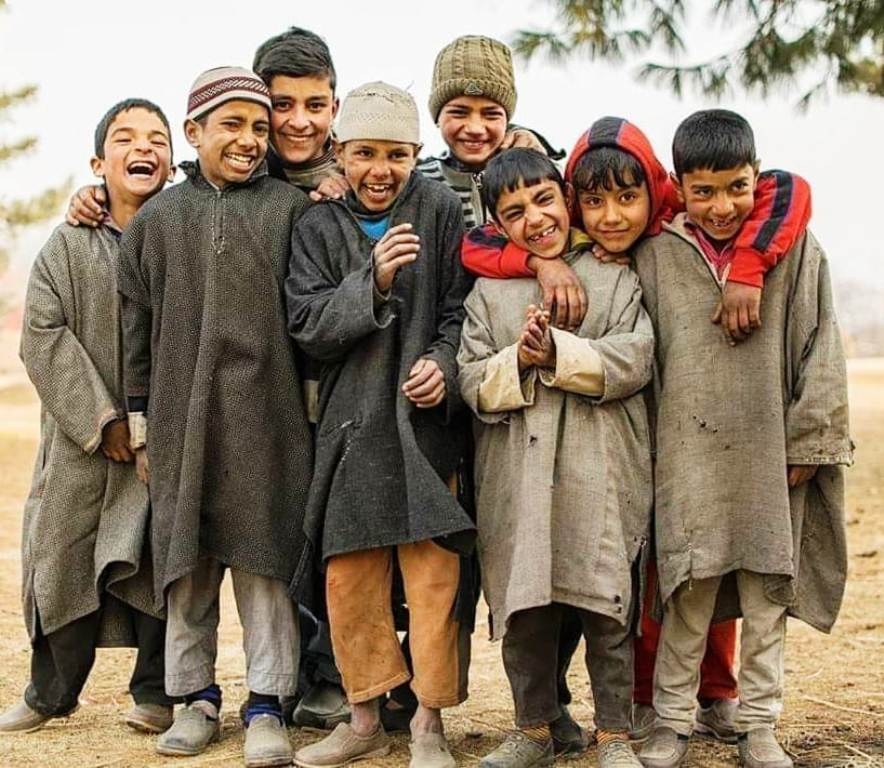
Other traditional games that were played across Kashmir were baante zaar, a game that involved playing with the glass marbles, dajji ball, a game similar to football which was mostly played by boys. The ball used in this game was made out of old cloth or rug. Another famous game was that of joutas, in which, one player used a piece of cloth to blindfold him or herself, and the other players would tease him or her by pushing, pulling his or her clothes, and running around him or her. The positions would switch if the person wearing the blindfold managed to gain hold of any of the players. The elderly claim that this game requires more focus and wind-blown sound perception.
In not-so-distant Kashmir, in the absence of technology, children used to play mostly outdoors, which kept them both healthy and entertained. The type of games involved more than one player and often games also involved proper decision making. “Like when I used to play gharghar, I had my kitchen, my own house and then I made all the decisions regarding my household, though it was all play, yet I learnt the art of decision making from playing these games,” lamented Nousheen, 30, a resident of Srinagar, “I learnt adjusting with different people too.”
The Health Benefits
According to Dr Rayees, a child specialist, Kashmir’s traditional games helped children in socialising more. “Since all those games used to be outdoors and multi-players, the children socialised and interacted more eventually resulting in a lot of friendships,” he said. “Those games were very beneficial and different from the indoor games which children play these days.”
Traditional games, Rayees said were learning experiences as children picked up skills to control their anger, communicate, and improve their languages. Even the physical benefits were huge. “As children used more physical exertion, or the games were more of exercises, so, the children were healthier. But unfortunately, now these games are not played as much as they used to be played.”