by Lilac Ali
SRINAGAR: Kashmir’s historic Mughal gardens have received what experts describe as the first comprehensive scholarly treatment devoted exclusively to their landscape heritage. Kashmir conservationists and historians hope that the work will serve as a blueprint for preserving some of the Valley’s most significant cultural assets.
The optimism emerged at a pre-launch event and panel discussion held at the Amar Singh Club on Friday, where Belgian landscape architect and researcher Prof Jan Haenraets unveiled his forthcoming 600-page book, Kashmir’s Mughal Landscape of Gardens: Creation and Decline of a Golden Age, 1586–1753.
Speakers at the event said the publication fills a long-standing gap in scholarship by documenting the historical evolution, design principles, ecological contexts and conservation challenges of Kashmir’s Mughal gardens, while also bringing lesser-known and forgotten sites into focus.
The study, which draws on more than 16 years of research and examines around 80 Mughal garden sites across Kashmir, is expected to provide a critical reference for heritage professionals, planners and policymakers involved in conservation efforts.
Addressing the gathering, Haenraets said Kashmir’s gardens were not merely regional monuments but served as influential models for Mughal landscape architecture across South Asia.
“Kashmir gardens were essential to what was practiced by the Mughals outside,” he said, noting that design elements seen in sites such as the Taj Mahal in Agra and Bagh-e Babur in Kabul reflected concepts first developed in Kashmir.
He highlighted the Valley’s distinctive terraced layouts, sophisticated hydraulic engineering and elongated garden designs, arguing that these features helped shape imperial garden traditions beyond Kashmir.
The author described the gardens as “essential elements of Kashmir’s identity and heritage” and stressed that the book was intended not only as a historical record but also as a practical guide for future conservation.
He warned that rapid urbanisation and infrastructure development could threaten the integrity of historic landscapes if preservation concerns are overlooked.
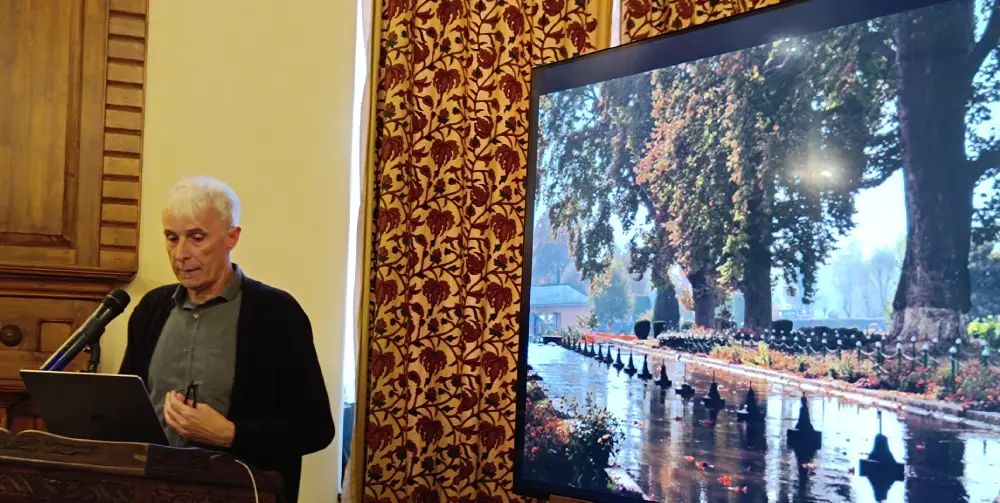
“Conservation needs knowledge and understanding,” Haenraets said, expressing concern that some restoration projects have prioritised tourism-driven beautification over historical authenticity.
The book identifies more than 50 Mughal gardens across Kashmir and presents detailed maps, archival photographs, field surveys and historical analysis. It also examines the broader network of gardens created by Mughal emperors, empresses, governors and nobles who shaped the Valley’s landscape over nearly two centuries.
Speaking on the occasion, Saleem Beg, convener of the Jammu and Kashmir chapter of the Indian National Trust for Art and Cultural Heritage, described the publication as a landmark contribution to heritage studies. He said the work offers new insights into Kashmir’s cultural landscape and provides an important foundation for future restoration and preservation efforts.
“The stage has come to restore these gardens to respectable levels and preserve them as collective heritage spaces,” Beg said, adding that decades of interventions had often compromised the historical character of the sites.
Historian Sameer Hamdani also hailed the publication as a major addition to the literature on Kashmir’s built heritage, noting that while Mughal architecture has been widely studied, the landscapes surrounding monuments have received comparatively little scholarly attention.
Participants from academic, architectural and conservation circles welcomed the study, expressing hope that it would encourage greater public awareness, research and policy attention towards the preservation of Kashmir’s historic garden network.
The event was attended by historians, architects, conservation practitioners, students, journalists and members of the public, generating extensive discussion on the future of Kashmir’s cultural landscapes and the challenges involved in protecting them amid modern development pressures.
The book is expected to be released in August.