SRINAGAR: June 6, 2025, is poised to be inscribed in golden letters in the history of Jammu and Kashmir, as the country’s most iconic and advanced Katra-Srinagar stretch of the prestigious Udhampur-Srinagar-Baramulla Rail Link (USBRL) project is set to be inaugurated by Prime Minister Narendra Modi.
The Katra-Srinagar rail section was the most critical component of the ambitious USBRL project, considered a transformative infrastructure initiative aimed at connecting the Kashmir Valley with the rest of India through a robust, all-weather railway network.
HISTORY
The vision to connect the Kashmir Valley with the rest of India through a railway line is rooted in the late 19th century during the reign of Maharaja Pratap Singh. In 1898, he first articulated the vision of a railway line connecting Jammu, the winter capital of the princely state, to Srinagar, the summer capital nestled in the Kashmir Valley. In 1905, he approved the construction of a narrow 762 mm gauge railway via Reasi, which would eventually evolve into the modern USBRL project.
By 1905, after years of deliberation, surveys, and consultations with British engineers, Maharaja Pratap Singh approved the construction of a railway line from Jammu to Srinagar. The proposed railway was to be a narrow gauge of 762 mm (2 feet 6 inches), a common choice for mountainous regions in India at the time. British and local engineers conducted preliminary surveys to assess feasibility, map the route, and estimate costs. These surveys identified the need for tunnels, bridges, and embankments to navigate the rugged landscape.
The ruler allocated funds from the state’s treasury and sought collaboration with the British Indian government and the Northwestern Railway, which operated lines in nearby Punjab. However, the challenging topography, geological instability, and harsh weather conditions of the region delayed significant progress for decades.
USBRL REBORN
In 1983, Prime Minister Indira Gandhi laid the foundation stone for the Jammu-Udhampur section of the railway line. Following this, in 1994, Prime Minister P. V. Narasimha Rao announced the modern-day USBRL with an extended railway line from Udhampur to Baramulla via Srinagar to connect the mainland to the Kashmir Valley. The project was formally sanctioned by the Railway Ministry in the 1994-95 budget, with an initial estimated cost of Rs 2,500 crore.
NATIONAL PROJECT
In 2002, USBRL was declared a “National Project” by the then Prime Minister Atal Bihari Vajpayee-led NDA government, underscoring its strategic and socio-economic importance. The project aims to bridge the geographical and logistical challenges of the Himalayan terrain, enhance regional connectivity, boost tourism, and facilitate trade and economic development in Jammu and Kashmir.
The project is divided into four key legs:
Leg 0: Jammu to Udhampur (53 km)
Leg 1: Udhampur to Katra (25 km)
Leg 2: Katra to Banihal (111 km)
Leg 3: Banihal to Baramulla (135 km)
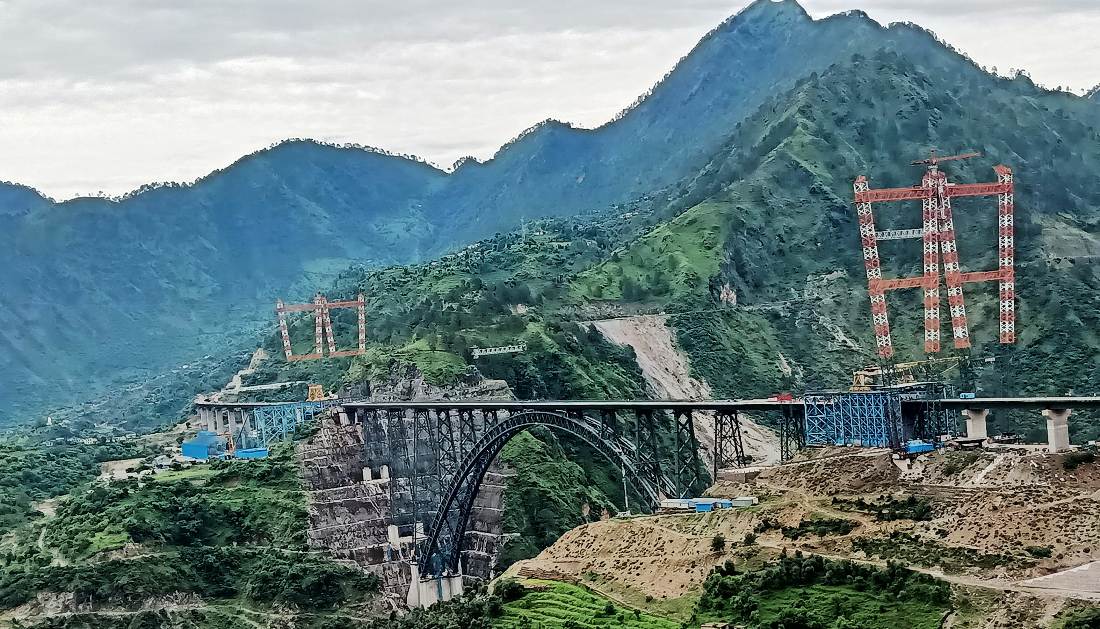
The Katra-Srinagar rail section is a cornerstone of the USBRL, primarily encompassing the 111-km Katra-Banihal stretch (Leg 2) and linking to Srinagar via the already operational Banihal-Srinagar portion of Leg 3. This route contains challenging engineering marvels, including the world’s highest railway arch bridge, standing 359 metres above the Chenab riverbed in Reasi district, 35 metres taller than the Eiffel Tower. The section also includes 35 tunnels (27 main and 8 escape tunnels), with 97.42 km (87 per cent of the 111 km) in tunnels. The 12.77-km T-50 tunnel between Khari and Sumber is India’s longest transport tunnel.
MILESTONES AND TIMELINE
The USBRL project has been executed in phases, with key sections commissioned over the years. Below are the major milestones, including those relevant to the Katra-Srinagar rail section:
1994-95: USBRL sanctioned by the Government of India with an estimated cost of Rs 2,500 crore.
2002: Declared a “National Project” by the Atal Bihari Vajpayee government.
April 13, 2005: PM Manmohan Singh inaugurates the 53-km Jammu-Udhampur section (Leg 0) at a cost of Rs 515 crore.
October 2009: The 118-km Qazigund-Baramulla section (Leg 3) is commissioned.
June 2013: The 18-km Banihal-Qazigund section opens with the 11-km Pir Panjal Tunnel.
July 4, 2014: PM Modi inaugurates the 25-km Udhampur-Katra section (Leg 1).
February 2020: PM Modi inaugurates the 48.1-km Banihal-Sangaldan stretch.
July 2020: Electrification begins; Baramulla-Sangaldan route fully electrified by 2024 at Rs 470.23 crore.
December 2024: Final track work completed; trial runs begin on the 18-km Katra-Reasi section.
January 6, 2025: Jammu Railway Division inaugurated; CRS conducts final safety inspection; Vande Bharat trial run completed.
April 19, 2025: Inauguration deferred due to weather.
June 6, 2025: PM Modi to flag off the first Vande Bharat train from Katra to Srinagar.
COSTS AND FINANCIAL DETAILS
The USBRL project was sanctioned in 1994-95 with an estimated cost of Rs 2,500 crore. By 2014, the cost had risen to Rs 19,565 crore. The latest sanctioned cost, as of 2023, stands at Rs 37,012.26 crore, with cumulative expenditure reaching Rs 33,421 crore by February 2023 and Rs 38,931 crore by March 2024. The projected total cost is now pegged at Rs 44,000 crore. The Banihal-Khari-Sumber-Sangaldan section alone cost approximately Rs 15,836 crore.