SRINAGAR: Ladakh has begun a pilot project to cultivate saffron on nearly 4,000 square metres of land in Leh, with around 90,000 premium Iranian saffron corms weighing about 800 kg planted at Spituk Pharka.
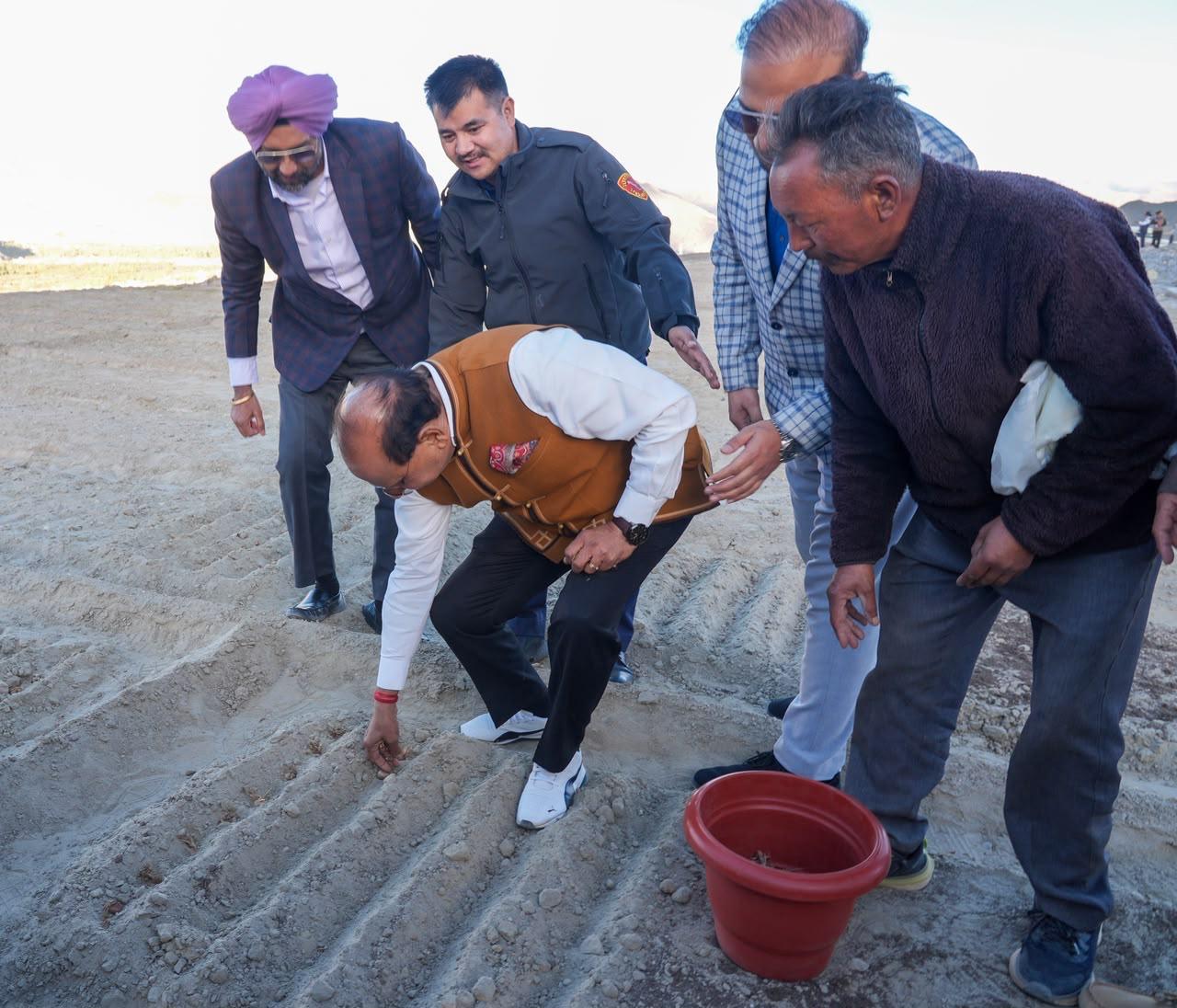
The cultivation is being undertaken at Command Area Gate No. 27 on land that was previously barren and has recently been restored for agricultural use. The Administration said the experiment is aimed at assessing whether the high-value crop can be successfully grown under Ladakh’s high-altitude agro-climatic conditions.
The saffron plantation is part of a wider land-restoration effort near Spituk, where nearly 800 acres of barren land are being rejuvenated using water from the restored Igoo-Phey irrigation canal. The Ladakh Administration had earlier said excess water from the canal was being channelled towards the land to improve soil moisture and facilitate its conversion for cultivation.
The saffron corms planted for the pilot have a circumference of 8 to 10 cm, a diameter of 2.5 to 3 cm or more, and a weight of at least 10 grams. Agriculture experts associated with the initiative expect the corms to produce a significant quantity of saffron, although the actual yield will be assessed after cultivation.
Lieutenant Governor Vinai Kumar Saxena said the initiative could provide another high-value crop for farmers and contribute to the local economy. He said the project was also intended to demonstrate the potential of restoring degraded land and diversifying agriculture in Ladakh.
The initiative follows the Administration’s efforts to expand agricultural activity in areas previously considered unsuitable for cultivation. Project Him Sarovar, launched in April, envisages the creation of water bodies to conserve snowmelt and improve irrigation and agricultural potential across Ladakh.
At Spituk Pharka, four water ponds have been developed under the project, with a combined storage capacity of around 24 million litres, according to the Administration.
The saffron experiment also builds on earlier high-value floriculture initiatives in Leh, including cultivation of Lilium and Gladiolus, which the Administration has linked to additional livelihood opportunities for farmers, Self-Help Groups and local entrepreneurs.
Saffron is already cultivated extensively in Jammu and Kashmir, which accounts for about 90 per cent of India’s saffron production, according to the Administration. Its introduction in Ladakh is being undertaken as a pilot to determine the crop’s suitability and economic potential in the Union Territory.
The development comes after the restoration and operationalisation of the Igoo-Phey canal, which the Ladakh Administration said had remained unused for several years. The canal is designed to irrigate more than 4,300 hectares across several villages.
The Administration has described the broader land-reclamation exercise as an effort to convert barren and degraded areas into productive agricultural assets through improved water availability and soil rejuvenation.