SRINAGAR: The ongoing political dialogue between Ladakh leaders and the Union Government has hit a fresh hurdle after the Leh Apex Body (LAB) refused to sign the draft minutes of the May 22 meeting with the Union Ministry of Home Affairs (MHA), alleging that a crucial point discussed during the negotiations was omitted from the official record.
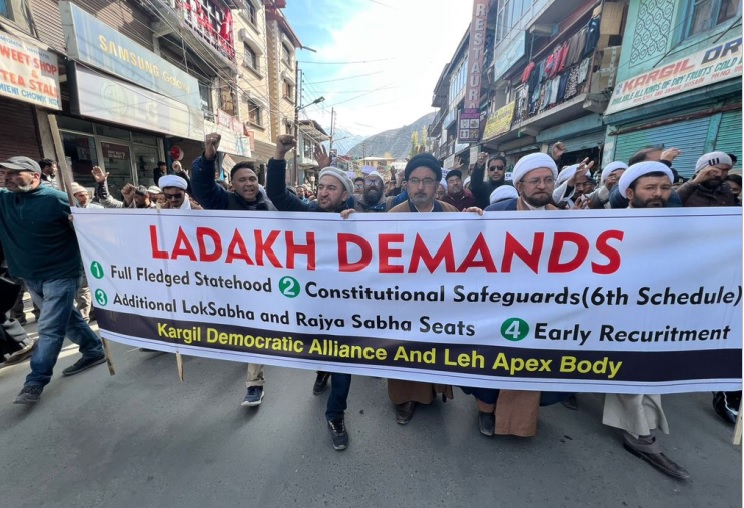
The development comes days after the Leh Apex Body and the Kargil Democratic Alliance (KDA), the two organisations spearheading the movement for constitutional safeguards in Ladakh, announced that an “in-principle” understanding had been reached with the Centre on restoring democratic governance and creating a constitutional framework for the Union Territory.
LAB co-chairman Chering Dorjay Lakruk said the organisation declined to endorse the minutes because they failed to mention an important understanding regarding administrative control over senior bureaucrats.
“I did not sign the document because one of the key points discussed during the meeting was missing. It was agreed that the Annual Performance Appraisal Reports of officers, up to the level of Chief Secretary, would be written by the elected body. This proposal came from the Centre itself,” Lakruk said.
He maintained that the Union Government should not dilute or omit any aspect of the understanding reached during the May 22 talks in New Delhi.
According to LAB leaders, the proposed arrangement discussed during the meeting envisaged the creation of a Union Territory-level elected legislative body with legislative, executive and financial powers. Under the proposed framework, bureaucrats, including the Chief Secretary, would function under the executive authority of the elected government.
Lakruk told reporters that all three LAB representatives who attended the subcommittee meeting refused to sign the draft minutes because the clause relating to the authority of the elected executive head over senior officers was missing.
“The Government of India should not backtrack from the in-principle agreement reached during the May 22 meeting,” he said.
The May 22 talks between Ladakh representatives and the MHA were widely viewed as a breakthrough in the long-running negotiations over Ladakh’s political future following the abrogation of Article 370 and the bifurcation of the erstwhile Jammu and Kashmir state in 2019.
Following the meeting, both LAB and KDA had stated that discussions were moving towards a constitutional mechanism on the lines of Articles 371A, 371F and 371G, which provide special protections to Nagaland, Sikkim and Mizoram respectively.
The organisations had also said that the proposed arrangement would vest legislative, executive and financial powers in elected representatives through a democratically elected body for Ladakh.
Climate activist and LAB member Sonam Wangchuk, who attended the May 22 meeting, said senior leaders, including BJP leader Tashi Gyalson and former LAB co-chairman Thupstan Chhewang, had publicly acknowledged after the meeting that bureaucrats, including the Chief Secretary, would report to the proposed executive head of the elected body.
Tashi Gyalson, however, described the understanding as being at a preliminary stage and said substantial work still remained.
“An in-principle agreement has been reached on the issue that Ladakh will have an elected legislative body with legislative, financial and executive powers and seven councils. But this is still at the draft stage,” he said, adding that the Centre and Ladakhi representatives would continue consultations on the structure and nomenclature of the proposed body.
Meanwhile, Ladakh Chief Secretary Ashish Kundra sought to downplay the controversy over the unsigned minutes, stating that the discussions held during the nearly two-and-a-half-hour meeting could not be fully reflected in a brief draft record.
“The subcommittee meeting lasted nearly two and a half hours. There was a lengthy discussion and both sides presented their viewpoints. The minutes are only the crux of the discussions,” Kundra said while addressing the media in Leh.
He said the Government had, for the first time, shared draft minutes in “good faith” to facilitate discussions among stakeholders and insisted that the Centre remained committed to continuing dialogue with Ladakhi groups.
Describing the May 22 meeting as a “breakthrough moment”, Kundra said the discussions had opened the possibility of evolving a “customised” constitutional and administrative framework tailored specifically for Ladakh within the ambit of the Constitution.
“For many months and years, different groups have been advocating their concerns through dialogue. The May 22 meeting marked a significant step forward in creating an atmosphere where stakeholders could engage openly and work towards consensus,” he said.
Kundra revealed that the Centre had asked Ladakhi representatives to prepare and submit a detailed document outlining their proposed framework, while the Government of India would formulate its own position after consultations with the Ministry of Law.
“These documents will form the basis for future discussions,” he said, adding that the process had now entered a “very encouraging stage”.
According to Kundra, the latest discussions explored whether a special framework under Article 371 could be developed to safeguard Ladakh’s land, culture and employment opportunities while strengthening local political institutions.
“The discussions examined the possibility of creating a body with political, executive and legislative powers and strengthening local governance institutions,” he said.
The Chief Secretary acknowledged that aspirations for statehood had also figured during the talks, but said the Centre believed prevailing administrative and financial conditions were not conducive for granting statehood immediately.
“They acknowledged that people have aspirations regarding statehood. However, under present circumstances, the conditions may not be conducive for granting statehood immediately,” he said.
At the same time, Kundra said the Centre had not rejected the demand altogether and was instead exploring “practical and constitutionally viable alternatives”.
“The question now is — if not statehood, then what alternative framework can address Ladakh’s aspirations? Discussions have now begun on a customised model for Ladakh unlike any arrangement existing elsewhere in India,” he added.
Kundra also clarified that the draft minutes circulated among stakeholders were not final and were intended only to facilitate further discussions.
Emphasising the importance of trust and continued engagement, he said the latest round of talks had generated a “new atmosphere of confidence”.
“If both sides continue to move forward in this spirit, more possibilities and solutions will emerge,” he said.