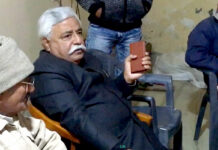
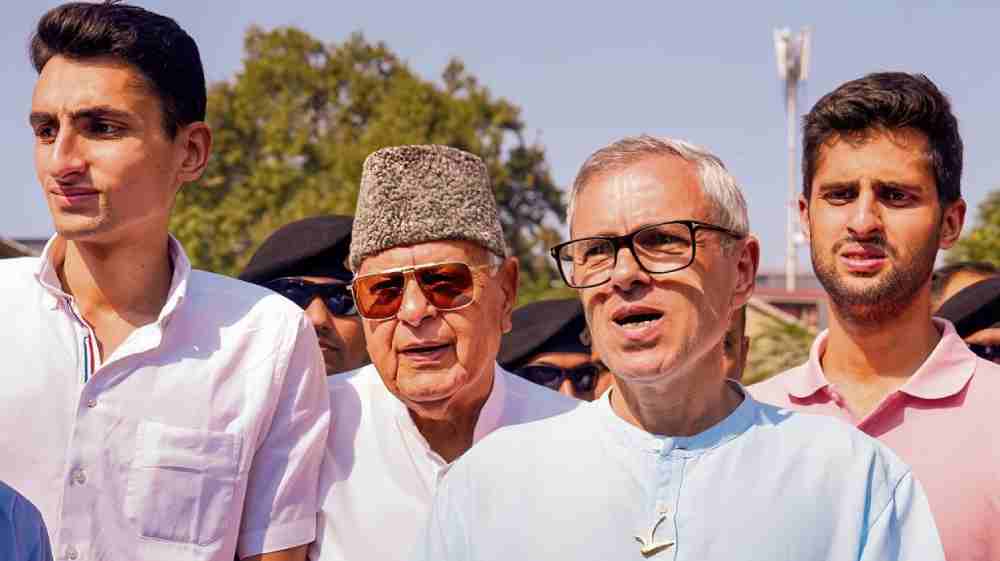
SRINAGAR: In an emotional journey that symbolised decades of aspirations finally turning into reality, National Conference president and former Jammu and Kashmir Chief Minister Dr. Farooq Abdullah on Tuesday rode the newly operational Vande Bharat Express from Srinagar to Katra, hailing it as a “historic gift” that bridges not just geographical distances but also emotional and political divides.
The Vande Bharat Express, flagged off by Prime Minister Narendra Modi on June 6, is the first semi-high-speed train to connect the Kashmir Valley with the rest of India via the Udhampur-Srinagar-Baramulla Rail Link (USBRL). The 272-km corridor, built at a staggering cost of Rs 43,780 crore, is an engineering marvel featuring 36 tunnels spanning 119 km and 943 bridges, including the iconic Chenab Rail Bridge, the world’s highest railway arch bridge at 359 meters.
As the sleek blue-and-white train glided over the Chenab Bridge, Abdullah, a three-time former CM, was overcome with emotion. “Tears welled up in my eyes when we crossed the Chenab Bridge,” he told reporters at Katra station. “It’s a dream come true. For the first time, Kashmir is truly connected to the country by rail.”
Abdullah emphasized that the Vande Bharat service is not merely about faster travel but about economic revival, tourism growth, and national integration. With travel time between Srinagar and Katra slashed by nearly three hours, the train is expected to significantly boost pilgrimage tourism, particularly for the Vaishno Devi shrine and the upcoming Amarnath Yatra starting July 3. He highlighted how Kashmiri apples, saffron, and other produce can now reach markets across India, from Kanyakumari to Kolkata and Mumbai, more efficiently. Unlike road travel, which often gets disrupted due to snowfall and landslides, the Vande Bharat offers reliable, year-round connectivity.
Praising the efforts of engineers and labourers who braved extreme terrain to complete the project, Abdullah acknowledged the contributions of successive governments. “It started as a vision of Atal Bihari Vajpayee, was advanced by Manmohan Singh, and completed under Prime Minister Modi,” he said. “This is a collective achievement. I salute every hand that built it.” The Chenab Bridge, standing taller than the Eiffel Tower, and the Anji Khad Bridge, India’s first cable-stayed railway bridge, were particularly lauded as testaments to India’s engineering prowess.
Beyond infrastructure, Abdullah framed the train as a symbol of emotional and political reconciliation. “This is the first step in reducing ‘Dil Ki Doori’ (emotional distance) and ‘Delhi Ki Doori’ (political distance),” he said, while reiterating his party’s demand for J&K’s full statehood restoration. “Mata ne bulaya hai (The Mother Goddess has called),” he declared at Katra, drawing cheers from supporters. “This train is hope roaring across bridges, bringing Kashmir closer to India—not just in miles, but in spirit.”
The Vande Bharat trains, equipped with KAVACH anti-collision technology, Wi-Fi, and cold-climate adaptations, are set to redefine travel in the region. With two services now operational, Srinagar-Katra and Baramulla-Delhi—the project marks a turning point in J&K’s integration with mainland India. As Abdullah concluded, “This is more than steel and rail. It’s a new dawn for Kashmir.”