SRINAGAR: Jammu and Kashmir has witnessed an unprecedented response to its high-density plantation initiative, with applications received for over 7,000 hectares of land, far exceeding the official target of 1,343 hectares set for the project.
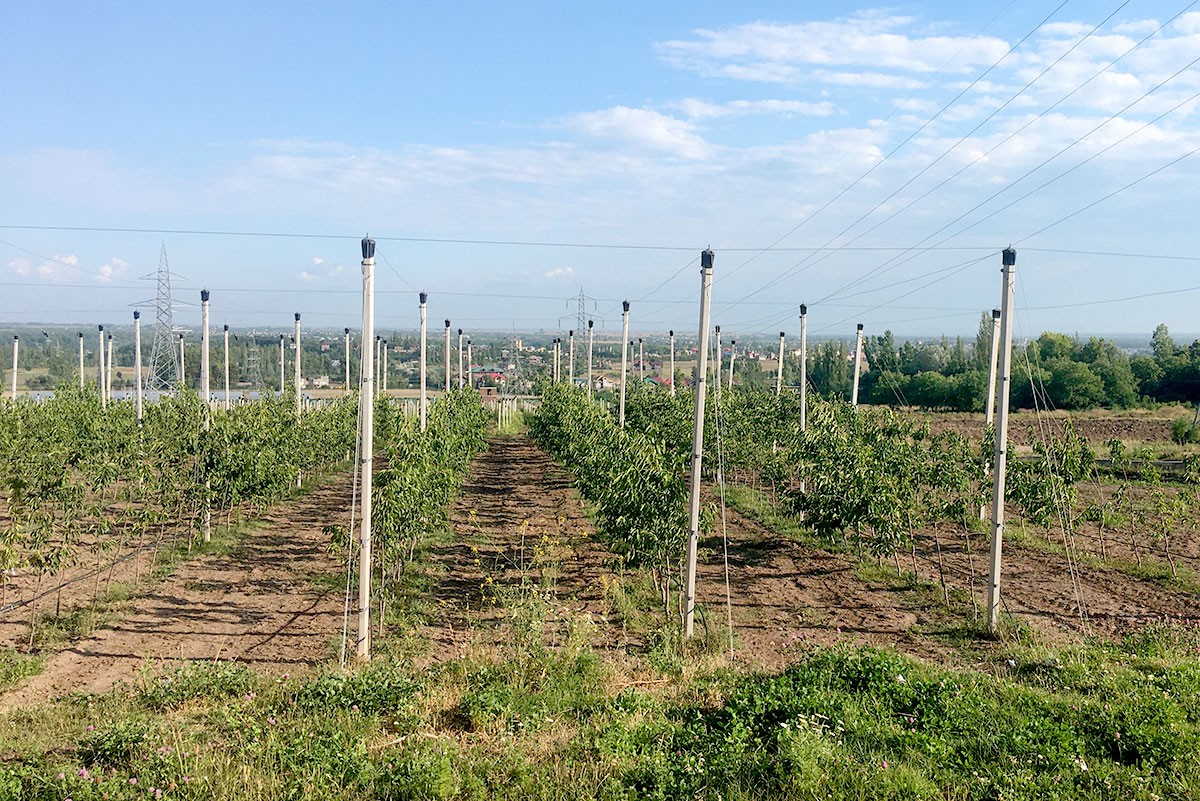
The scheme, aimed at boosting horticulture production in the region, has attracted a massive number of farmers and orchardists eager to adopt modern plantation techniques. The overwhelming demand highlights a growing interest in high-density farming, which promises higher yields, better quality produce, and improved income for farmers.
The Department of Horticulture had initially planned to bring 1,343 hectares under high-density plantation in the next financial year. However, the response has been far greater than expected, signalling a significant shift towards modern horticultural practices in the Union Territory.
High-density plantations, particularly in apple, pear, and cherry orchards, have proven to increase productivity manifold compared to traditional farming methods.
Officials stated that the proposed target under the High-Density Plantation (HADP) for the next financial year in Kashmir is 808.5 hectares, while the applications received so far total over 6,240 hectares.
In the Jammu division, the target for the HADP for the next financial year is 535 hectares, while applications received cover 885 hectares. In Pulwama district, which has a target of 90 hectares, applications have been received for 1,855 hectares. In Anantnag, where the target is 70 hectares, applications received amount to 1,473 hectares.
Ramban is the only district where applications received so far have not met the target; there is a target of 48 hectares, while only 22 hectares of applications have been submitted.
It is pertinent to mention that Jammu and Kashmir’s horticulture sector continues to grow, with Anantnag emerging as the leading district in terms of horticultural area during 2023-24. Official data reveals Anantnag accounts for 32,156 hectares, making up 9.33 per cent of the total horticultural land in the Union Territory.
Following closely are Baramulla with 30,398 hectares (8.82 per cent) and Kupwara with 29,167 hectares (8.46 per cent), both playing crucial roles in fruit and dry fruit cultivation. Pulwama (26,463 hectares, 7.68 per cent), Shopian (26,242 hectares, 7.61 per cent), and Kulgam (23,276 hectares, 6.75 per cent) are also key contributors to horticulture in the region.
On the lower end of the spectrum, Srinagar has the smallest horticultural footprint, covering only 3,298 hectares (0.96 per cent). Samba follows with 5,653 hectares (1.64 per cent), while Bandipora has 6,849 hectares (1.99 per cent). Other districts with comparatively lesser horticultural land include Reasi (9,053 hectares, 2.63 per cent) and Kishtwar (9,814 hectares, 2.85 per cent).
The total horticultural area across J&K stands at 344,696 hectares. Fresh fruit cultivation spans 252,257 hectares (73.2 per cent), while dry fruit orchards cover 92,438 hectares (26.8 per cent).
The Kashmir Valley remains the dominant region for horticulture, with Anantnag, Baramulla, and Kupwara leading the way. Meanwhile, the Jammu region contributes to the sector with crops like mangoes, and citrus fruits. (KNO)