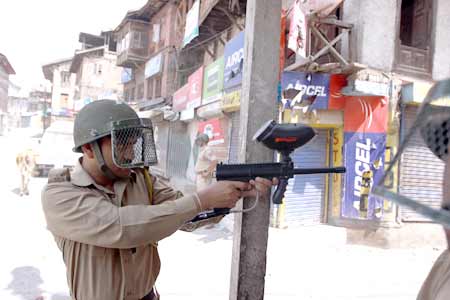
SRINAGAR: The Supreme Court on Thursday said it could not prohibit the use of pellet guns by security forces for crowd control as long as the existing Bureau of Police Research and Development (BPRD) advisory permits their use in exceptional circumstances, while observing that allegations of misuse in specific incidents can be examined independently.
A bench comprising Chief Justice Surya Kant and Justices Joymalya Bagchi and V Mohana was hearing a petition seeking a nationwide ban on the use of metallic pellet guns following injuries allegedly suffered by protesters during the July 20 ‘Sansad Chalo’ march against the NEET paper leak in Delhi.
The court issued notices to the Centre and the Inspector General of the Rapid Action Force (RAF) on the plea filed by former Central Information Commissioner and retired IPS officer Yashovardhan Azad along with two injured protesters, Prashant Kumar and Sheikh Irshad Mansoori.
The bench also directed the Centre to preserve the RAF’s ammunition log and asked the Delhi government to ensure the injured protesters receive the best possible medical treatment.
During the hearing, Justice Bagchi observed that the petition’s prayer for a complete ban was too broad as it did not challenge the legal framework permitting the use of pellet guns.
“As long as the regulations permit their use in exceptional situations, the court cannot ban them. If the petitioners seek to phase out pellet guns, they must challenge those provisions as being unconstitutional under Article 21,” the bench observed.
Senior advocate Vrinda Grover, appearing for the petitioners, argued that the case specifically concerned the use of metallic pellets against civilians during the protest. She submitted that metallic pellets had been recovered from the bodies of the injured protesters and contended that no Delhi Police standing order authorising such use was available in the public domain.
Grover requested the court to direct the Centre to place the relevant rules and standing orders on record, saying she had relied on the BPRD advisory in the absence of any publicly available Delhi Police guidelines.
The bench said it was willing to examine whether the use of pellet guns in the July 20 incident conformed to the prescribed “graded response” for crowd control but reiterated that it could not issue a blanket prohibition without examining the governing regulations.
Solicitor General Tushar Mehta, appearing for the Centre, assured the court that the government would provide all necessary assistance and preserve all material required for the investigation, including the ammunition records sought by the petitioners.
The court noted that peaceful demonstrations can sometimes turn violent due to the involvement of anti-social elements, requiring law enforcement agencies to take immediate decisions depending on the situation. It observed that the use of force must follow a graded approach based on the circumstances.
The petition seeks a nationwide ban on wholly or partly metallic pellet ammunition fired from pump-action or projectile guns for dispersing civilian assemblies, arguing that such weapons are inherently incapable of precise targeting and pose a high risk of causing serious injuries, particularly to the eyes and other vital organs.
It also seeks compensation, medical treatment and rehabilitation for those injured during the July 20 protest, alleging that RAF personnel used tear gas, lathi-charge and metallic pellet ammunition without prior warning near Connaught Place.
According to the petitioners, the use of metallic pellet guns violates constitutional guarantees of life and the right to peaceful assembly as it fails the tests of necessity, proportionality and reasonableness governing the use of force by the State.