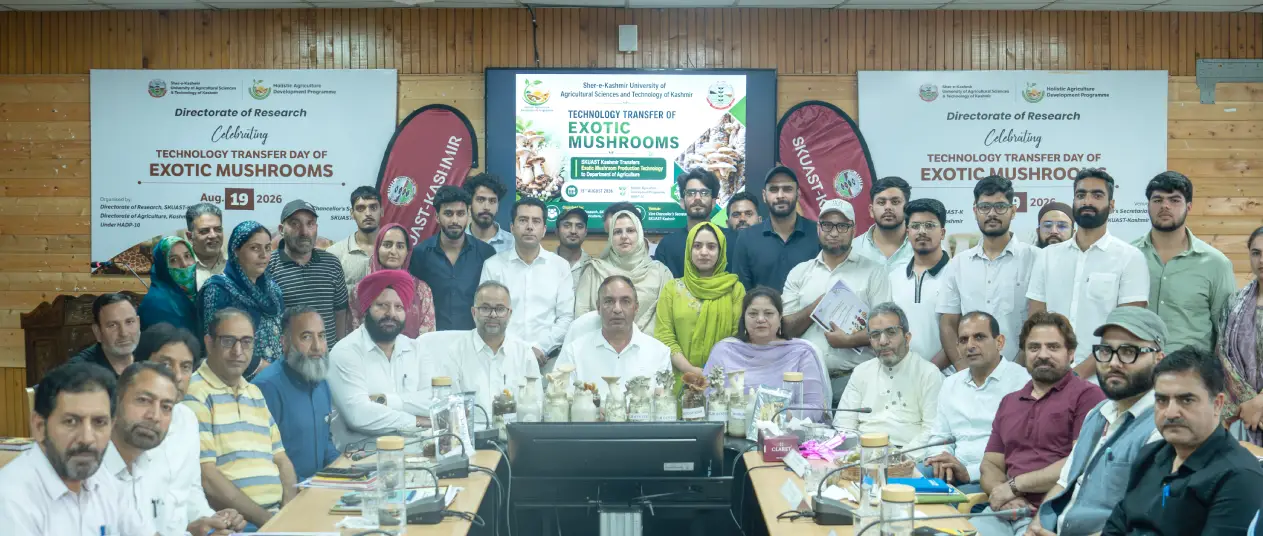
SRINAGAR: Sher-e-Kashmir University of Agricultural Sciences and Technology of Kashmir (SKUAST-K) has transferred its patented production technology for three high-value exotic mushrooms—Shiitake, King Oyster and Enoki—to the Jammu and Kashmir Department of Agriculture, paving the way for wider adoption of the technology by farmers and agri-entrepreneurs.
Developed by the university’s Mushroom Research and Training Centre (MRTC), the technology includes production protocols and associated strains for the three mushrooms. The transfer is intended to move the technology beyond the university’s research facilities and into commercial cultivation.
A key attraction of the technology is its use of locally available woody agricultural and horticultural biomass, including apple-pruning waste, as a cultivation substrate. The approach could provide an alternative use for material that is frequently discarded or burnt, while creating an additional source of income from horticultural waste.
SKUAST-K Vice Chancellor Prof Nazir Ahmad Ganai said the technology could help shift agriculture towards higher-value and more resource-efficient production. He said exotic mushrooms generally command substantially higher prices than conventional button mushrooms, creating opportunities for small enterprises, rural youth, women and agricultural graduates.
The university estimates that apple-pruning wood alone could potentially support production of about 3.4 lakh tonnes of premium mushrooms annually, with an estimated market value of around Rs 17,000 crore. The estimate indicates the scale of the opportunity if the technology can be successfully commercialised. However, actual production would depend on the availability and collection of biomass, cultivation capacity, market demand and other infrastructure.
The technology transfer was organised by SKUAST-K’s Directorate of Research under the Holistic Agriculture Development Programme (HADP).
Director Agriculture Sartaj Ahmad Shah said diversification had become increasingly important because of pressure on land and other resources and changing market demand. He said mushroom cultivation required relatively little land and could provide a high-value agricultural activity.
The university said entrepreneurs, including SKUAST-K students Munnazah Naseer and Kamran Showkat, have already taken up the technology on a pilot scale and reported commercial potential.
Dr Khursheed Ahmad Bhat, Assistant Professor and in-charge of the Mushroom Research and Training Centre, outlined the production systems, substrate preparation, infrastructure requirements, crop management and enterprise-development aspects of the technology.
According to the university, the MRTC has developed four patented mushroom strains and technologies. A technology book dealing with exotic mushroom cultivation and the utilisation of woody agricultural and horticultural waste was also released during the programme.
The transfer gives the Agriculture Department access to a technology that could potentially combine two of J&K’s existing agricultural strengths—horticultural biomass and high-value food production. Its wider significance, however, will depend on whether the technology can be taken beyond pilot cultivation and translated into viable enterprises with reliable supply chains, technical support and markets.
For J&K’s apple economy, the proposition is particularly relevant: instead of treating pruning wood as waste, it could become an input for a new value-added agricultural activity.