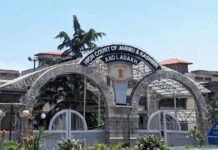
SRINAGAR: The Court of the 3rd Additional Sessions Judge, Srinagar, has made interim anticipatory bail granted to Tariq Ahmad Mir absolute in a case registered at Nishat police station, citing his compliance with bail conditions, the recovery of most of the allegedly stolen articles and the fact that the other accused have also been granted bail.
In an order dated October 17, 2026, Judge Dinesh Gupta directed Mir to continue cooperating with the investigating officer, refrain from influencing prosecution witnesses and obtain prior court permission before leaving the Kashmir Division. He was also directed to appear before the trial court when the challan is presented.
The case pertains to FIR No. 84/2026, registered at Police Station Nishat on September 1, 2026, under Sections 74, 324(4) and 305 of the Bharatiya Nyaya Sanhita (BNS). Mir had been granted interim bail by the court on September 2, 2026, while his application seeking anticipatory bail was under consideration.
According to the prosecution, the case involves allegations of outraging a woman’s modesty, theft, criminal intimidation and voluntarily causing hurt. The prosecution also alleged that articles worth more than Rs 1.80 crore had been stolen and that some of the property remained to be recovered.
Opposing the application, the prosecution argued that the allegations were serious and that custodial interrogation was required for a proper investigation. The prosecution maintained that the material collected during the investigation prima facie supported the allegations against the accused in association with the co-accused.
The defence, however, submitted that the case had arisen from an ongoing dispute between relatives. Counsel for Mir argued that a dispute existed between the complainant’s husband and his father, Hashim Qureshi, who had earlier lodged an FIR against Junaid Ahmad Qureshi, the complainant’s husband.
According to the defence, after Junaid Qureshi’s arrest, the complainant lodged the present case against his brother Abrar Qureshi and sister Laila Qureshi. Mir is Laila Qureshi’s husband. The defence described the allegations against the applicant as false and submitted that he had complied with all conditions imposed by the court.
The defence also pointed out that the investigation was almost complete and that the other accused had been granted bail. It urged the court to confirm the interim protection already extended to Mir.
After hearing both sides and examining the case diary produced by the investigating officer, the court noted that the officer had acknowledged Mir’s compliance with the bail conditions and stated that the majority of the allegedly stolen articles had been recovered.
The court also took note of the bail granted to the co-accused. Abrar Qureshi, whose earlier bail application had been dismissed, was subsequently granted bail by a magistrate in Srinagar on September 29, 2026. Laila Qureshi had been granted bail by the High Court of Jammu and Kashmir and Ladakh on September 26, 2026.
Observing that the parties were related and that several litigations were pending between them and their relatives, the court considered the circumstances of the dispute alongside the stage of the investigation and the accused’s conduct while on interim bail.
The court held that the mere non-recovery of some stolen articles was not, by itself, sufficient to justify refusing bail in the circumstances of the case. It further observed that the accused would remain obliged to assist the investigating officer and that any violation of the bail conditions could provide grounds for seeking cancellation of bail.
In its order, the court referred to the Supreme Court’s judgment in CBI v. Santosh Karnani, reported in 2023 (1) Crime (SC) 330, which states that there is no fixed formula for deciding anticipatory bail applications. The court noted the need to balance individual liberty with the requirements of a fair and effective investigation, taking into account the facts and circumstances of each case.
After considering the nature and gravity of the allegations, the stage of the investigation, the investigating officer’s statement regarding compliance with bail conditions and the bail granted to the co-accused, the court made Mir’s interim bail absolute.
The order requires Mir to cooperate with the investigation, not tamper with prosecution witnesses, remain within the Kashmir Division unless prior permission to leave is obtained from the court, and appear before the trial court when the challan is presented.
The order concerns bail and does not determine the accused’s guilt or innocence. The allegations remain subject to adjudication in accordance with law.