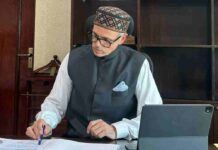
JAMMU: Jammu and Kashmir Pradesh Congress Committee (PCC) president Tariq Hameed Karra delivered a passionate speech on the proposed budget for the financial year 2025-26, calling for the restoration of statehood and a comprehensive economic roadmap to uplift the region. Addressing the legislative assembly, he underscored the historical significance of the newly elected House, terming it an “extraordinary institution working in extraordinary times.”

Karra described the assembly as a citadel of aspirations for the people of Jammu and Kashmir, particularly after the Supreme Court’s intervention that facilitated the democratic process following the abrogation of Article 370 in August 2019. He cautioned that failure to meet public expectations, especially those of the youth, could erode faith in democracy. He urged members to transcend political affiliations and work collectively towards stability and progress.
Calling the restoration of statehood a right rather than a privilege, Karra reminded the government of its commitment made on the floor of Parliament. He highlighted the economic progress in the region, noting that Jammu and Kashmir’s Gross State Domestic Product (GSDP) had grown from Rs 1.64 lakh crore in 2020-21 to Rs 2.45 lakh crore in 2024-25. He welcomed the focus on economic growth, social welfare, and sustainability, while urging the government to adopt global best practices in tourism, agriculture, and digital infrastructure to maximize economic potential.
Karra pointed out several budgetary allocations and areas requiring urgent attention. He noted that despite the government’s emphasis on economic growth, sectors such as education, health, and agriculture remained underfunded. He criticised the high budgetary allocation to security forces, which stood at 30 per cent in 2021-22, compared to 6 per cent for health and 4 per cent for education. He warned that the post-2019 economic policies had failed to bring the promised prosperity, citing rising costs for apple growers, increased non-local ownership in the mining sector, and financial struggles faced by Jammu and Kashmir Bank.
The PCC chief also questioned the operations of the National Hydroelectric Power Corporation (NHPC), alleging that it had extracted significant revenue from Jammu and Kashmir while failing to provide adequate benefits to local stakeholders. He claimed that NHPC had siphoned off at least Rs 300 crore from the state in consultancy charges alone.
Karra expressed concern over the plight of daily wage earners, contractual employees, and healthcare workers, stating that they had pinned high hopes on the budget, only to be left disappointed. He urged the government to reconsider its policies on excise duties, age limits for government jobs, and employment generation.
Referring to the Kashmiri Pandit community and the refugees of 1947, 1965, and 1971, Karra called for concrete rehabilitation policies rather than superficial measures. He stated that true rehabilitation should address security, economic stability, and political rights, rather than being reduced to mere electoral rhetoric. He also demanded immediate implementation of the one-time Rs 30 lakh settlement for displaced refugees.
The Congress leader urged the government to ensure that tourism development in Jammu and Kashmir adheres to environmental sustainability. He proposed that Dal Lake and the Mata Vaishno Devi shrine be recognised as UNESCO World Heritage Sites. Karra also spoke about recent religious sensitivities, condemning the arrest of three women for distributing copies of the Quran and calling for introspection on such actions.
Concluding his speech, Karra stressed the need for action beyond rhetoric, urging lawmakers to restore hope and dignity to Jammu and Kashmir. He reminded them that the people of the region were watching closely and that it was their collective responsibility to ensure justice, economic progress, and social stability.
“The path ahead is ours to shape. Let us rise above rhetoric and commit to action—action that restores hope, dignity, and prosperity to Jammu and Kashmir,” he said.