SRINAGAR: The Islamic Civilisation Centre opened to the public on Monday in Tashkent, marking one of the most significant cultural developments in contemporary Uzbekistan.
Conceived under an initiative first announced in 2017 by President Shavkat Mirziyoyev, the Centre has been positioned by authorities as both a museum and a national institution aimed at preserving and presenting the country’s intellectual and spiritual heritage. Officials describe it as a bridge between the region’s historical “Golden Age” and what is termed “New Uzbekistan,” linking past scholarship with modern state-building.
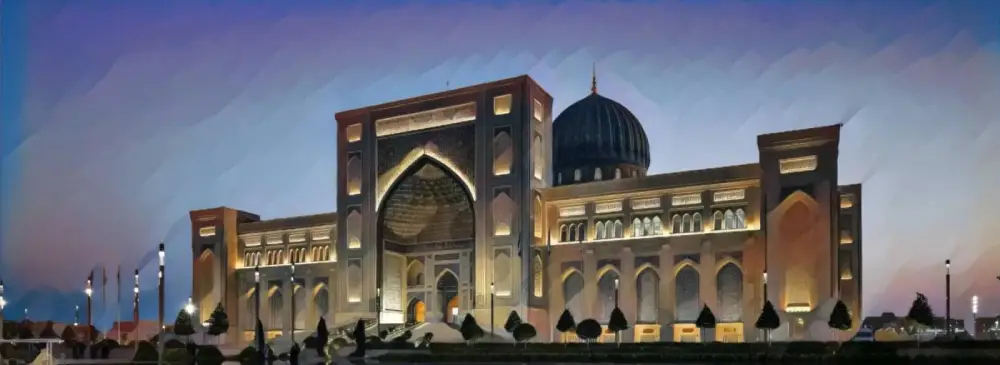
Located in the historic Hast-Imam complex in the Almazar district, the structure features a 65-meter dome and four monumental portals, symbolising national unity. The site has been designed as both an architectural landmark and a cultural space intended to guide visitors through the evolution of faith, science, and governance in Central Asia.
The Centre integrates multiple functions beyond exhibition display, including a research library, restoration and digitisation laboratories, archival storage, and academic departments. This hybrid model reflects an effort to position the institution as an active centre of scholarship rather than a conventional museum. Its conceptual framework draws inspiration from historic institutions such as the House of Wisdom and the Ma’mun Academy, as well as the legacy of Ulugh Beg.
At the core of the complex is the Qur’an Hall, which houses the 7th-century Mushaf of Uthman, a manuscript recognised under UNESCO’s Memory of the World Register. The hall also displays 114 Qur’ans representing the evolution of Islamic calligraphy and is designed as a space for both exhibition and continuous recitation.
The broader exhibition program traces regional history from pre-Islamic periods through successive renaissances to the present day. Displays combine original artefacts with replicas, digital reconstructions, and interactive tools. One of the key sections, the Hall of Honour, features 14 thematic arches illustrating major historical developments and includes digital interfaces presenting more than 100 scholars and thinkers.
According to official figures, nearly 2,000 manuscripts and artefacts have been repatriated through international cooperation, while over 1,500 specialists from Uzbekistan and abroad contributed to the project. Approximately 100 academic contracts were also signed to support the development of exhibition content.
The project has involved international collaboration, including partnerships with Italy-based Magister Art and French architectural firm Wilmotte and Associés, aimed at aligning the Centre with global museum standards. Plans for international forums and scholarly exchanges have also been linked to the opening.
Officials state that the Centre is intended to serve as a platform for research, education, and intercultural dialogue. In December 2025, it signed a memorandum of understanding with the United Nations Alliance of Civilisations, reinforcing its international orientation.
With its opening, the Islamic Civilisation Centre is expected to become a key cultural institution in Central Asia, positioning Tashkent as a renewed hub for historical scholarship and global cultural engagement.