by Maleeha Sofi
SRINAGAR: In 1965, in the crowded lanes of Amman, Jordan, a young boy named Omar Mwannes Yaghi was born into a Palestinian refugee family that had been uprooted from the depopulated village of Al-Masmiyya, once nestled in the Gaza Subdistrict. His family, like thousands of others displaced during the 1948 Arab–Israeli war, lived in stark poverty. Their single-room home doubled as a shelter for livestock, with no electricity and scarce access to clean water. Yet from that modest beginning would rise one of the most celebrated chemists of the 21st century.
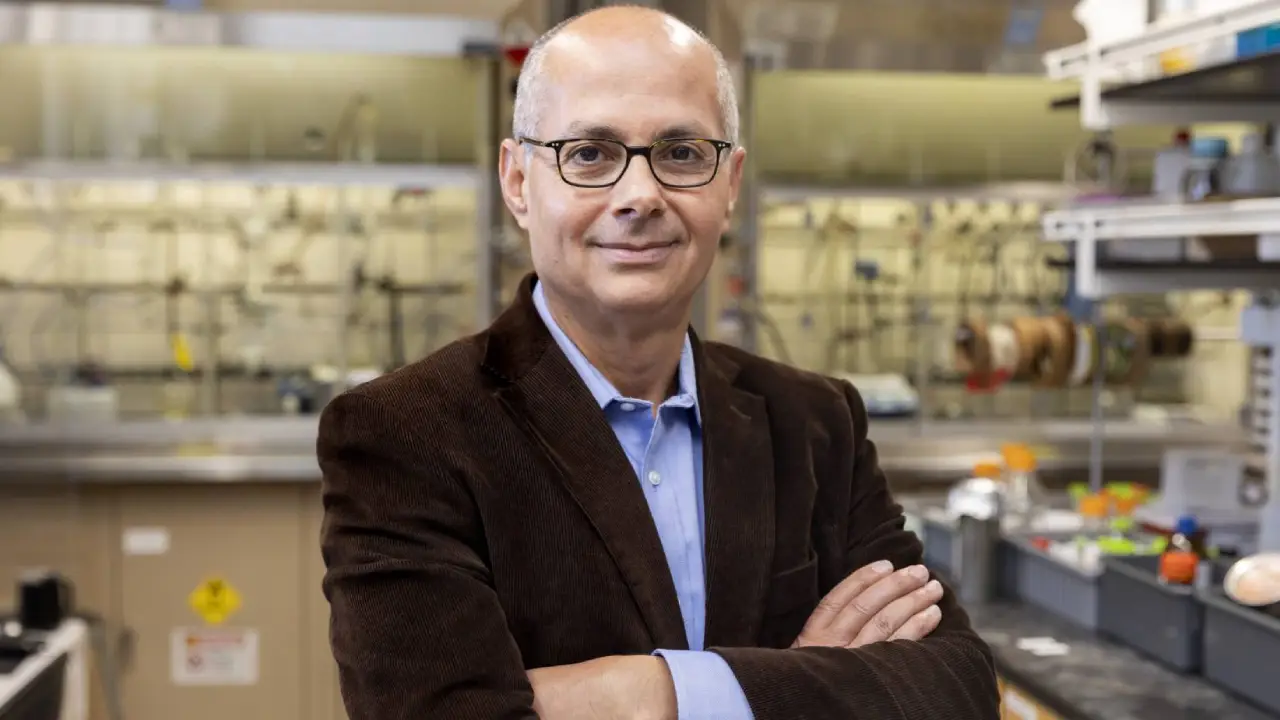
On October 2, 2025, the Royal Swedish Academy of Sciences awarded the Nobel Prize in Chemistry to Omar M. Yaghi, now a professor at the University of California, Berkeley. He shared the honour with Susumu Kitagawa of Kyoto University and Richard Robson of the University of Melbourne for their pioneering work on metal–organic frameworks (MOFs)—molecular architectures with vast internal spaces that allow gases and chemicals to pass through them.
The Academy described these porous crystals as “rooms for chemistry,” materials capable of capturing carbon dioxide, storing hydrogen, and even harvesting water from desert air. The discovery, they said, had “revolutionised materials science” and could play a decisive role in addressing humanity’s greatest environmental challenges.
For Yaghi, the Nobel recognition was more than a professional milestone; it was the culmination of a journey that began in exile and hardship. His parents, refugees from Al-Masmiyya, were among those who had lost everything when their village was depopulated in 1948. The family’s resilience and insistence on education shaped the young boy’s destiny. His father encouraged him to pursue science and dream beyond the confines of displacement.
At 15, Yaghi left for the United States, speaking barely any English. He enrolled at Hudson Valley Community College, later transferring to the State University of New York at Albany, where he completed his undergraduate degree in chemistry. Working menial jobs to sustain himself, he persevered, eventually earning a PhD in chemistry from the University of Illinois at Urbana–Champaign in 1990, under the mentorship of Walter G Klemperer.
He went on to postdoctoral research at Harvard University and began his teaching career at Arizona State University. From there, his academic path took him through the University of Michigan and UCLA, before finding a lasting home at UC Berkeley, where he holds the James and Neeltje Tretter Chair in Chemistry.
It was in Berkeley that Yaghi built a global reputation as the founder of reticular chemistry, a new field dedicated to “stitching molecular building blocks into extended crystalline frameworks.” His work led to the creation of MOFs, COFs (covalent organic frameworks), and ZIFs (zeolitic imidazolate frameworks), materials now hailed for their ability to capture carbon, generate clean fuels, and even extract drinking water from dry air.
The magnitude of his research is reflected in numbers: over 300 scientific papers, more than 250,000 citations, and an h-index of 190, figures that place him among the world’s most influential scientists.
But Yaghi’s contributions extend beyond the laboratory. As founding director of the Berkeley Global Science Institute, he has worked to establish research centres in developing countries, offering opportunities to young scientists from regions like Vietnam, Jordan, and Saudi Arabia. His aim, he often says, is to “democratise science”—to make discovery accessible to those who, like him, began with little more than curiosity and determination.
In 2021, he was granted Saudi citizenship by royal decree, recognising his global contributions to science. He has since co-founded startups such as Atoco and H2MOF, which aim to commercialise MOF and COF technologies for carbon capture and water harvesting.
Yaghi’s journey is not just the story of an individual triumph but a broader testament to perseverance and identity. From a village erased from the map, he rose to build molecular frameworks that could help sustain the planet itself. His story carries symbolic weight for millions of Palestinians whose histories are marked by loss and exile, yet whose resilience continues to inspire.
Speaking after the Nobel announcement, Yaghi said, “I was in love with chemistry from the very beginning. I disliked class, but I loved the lab.” It was a simple confession that echoed a lifelong devotion to discovery.
The Nobel Committee’s chair, Professor Heiner Linke, likened the laureates’ molecular creations to “rooms in a hotel” or “Hermione’s handbag”, small yet vast, ordinary yet wondrous. In those crystalline “rooms,” gases can be stored, toxins can be filtered, and water can be drawn from the driest air.
As the scientific community celebrated his achievement, tributes also poured in from across the Arab world. The World Cultural Council, where Yaghi serves as president, called his win “a victory for curiosity, perseverance, and the human spirit.”
For chemistry, the award marks a turning point in how scientists imagine materials. For Omar Yaghi, it is a deeply personal vindication, a life’s work that began in a refugee family from Al-Masmiyya, shaped by displacement but driven by the enduring belief that knowledge can build what war and loss once destroyed.
In the words of one of his former students: “He came from a place that no longer exists. Yet he built worlds that never existed before.”