SRINAGAR: The United States launched a third consecutive night of military strikes against Iran early Tuesday (local time Monday), targeting Iranian military infrastructure as tensions intensified over the Strait of Hormuz and the security of commercial shipping through the strategic waterway.
The US Central Command (CENTCOM) said the latest operation began at 4:45 p.m. ET on Monday on the direction of President Donald Trump.
“These strikes will continue imposing a heavy cost on Iranian forces and degrade their ability to attack innocent civilians and commercial shipping in the Strait of Hormuz,” CENTCOM said in a statement posted on X.
According to a US official cited by CNN, the strikes targeted Iranian military assets, including coastal surveillance systems, drone capabilities and missile infrastructure.
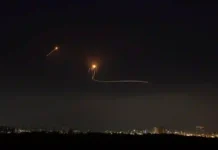
Iranian state media reported multiple explosions across southern Iran following the strikes. The state-run Islamic Republic News Agency (IRNA) said three explosions were heard in the port city of Bandar Abbas, while the Hormozgan provincial government said a projectile struck the western part of the city. No casualties were immediately reported.
The semi-official Fars News Agency also reported explosions on the islands of Kish, Qeshm and Abu Musa, as well as in Jam and Kangan in Bushehr province.
The latest strikes come amid an escalating confrontation between Washington and Tehran over the Strait of Hormuz, through which around one-fifth of global oil and gas supplies normally pass.
Shortly before the strikes, President Trump announced plans to reinstate a blockade on Iranian shipping and impose a 20 per cent charge on cargo transiting the Strait of Hormuz.
“The Hormuz Strait is OPEN, and will remain OPEN, with or without Iran. We are reinstating THE IRANIAN BLOCKADE,” Trump said on Truth Social, according to Reuters.
He said the United States would collect the fee “as a matter of fairness” for providing security in the region and warned of further military action against Iran.
“We’re going to hit them very hard tonight, and we’re going to hit them hard tomorrow,” Trump said in an interview with conservative radio host Hugh Hewitt, according to Reuters.
Speaking separately to reporters, Trump said the US was targeting Iran’s offensive capabilities and would continue military operations.
Iran rejected the US position, insisting it retained the authority to regulate traffic through the Strait of Hormuz. Iranian Foreign Minister Abbas Araghchi, in a post on X, described Iran as the “guardian” of the strategic waterway and criticised the proposed transit charge.
Meanwhile, the US Navy-led Joint Maritime Information Centre (JMIC) announced that a maritime blockade of Iranian ports, oil terminals and coastal areas would take effect from Tuesday. The measure applies to vessels entering or leaving Iranian ports, while neutral transit to and from non-Iranian destinations will remain unaffected.
The International Maritime Organisation (IMO) has opposed mandatory transit charges in international waterways, stating that there is no legal basis for imposing such tolls.
The renewed military escalation has heightened concerns over regional stability, with global markets and shipping operators closely monitoring developments. Oil prices rose more than 9 per cent on Monday, with Brent crude settling at its highest level since June 12 amid fears of prolonged disruption to energy supplies.