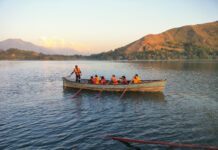
SRINAGAR: The Jammu Kashmir government has said that nearly 4.5 square kilometres of critically silted area in the Wular Lake and its feeding channels have been restored through dredging and de-siltation works. A comprehensive bathymetric and hydrodynamic study by the National Institute of Hydrology (NIH), Roorkee, is currently under way to assess the lake’s current water-carrying capacity and the extent of silt deposition.
Responding to a question by MLA Irshad Rasool Kar, the Jal Shakti Department said that approximately 63.93 lakh cubic metres of silt—about 6.393 million cubic metres—had been dredged from the main lake area at SK Payeen, leading to the restoration of around 3.10 sq km of the lake body. Together with de-siltation in catchment channels, the total dredged volume stands at about 78.25 lakh cubic metres, significantly improving hydraulic connectivity and overall water flow in the region.
The government also informed that the Irrigation and Flood Control (IFC) Department carried out dredging in the Sopore–Baramulla OFC channel over the last two years, removing around 2.85 lakh cubic metres of silt through mechanical dredgers.
For embankment strengthening, Rs 1.80 crore has been earmarked for works at Zalwan, Makhdoomyari, and Shahgung along the Wular Lake during the current financial year. In addition, a guide wall is being constructed at Sher Colony and Maharajpora in Sopore under the Flood Management and Border Area Programme (FMBAP) at an estimated cost of Rs 4.55 crore. Nearly 95 per cent of the work has been completed, the reply stated.
Regarding flood management, the government said that the present carrying capacity of the Jhelum Flood Spill Channel at the inlet is estimated at 8,700 to 10,000 cusecs before overtopping. During the September 2025 floods, the discharge recorded at Padshahi Bagh was 6,900 cusecs, leaving adequate freeboard.
The Jal Shakti Department said that several flood mitigation works had been executed under Phase I of the Flood Management Programme (FMP), including re-sectioning from Naidkhai downstream to Gulabwari and beyond. River training works worth Rs 1.64 crore have also been carried out under the CAPEX budget at Wazipora Naidkhai and upstream of Sultanpora Bridge.
While noting that complete flood immunity is not technically possible, the government said that it continues to reduce risks through both structural and non-structural measures, including early warning systems and floodplain zoning.