by Babra Wani
Grief is not a visitor but a tenant. It does not knock; it builds its home inside me. It moves through my body like blood. Mourning, heartache, the slow throb of memory they are not afflictions, but a lineage I carry.
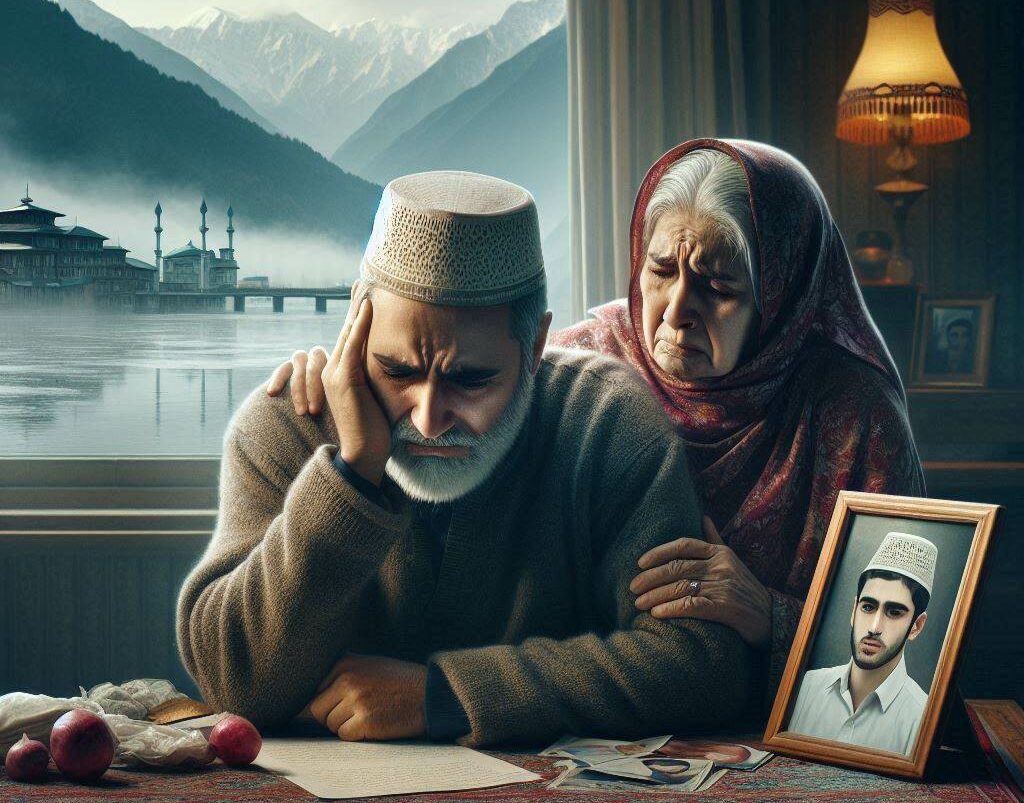
I remember meeting death when I was six. The cries came first, women wailing, their voices riven by grief. Then the silences arrived, thick and unmoving, broken only by the faint rustle of bodies shifting. The men said nothing. They only shook their heads as if language had failed them.
They said they would bathe him, my beloved mamu, my uncle Bilal. And then they brought him back. But something had changed. They laid him beside my grandmother and asked me to call his name.
“Call him,” they said. “Maybe he will wake up.”
I called. He did not answer.
Confused, I turned to my cousin. “Bilal mamu kyun nahi uth rahe?”
With a child’s soft precision, he said, “Kyunki woh mar gaye hain.”
I did not know what “marna” meant. I did not know what death was. Not then. Perhaps I still do not, even now.
At six, I was ‘untouched’ by the weight of such things. (Or, so, I thought.) Innocent. Unaware of what ends meant. Someone asked gently, “Maamas traavikhe kabri meatch? Will you put soil in your uncle’s grave?”
I did not understand.
I saw my older cousins walking ahead with the crowd, the gathering that carried my uncle in a wooden box they called a taboot. They said it was his janaza . These words were strange, unfamiliar, barely mine. I had only known six years of language, six years of the world when he left it.
I followed, my small feet trailing behind a sorrow too vast for sense.
In the graveyard, they laid down the box. Prayers began. I watched from a distance, too far to touch and too close to forget. They lowered him into the dug earth, and someone called my name. I stepped forward. I was asked to place soil over him.
I did.
That was the last time I saw his face, shrouded in white, a cloth I later learned was called kaffan. From lying under the red tiger-printed blanket in my grandfather’s room to being wrapped in white and placed beneath the soil, that was the final image I would carry of him.
Presence, Absence
That was 2003. I had known him for only six years. His love lived in chocolates, in the way he swung us onto his shoulders, in old movies played on his VCR. For years afterwards, I did not understand where he had gone or why he could not return. I asked my older cousins. I asked my mother. But with each unanswered question, his presence receded. Memory thinned. Time, unkind, began to steal his outline.
It has been over two decades now. As I write this, I can no longer recall the exact lines of his face. But I try to remember him, not as absence, but as he was.
He was young. Bold. Beautiful. A handsome, decisive man. His hair was long, his fringe touched the edges of thick, expressive brows. His eyes always seemed to be smiling. He was tall, lean, elegant in whatever he wore. He was the youngest of six siblings, his mother’s heart. He could do everything, cook, clean, manage the home. When my grandmother fell ill, it was he who held everything together. He was the beloved of all.
He was the kind of man who left a silence behind, a silence large enough for a six-year-old to walk through and still not find the end.
Meeting Death Again
His death was new to me. I was young, a small child, untouched by the idea of finality, until 2014 when my nanu passed away. One morning, as Kashmir strained under the weight of snow, its streets frozen stiff and silent, we sat in the kitchen sipping noon chai. The phone rang. My amijani was calling: my mother must come quickly to Batkoot. “Daddy is not well.”
That was the moment it was decided. We were going to Pahalgam, my nanihaal. It was Friday, 14 March. He was still breathing when we arrived. Draped under a black blanket, he lay with his eyes open, waiting. The family crowded the room. My parents sat beside him. My mother placed her hand on his head. Outside, the mosque loudspeakers spilt prayer into the mountains, darood, Qur’an, supplication rising and falling like the wind over snowdrifts.
A distant relative entered. He began reciting Surah Yasin. Slowly, steadily, Daddy closed his eyes. A tear slid from the corner of his left one. And that was how I met death for the second time. The room split open with wails. Cries tore through the cold air. My boba looked at her companion of decades and asked, watheakh naa? Was this it?
It was. He had gone, quietly, leaving behind memories and a legacy both vast and tender. He had been a reader, a scholar, a critic, a teacher, the patriarch of our maternal family. He led us. He lifted us. I have known no man more steadfast in his support for women. He believed in our strength and our right to move forward.
This time, I understood. I felt something pressing against my chest. A constriction. Later, I would name it, grief. It was heavy. It pierced and pulled. It quieted every other feeling. For the first time in my life, I was unable to move through pain. It settled in me. It stayed.
He had long since gone when the truth of it struck. He was not coming back. I remember the mourners, the multitude. Their weeping. Their voices full of praise. Then I saw myself in a mirror, hair tangled, face unwashed for five days, wearing a green pheran. And I understood: I was grieving. That was the feeling I had not known when my mamu died. Now I did.
Grief, Named
Grief is not singular. It overwhelms, smothers, chokes. It confuses. It drowns you in its depth, then presses you to the surface just long enough to gasp. It gnaws, pricks, burns. It leaves your insides hollow. Your stomach clenched. Your throat is dry. It steals your appetite and your rest. And somehow, it belongs to you.
I remember the exact shape of it, the temperature it carried. Grief feels strange. Strangely familiar. Strangely other. Strangely yours. It came for me. It came for the rest of the family, each person cradling their own version of sorrow, as if mourning had infinite rooms, and we entered separate ones.
I processed mine by forgetting. I forgot small things, then large ones. Then I forgot myself. That forgetting, brief, merciful, felt like freedom. But I could never truly let go. I still cannot. I carry people, alive, departed, inside me. I cannot abandon them. I hold on.
People are precious. That is the lesson grief teaches most clearly. Grieving is remembering. It is the recollection of little things, gestures, glances, habits, that shape longing. That become the memory itself.
There are regrets. Small, sharp things. Words unsaid. Sorry. Thank you. I love you. I did not say them. I waited. And then they were gone, and I was left speechless, struck dumb by the silence that follows loss.
The Third Time I Met Death
It was July. The air held the weight of heat and memory. That month, death returned, quiet, deliberate, wearing the soft fur of my beloved cat, Kimba, a grey, stray tabby. His departure, unlike the others, altered something elemental in me. A creature of warmth and wild tenderness, Kimba passed not from age nor sudden illness, but from absence. From separation.
He had Baa. A partner. An older cat without a nose. They were never apart. When Baa disappeared, without warning, without trace, Kimba ceased eating. The stubbornness with which he once forced himself indoors vanished. He no longer resisted the world. Instead, he yielded to it.
Then came the day he returned home, his breath loud and laboured. His body, once plush with life, now gaunt and thin, curled near my mother’s feet. He panted, breath after breath, frantic yet determined. We watched the tide of life recede. We knew.
That night, he sought the washroom, the very corner where he had first slept, back in 2023 when he chose us. It was there he died, moments before Fajr. His body was found by my younger sister. Cold. Still. We screamed. We wailed. We clutched at our hair in grief. And only then did we understand the ancestral gestures of mourning, the raw despair of the body speaking where language failed.
My father buried him. The chicken he had bought, Kimba’s favourite, was cooked with saffron rice and shared in his name. Tehri for the ease of the dead. For days, our home echoed with grief. My mother sobbed. My father wept. My sister wept. I wept. And in those tears, the truth became clear, death is certain. And grief, its shadow.
About Love
Kimba’s death taught me what no sermon, no scripture, and no survival could. He had loved Baa deeply, wordlessly, as animals do. He let Baa sleep against his body, fed him first, watched over him with the solemnity of one who knew time was a thinning thread. When Baa vanished, Kimba began to vanish too. He stopped eating, stopped entering the house, abandoned the warmth he had once insisted on.
I had met death before in my grandfather’s quiet departure, in my uncle’s sudden absence but this was different. Kimba’s grief killed him. He died not from disease, not from age, but from love.
How Does One Let Go?
These deaths, layered like old paint over my soul, have thinned me. Each one peeled something away. Yet they taught me nothing of release. I do not know how to let go. Perhaps I never will.
Grief is not a visitor but a tenant. It does not knock; it builds its home inside me. It moves through my body like blood. Mourning, heartache, the slow throb of memory they are not afflictions, but a lineage I carry.
So I cling. I grip the living too tightly. I memorise voices, trace gestures, catalogue silences. Because I know the truth, unbearable in its inevitability. Death will come again. It will take again. And there will be no negotiations.
As someone once wrote, “Each day is a battle to keep your heart alive, every time you bury the beloved.”
(Babra Wani holds a postgraduate degree in Journalism and Mass Communication from the University of Kashmir. She reports across multiple beats with a focus on in-depth, society-centric stories and has a strong interest in the Urdu language, which she actively reads and writes. Ideas are personal.)
Edited by Muhammad Nadeem