SRINAGAR: More than 200 people have been killed across Iran following joint US-Israeli strikes, according to Iranian state television, citing the Red Crescent, as a rapidly escalating conflict triggered retaliatory missile and drone attacks across Israel and several Gulf states hosting American military bases.

According to Associated Press (AP), Iranian state media reported that “at least 201 people had been killed and more than 700 injured” by Saturday evening as exchanges of fire continued into the night. The strikes followed what US President Donald Trump described as a “massive operation” aimed at destroying Iran’s military capabilities and eliminating the threat of it developing a nuclear weapon.
In an eight-minute video statement, Trump called the action “major combat operations” and urged Iranians to “take over your government” once the bombing ends. “When we are finished, take over your government. It will be yours to take. This will be probably your only chance for generations,” he said, according to AP and Reuters.
The Pentagon named the operation “OPERATION EPIC FURY,” Reuters reported, adding that the first wave of strikes primarily targeted senior Iranian officials and military leadership.
Reuters reported that Iran’s Defence Minister Amir Nasirzadeh and Revolutionary Guards commander Mohammed Pakpour were killed in Israeli strikes, citing three sources familiar with the matter. An Israeli official told Reuters that Supreme Leader Ali Khamenei and Iranian President Masoud Pezeshkian were also targeted, though their status remained unclear.
Iranian Foreign Minister Abbas Araghchi told NBC News that both leaders were alive “as far as I know,” AP reported.
Israel confirmed it had launched the attack after explosions were heard in Tehran. Prime Minister Benjamin Netanyahu said in a video message that Israel was striking military installations and targets connected to what he called the “oppressive regime.” “The objective of the operation is to put an end to the threat from the Ayatollah regime in Iran,” Netanyahu said, adding that it would continue “as long as necessary,” according to AP.
AP reported that more than 80 people were killed and dozens wounded at a girls’ school in southern Iran, according to a local governor speaking to Iranian state TV. Reuters separately reported that a girls’ primary school in Minab was hit, killing 85 people, citing a local prosecutor. Reuters said it could not independently confirm the report, and Israel’s military did not immediately respond to requests for comment.
In northern Israel, an Iranian missile struck a building in Bnei Brak near Tel Aviv, wounding several people, Anadolu Agency reported, citing Israeli media outlets Yedioth Ahronoth and Channel 12.
Lt Col Nadav Shoshani said there had been no significant hits in Israel, while rescue services reported no serious injuries from missile barrages, according to AP.
Iran’s Revolutionary Guards announced that “all occupied territories and the criminal US bases in the region have been struck by the powerful blows of Iranian missiles,” according to Arab News. The Guards warned that operations would continue “until the enemy is decisively defeated.”
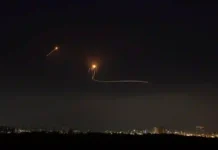
Missile and drone attacks were reported in Bahrain, Kuwait, Qatar, the United Arab Emirates and Jordan. Bahrain confirmed a missile strike near the US Navy’s Fifth Fleet headquarters. Video footage cited by Arab News and Reuters showed grey smoke rising near the island nation’s coastline.
The United Arab Emirates reported that one person of Asian nationality was killed in Abu Dhabi after shrapnel fell in a residential area, state news agency WAM said, as cited by Arab News. Loud explosions were heard across Abu Dhabi and Dubai. UAE air defences intercepted multiple missiles, authorities said.
Kuwait confirmed a drone strike at Kuwait International Airport that caused minor injuries and limited material damage, Arab News reported. Qatar said it intercepted incoming missiles before they reached its territory.
Saudi Arabia said it had repelled Iranian missile attacks targeting Riyadh and the Eastern Province, describing them as “unjustifiable under any circumstances,” according to Anadolu Agency.
Jordan’s armed forces said they intercepted 13 ballistic missiles and 49 drones targeting its territory, resulting in material damage but no casualties.
Reuters reported that Iran warned shipping that the Strait of Hormuz, through which around one-fifth of global oil consumption passes, had been closed. Oil markets were expected to surge, with Rystad Energy’s Jorge Leon predicting a possible $10–20 per barrel jump if de-escalation does not occur.
Airspace closures spread across the region. AP reported that Israel, the UAE, Qatar, Iran, Iraq, Kuwait, Bahrain and Oman suspended flights. Airlines, including Virgin Atlantic, Turkish Airlines and KLM, cancelled or rerouted services.
The UN Security Council scheduled an emergency meeting at the request of Bahrain and France, AP reported. UN Secretary-General António Guterres called for an immediate cessation of hostilities.
European leaders, including British Prime Minister Keir Starmer, French President Emmanuel Macron and German Chancellor Friedrich Merz called for renewed negotiations. “We call for a resumption of negotiations and urge the Iranian leadership to seek a negotiated solution,” they said in a joint statement cited by AP.
Macron later said France was “neither warned nor involved” and cautioned that Iran’s nuclear and ballistic issues “will not be settled by strikes alone.”
Russia’s Foreign Ministry described the attacks as “a pre-planned and unprovoked act of armed aggression against a sovereign and independent UN member state,” AP reported. China said it was “highly concerned” and called for an immediate halt to military action.
Turkish President Recep Tayyip Erdogan said Türkiye felt “deep sorrow” over the US-Israeli attacks and warned that unless diplomacy prevails, “our region faces the risk of being dragged into a ring of fire,” Anadolu Agency reported.
Australia and Canada expressed support for the US action. Canadian Prime Minister Mark Carney said Iran was “the principal source of instability and terror throughout the Middle East,” AP reported.
Reuters reported scenes of panic in Iranian cities as residents rushed to collect children from schools. “We are scared, we are terrified. My children are shaking, we have nowhere to go,” a resident in Tabriz told Reuters by phone.
In the occupied West Bank, AP reported that Palestinians continued daily activities despite missile interceptions overhead, though gas stations saw longer lines amid fears of supply disruptions.
With missile exchanges continuing and diplomatic channels strained after failed nuclear talks in Geneva under Oman’s mediation, leaders across the region warned of the risk of a broader war.
As Trump framed the offensive as a decisive move to eliminate what he called “imminent threats from the Iranian regime,” Tehran vowed a stronger response. A senior Revolutionary Guards commander told Reuters that Iran had so far used only “scrap missiles” and would soon unveil unforeseen weapons.
Whether the confrontation remains contained or expands into a protracted regional conflict remains uncertain, as global markets, governments and civilians brace for further escalation.