SRINAGAR: Astronauts aboard NASA’s Artemis II mission are now en route around the Moon after a landmark launch carried humans beyond Earth’s orbit for the first time in more than five decades, marking a decisive return to deep-space exploration since the Apollo 17 mission.

The mission lifted off from Kennedy Space Centre in Florida aboard the Space Launch System, sending four astronauts, Reid Wiseman, Victor Glover, Christina Koch and Canadian astronaut Jeremy Hansen, into space inside the Orion spacecraft. Now several days into the 10-day mission, the crew is on a looping trajectory that will take them around the Moon and back to Earth, travelling farther than any humans in a generation.
“Today’s launch marks a defining moment,” NASA Administrator Jared Isaacman said, describing the mission as the beginning of a long-term return to the Moon aimed not just at exploration but at establishing a sustained human presence.
After reaching orbit, Orion deployed its solar arrays and underwent a series of propulsion burns to place it on course for the Moon. Mission controllers then executed the critical translunar injection, sending the spacecraft toward a lunar flyby that will use the Moon’s gravity to propel the crew back to Earth, in a trajectory comparable to the Apollo 13 mission.
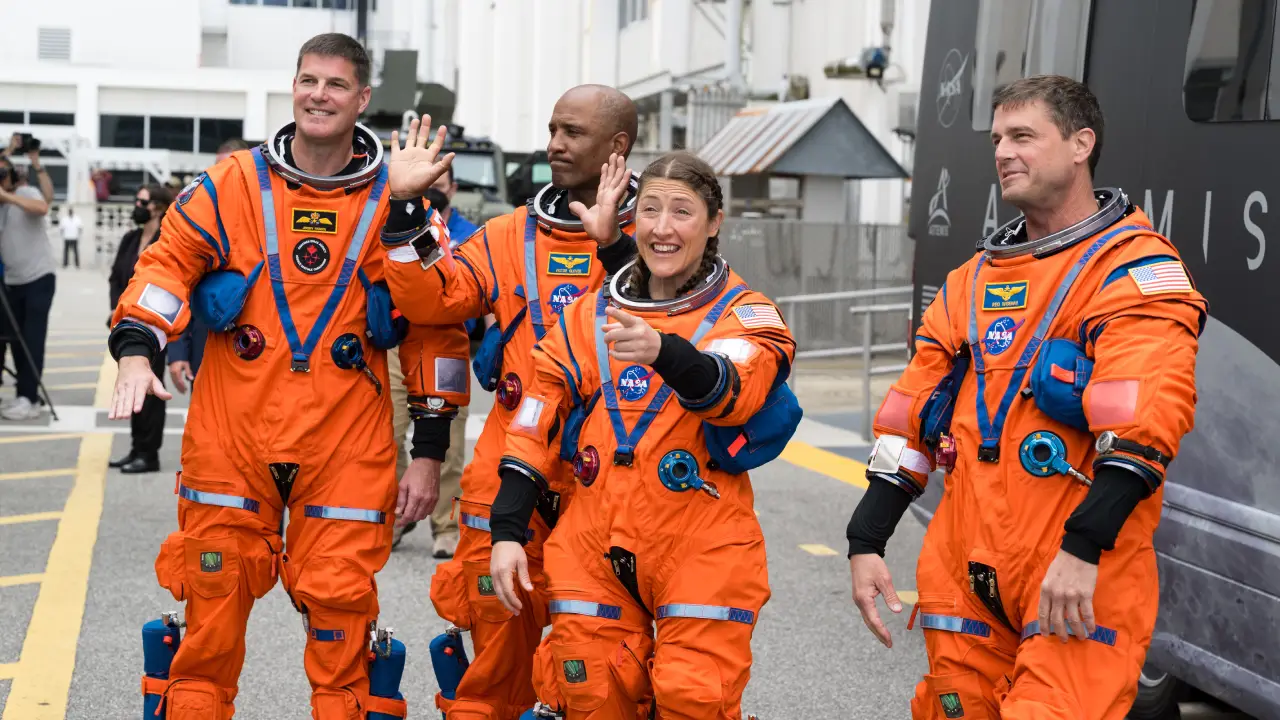
Image: NASA/Aubrey Gemignani
The 10-day mission is designed primarily as a test of systems that will be essential for future lunar landings, including life support, navigation and re-entry capabilities. Speaking to The Conversation Weekly, space policy expert Scott Pace said the mission reflects decades of technological evolution following the end of the space shuttle era, particularly after the Space Shuttle Columbia disaster forced a reassessment of crew safety. He noted that one of the most critical checkpoints comes before committing to the journey to the Moon, when engineers must verify that Orion’s environmental control and life support systems can sustain astronauts beyond Earth orbit. “Once you make the commitment to head for the Moon, that life support system is going to be essential,” Pace said.
While early mission operations have proceeded largely as planned, including system checks and manual piloting tests by the crew, the flight has also highlighted the practical challenges of human spaceflight. According to BBC reporting, the Orion capsule has experienced intermittent issues with its waste management system, including a clogged vent line that temporarily affected the onboard toilet. Engineers have been working to resolve the issue by orienting the spacecraft toward the Sun to thaw potential ice buildup, while astronauts have used backup systems when needed.
NASA said the system remains operational, though engineers continue to monitor it closely. The issue underscores the confined and complex conditions aboard Orion, where four astronauts are sharing a cabin roughly the size of a camper van as they travel deep into space.
Despite such challenges, Artemis II represents a major milestone in NASA’s Artemis programme, which aims to return humans to the Moon’s surface later this decade and eventually support missions to Mars. The flight will also allow astronauts to observe and photograph the Moon’s far side, contributing to scientific understanding ahead of future landings.
The mission also carries broader strategic significance, coming amid growing competition with China, which is planning its own crewed lunar missions. Pace noted that the current phase is less about a short-term “race” and more about establishing a long-term presence. Sustained activity on the Moon, he suggested, will shape future rules and norms in space.
As Artemis II continues its journey around the Moon ahead of a planned splashdown in the Pacific Ocean, it marks both a technological test and a symbolic turning point — reopening deep space to human exploration while laying the groundwork for a permanent human foothold beyond Earth.