SRINAGAR: Four astronauts have completed a nearly 10-day deep space mission, travel farther than any humans in history, and deliver critical data for humanity’s return to the Moon.
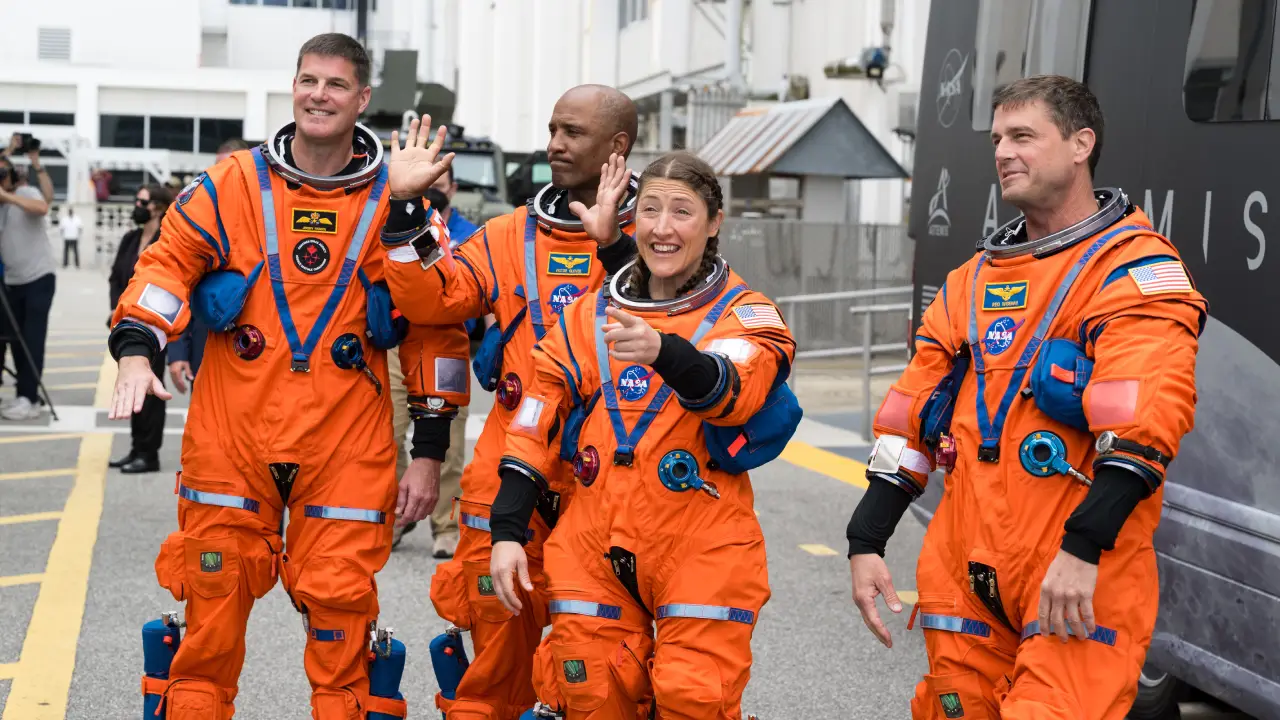
Image: NASA/Aubrey Gemignani
The first human mission to the Moon in more than fifty years has concluded successfully, as four astronauts aboard Artemis II returned safely to Earth following a landmark journey that redefines the trajectory of deep space exploration. The crew, NASA astronauts Reid Wiseman, Victor Glover, Christina Koch, and Canadian Space Agency astronaut Jeremy Hansen, splashed down in the Pacific Ocean off the coast of San Diego at 5:07 p.m. PDT on Friday, bringing to a close a nearly 10-day mission that pushed human spaceflight farther than ever before.
Following splashdown, recovery teams from NASA and the U.S. military secured the Orion spacecraft in open waters and assisted the astronauts out before transporting them by helicopter to the USS John P. Murtha. Initial medical evaluations were conducted aboard the vessel, with the crew expected to return to the Johnson Space Centre for further post-flight assessments. The safe return marked a critical milestone in NASA’s Artemis program, restoring human capability for deep space travel beyond low Earth orbit for the first time in decades.
During the mission, the astronauts travelled a total of 694,481 miles, reaching a maximum distance of 252,756 miles from Earth, surpassing the long-standing record set by the Apollo 13 crew in 1970. At one stage, the spacecraft crossed 248,655 miles from Earth, officially establishing the farthest distance ever reached by humans. The mission’s trajectory included a close lunar flyby that brought the crew within approximately 4,067 miles of the Moon’s surface, allowing them to directly observe parts of the lunar far side that have remained unseen by human eyes.
The mission began on April 1 with a launch aboard NASA’s Space Launch System from Launch Complex 39B at the Kennedy Space Centre. Generating 8.8 million pounds of thrust, the rocket carried the Orion spacecraft into orbit before placing it on a precise trans-lunar trajectory following a series of engine burns. Once in space, the crew conducted extensive system checks, confirming the health of the spacecraft before committing to the journey toward the Moon.
Engineers and astronauts used the mission to carry out a full in-flight evaluation of Orion’s systems. Life support capabilities were tested to confirm the spacecraft’s ability to sustain humans in deep space, while manual piloting demonstrations allowed crew members to validate handling characteristics and gather data essential for future docking operations. These tests are expected to inform mission architecture for subsequent lunar landing missions.
A defining feature of the mission was the unprecedented volume of scientific data collected. During a seven-hour lunar flyby on April 6, the astronauts captured more than 7,000 high-resolution images of the Moon and surrounding space environment. The imagery revealed detailed views of impact craters, ancient lava flows, surface fractures, and subtle variations in colour and brightness across the terrain. Scientists are particularly focused on observations made along the lunar terminator, where lighting conditions resemble those expected at the Moon’s south polar region, the planned site for future human landings.
The crew also documented rare phenomena from deep space, including a solar eclipse in which the Moon obscured the Sun, revealing the solar corona from Orion’s vantage point. Additional observations included earthrise and earth-set, as well as six meteoroid impact flashes detected on the Moon’s dark side. These observations, combined with telemetry and onboard recordings, are now being analyzed to refine scientific understanding of lunar geology and surface activity.
Human research formed another core component of the mission. Experiments such as the AVATAR investigation examined how human tissues respond to microgravity and deep space radiation, while additional studies evaluated astronaut performance, emergency procedures, and the functionality of the Orion crew survival system. These findings are expected to play a crucial role in preparing astronauts for long-duration missions beyond Earth orbit.
The mission also underscored the scale of international collaboration underpinning modern space exploration, with contributions from multiple countries and thousands of personnel involved in design, testing, and operations. Officials described the mission as a validation not only of the spacecraft and launch systems but also of the broader partnership framework that will support future exploration.
With Artemis II now complete, attention is turning toward Artemis III, which is expected to return humans to the lunar surface later this decade. That mission will test integrated operations with commercially developed landers and lay the groundwork for establishing a sustained human presence on the Moon, including the development of a permanent base.
More than half a century after the last human journey to the Moon, Artemis II represents a decisive step forward, demonstrating that deep space exploration has re-entered an active phase. By combining record-setting human spaceflight, extensive scientific research, and coordinated international effort, the mission has set the stage for a long-term return to the Moon and, ultimately, future missions to Mars.