by Mudasir Khan
Rapid digital journalism growth in Jammu and Kashmir has widened participation but weakened accountability. A balanced, constitutional policy is needed to curb misinformation, professionalise platforms, and restore public trust
Freedom of the press is the heart of social and political intercourse. The press has now assumed the role of the public educator, making formal and non-formal education possible on a large scale. (Supreme Court of India, Indian Express Newspapers v. Union of India (1985)).
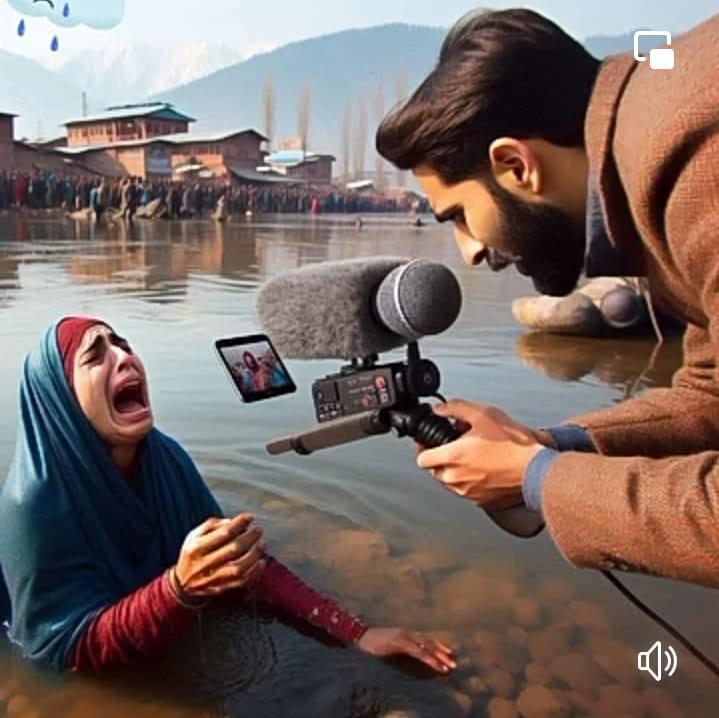
The explosive growth of digital and social media journalism in Jammu and Kashmir has transformed the way information is created, consumed, and shared. While this digital shift has widened democratic participation and amplified local voices, the absence of a clear and enforceable digital media policy has also given rise to serious challenges, particularly the proliferation of unregistered and unprofessional social media journalists.
Unlike traditional print and electronic media, digital journalism often operates without institutional structures, editorial oversight, or professional accreditation. Individuals armed with smartphones and social media accounts frequently assume the role of journalists, publishing content in real time without verification. This has significantly increased the risk of misinformation, sensationalism, and context-free reporting, with potentially destabilising consequences in a sensitive region like Jammu and Kashmir.
The lack of a structured digital media policy has resulted in a vacuum of accountability. Many social media-based journalists are not governed by any recognised ethical code or regulatory mechanism. In the absence of defined standards, practices such as paid content, selective narratives, and misleading headlines have become increasingly common, blurring the line between journalism, activism, and propaganda.
This unregulated environment has contributed to an erosion of public trust. When credible news reports compete with unverified digital content, citizens struggle to differentiate between fact and fiction. This not only undermines public confidence in the media but also weakens journalism’s role as a democratic watchdog.
From a constitutional perspective, digital journalism enjoys the same protection as traditional media under Article 19(1)(a) of the Indian Constitution, which guarantees freedom of speech and expression. The Supreme Court has consistently affirmed that freedom of the press, irrespective of the medium, is an essential pillar of democracy. In Romesh Thappar v. State of Madras (1950), the Court underscored the foundational importance of a free press in a democratic society.
However, constitutional freedom is not absolute. Article 19(2) empowers the State to impose reasonable restrictions in the interests of the sovereignty and integrity of India, security of the State, public order, decency, morality, and defamation. Judicial pronouncements such as Sakal Papers v. Union of India (1962) and Bennett Coleman & Co. v. Union of India (1973) make it clear that while censorship is impermissible, reasonable regulation aimed at maintaining public order and professional standards is constitutionally permissible.
In the context of digital media, the Supreme Court’s observation in Secretary, Ministry of Information & Broadcasting v. Cricket Association of Bengal (1995) assumes renewed relevance. The Court recognised that media platforms are public resources and that their use can be regulated in a fair, transparent, and non-arbitrary manner in the public interest.
At the policy level, Jammu and Kashmir does have a framework that partially addresses digital and social media: the J&K Media Policy-2020. Approved in June 2020, the policy was intended to modernise government-media relations and respond to the changing communication landscape, including the growing influence of online and social media platforms.
The policy formally recognises digital media by extending empanelment and accreditation mechanisms beyond print and electronic outlets to include online platforms. It also mandates the creation of Social Media Cells within government departments to facilitate structured engagement with citizens and disseminate official information through digital platforms.
A key provision of the policy authorises the Department of Information and Public Relations (DIPR) to monitor print, electronic, and online content for instances of fake news, plagiarism, unethical or anti-national activities, with powers to recommend de-empanelment and legal action under relevant laws. The policy also requires departments to designate nodal officers to coordinate with the DIPR, thereby institutionalising oversight over media interactions, including in the digital space.
While these provisions indicate official acknowledgement of digital media’s growing role, the Media Policy-2020 is primarily administrative in nature. It focuses more on government communication management and content monitoring than on establishing clear professional standards, ethical safeguards, or protections for independent digital journalists. Critics have also pointed out that the policy’s broad and undefined terms risk subjective interpretation, raising concerns about potential overreach and chilling effects on free expression.
Consequently, the policy stops short of providing a comprehensive, journalism-centric regulatory framework for digital media. It neither clearly distinguishes professional digital journalism from casual content creation nor offers transparent mechanisms for accreditation, grievance redressal, or capacity building for online journalists.
A robust digital media policy for Jammu and Kashmir should therefore focus not on content suppression but on professionalisation and accountability. Key elements could include voluntary or mandatory registration of digital news platforms, disclosure of ownership and funding sources, adherence to a uniform code of ethics, and structured training in media law, digital verification, and conflict-sensitive reporting.
Such a policy would help curb misinformation, enhance journalistic credibility, and protect both the public and journalists from legal and security risks. Importantly, it would also safeguard genuine digital journalists by clearly distinguishing professional journalism from irresponsible or motivated content creation.
Critics fear that any regulation of digital media could threaten free expression. These concerns are legitimate and must be addressed through safeguards against arbitrary action, independent grievance-redress mechanisms, and judicial oversight. Regulation, if narrowly tailored and transparently implemented, can strengthen, not weaken, press freedom.
The debate around digital media regulation in Jammu and Kashmir must move beyond the false binary of freedom versus control. What is urgently required is a principled middle path, one that recognises digital journalism as an indispensable extension of democratic expression while firmly anchoring it in responsibility and professional ethics. In the absence of a coherent policy framework, the digital space risks being dominated by noise rather than news, speculation rather than substance.
A well-crafted digital media policy, rooted in constitutional values and informed by the region’s unique socio-political sensitivities, can serve as a corrective rather than a constraint. By institutionalising transparency, ethical standards, and accountability mechanisms, such a framework would strengthen public trust, protect journalists from arbitrary action, and ensure that the digital public sphere contributes to informed discourse instead of confusion and conflict.
In a region where information has the power to influence peace, stability, and public perception, the absence of a clear digital media policy is no longer sustainable. Jammu and Kashmir needs a balanced, constitutionally grounded digital media framework, one that protects freedom of expression while ensuring responsibility, accuracy, and accountability in an increasingly influential digital public sphere.
(The author is a former Attorney at Law in the Jammu and Kashmir High Court and currently serves as a Government Law Officer. He is also pursuing a Master’s degree in Political Science from Indira Gandhi National Open University. Ideas are personal.)