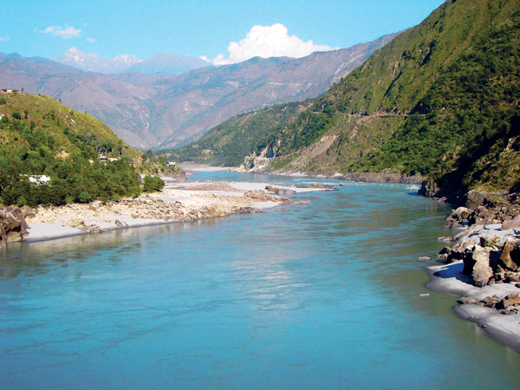
SRINAGAR: The Jammu and Kashmir government has disclosed that four large hydropower projects, with a combined installed capacity of 3,014 megawatts, are currently under construction on the Chenab River. These projects—Pakal Dul (1,000 MW), Kiru (624 MW), Kwar (540 MW), and Ratle (850 MW)—are being implemented through joint ventures between NHPC and the Jammu and Kashmir State Power Development Corporation (JKSPDC), with expected completion by 2027.
In response to a question raised by legislator Sajjad Shaheen in the assembly, the government provided a detailed status update on the progress of these projects. As of February 2025, Pakal Dul had achieved 65 per cent completion, Kiru 54.09 per cent, Kwar 18.55 per cent, and Ratle remained in its early stages at 1 per cent completion. These projects are expected to generate over 10,541 million units (MU) of electricity annually.
Addressing environmental concerns, the government stated that the projects have undergone extensive Environmental Impact Assessments (EIA) by accredited consultants. To mitigate any ecological imbalances, several environmental management plans are being implemented, including catchment area treatment, compensatory afforestation, biodiversity conservation, and waste management strategies.
The government, however, clarified that no geological studies have been conducted to establish a correlation between hydropower projects and increased seismic activity in the Chenab basin. It stated that no scientific research papers or peer-reviewed studies have confirmed the existence of reservoir-induced seismicity (RIS) linked to dam operations in the region. While some media reports have suggested the possibility of RIS, these claims lack solid empirical evidence.
Jammu and Kashmir has an estimated hydropower potential of 18,000 MW, with 11,283 MW identified in the Chenab basin alone. However, only 23.81 per cent of the total identified capacity has been harnessed to date. To expedite the development of remaining projects, the government has allocated projects to NHPC, joint ventures like CVPPL and RHPCL, and Independent Power Producers (IPPs). Currently, 15 projects aggregating 7,768 MW are at various stages, with six under construction, two at the award stage, and seven at the Detailed Project Report (DPR) clearance stage.
In addition to large-scale projects, the government is promoting small hydropower initiatives through the Jammu and Kashmir Energy Development Agency (JKEDA). On the Mahu River, the 3.75 MW Khari Hydroelectric Project has already been successfully commissioned. Two more projects—the 1.5 MW Kawna HEP and the 1.2 MW Buzta HEP—have been awarded by JKEDA and are set to begin development soon. Similarly, on the Pogal Nallah, JKEDA has identified two projects, Pogal-I (2 MW) and Pogal-II (2 MW), which will be tendered shortly under the Independent Power Producer (IPP) mode.
These smaller projects are expected to contribute to local energy supply while promoting decentralized power generation in remote areas. The government maintains that its ongoing efforts to harness hydropower resources will strengthen Jammu and Kashmir’s energy security and economic growth.