SRINAGAR: The humanitarian crisis in Gaza has reached catastrophic levels, with the United Nations issuing its starkest warnings yet of widespread starvation, collapsing health and water systems, and actions that may amount to war crimes, UN News reported.
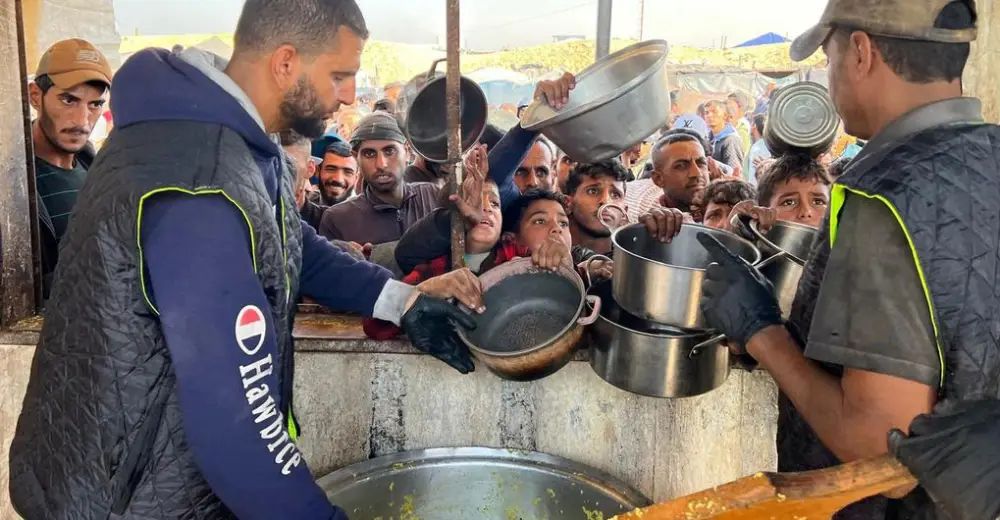
According to multiple UN agencies, including the Office for the Coordination of Humanitarian Affairs (OCHA), the World Food Programme (WFP), the UN Population Fund (UNFPA), and the Office of the High Commissioner for Human Rights (OHCHR), most families in the Gaza Strip are now surviving on just one meal a day, while over one-third are enduring entire days without eating. These meals are often limited to meagre combinations of broth, lentils, rice or a piece of bread, with many parents going without food to feed children or the elderly.
“[When my children wake up at night hungry] I tell them ‘Drink water and close your eyes.’ It breaks me,” one parent told WFP, encapsulating the desperation of hundreds of thousands trapped in a near-total blockade.
Since January, 112 children on average have been admitted daily for acute malnutrition. Yet the situation is worsened by deadly risks in obtaining aid, since May 27, at least 549 Palestinians have reportedly been killed and over 4,000 injured while trying to access food, often in US-Israeli-managed distribution hubs located in militarised zones. Many have been shelled or shot, UN officials confirmed.
“Desperate, hungry people in Gaza continue to face the inhumane choice of either starving to death or risk being killed while trying to get food,” the UN human rights office told UN News.
The UN human rights office on Tuesday sharply criticised the Israeli military’s management of the controversial Gaza Humanitarian Foundation (GHF), an aid mechanism operational since May 27 that bypasses UN and international NGO channels. OHCHR spokesperson Thameen Al-Keetan said that 410 Palestinians had been killed while trying to reach GHF distribution sites, branding the strategy as “the weaponisation of food” and warning that it may constitute a war crime.
“These aid hubs are militarised, unregulated, and deadly,” Al-Keetan said, adding that civilians have been either shelled or shot while approaching these sites. The UN has demanded accountability for both the killings and for incidents where GHF staff allegedly linked to Hamas were summarily executed by armed groups.
Women, children, the elderly and people with disabilities, those most vulnerable, are also being excluded from access, as looting and violence overwhelm non-UN aid convoys. Over 3,000 people have been injured in incidents linked to these sites, and the UN says many are no longer receiving any assistance at all.
Fuel restrictions imposed by Israel have crippled Gaza’s already strained lifelines. As of this week, only 40 per cent of drinking water facilities remain functional, and nearly 93 per cent of households are experiencing water insecurity.
UN Spokesperson Stéphane Dujarric confirmed that the remaining fuel stock is nearing exhaustion, jeopardising hospitals, ambulances, water pumping, and even basic telecommunications.
“Fuel for Gaza is a matter of life and death,” said Dujarric. The UN Population Fund has warned that 80 per cent of maternity care units risk shutting down. With approximately 130 women giving birth every day, the implications are dire. Already, many have resorted to burning plastic waste for cooking, raising health hazards in overcrowded tents with poor ventilation.
Community kitchens, once serving over one million meals a day in April, have now scaled down to a fifth of that output.
The UN estimates that since the resumption of bombardment on March 18, over 684,000 Palestinians have been displaced, most of them repeatedly. With 82 per cent of Gaza either designated a militarised zone or under displacement orders, schools, streets, and rubble-strewn buildings have become makeshift shelters.
Stéphane Dujarric reported that no new shelter material has entered Gaza since March 1, worsening conditions in overcrowded camps. Though 980,000 shelter items are pre-positioned by UN agencies, they remain undelivered due to Israeli restrictions.
The current aid flow is wholly inadequate, UN officials said. Of 15 humanitarian convoy requests made earlier this week, only three were fully facilitated by Israeli authorities, with seven denied outright and others either halted or cancelled. OCHA’s Jonathan Whittall described the impact as “a death sentence for people just trying to survive.”
“It is weaponised hunger. It is forced displacement. It’s a death sentence… All combined, it appears to be the erasure of Palestinian life from Gaza,” Whittall said.
UN officials continue to call on Israel to allow daily aid delivery through multiple crossings and to restore safe access for humanitarian teams. While limited supplies, including nine trucks of medical items, were allowed through the Kerem Shalom crossing this week, the volume remains a fraction of what is needed.
Meanwhile, telecommunications services, recently restored after fibre repairs, are again under threat due to fuel shortages. Without connectivity, coordination of life-saving relief operations will be severely hampered.
UN agencies have underscored that the situation is no longer sustainable. “The humanitarian community in Gaza has lost the tools to work,” said Neven, a UNRWA psychosocial worker in Khan Younis.
Yet even under bombardment, UNRWA and other UN bodies continue to serve. “We are not merely service providers,” said Hussein, a UNRWA worker in Gaza City. “In the eyes of people in Gaza, we are pillars of resilience, lifelines of stability and symbols of hope.”
But as aid dwindles and death tolls rise, that hope hangs by a thread.