SRINAGAR: World Wetlands Day 2026 was observed at the internationally recognised Hokersar Wetland on Sunday with a strong focus on linking ecological conservation with traditional knowledge and community stewardship, as experts, officials, and civil society groups gathered to reaffirm collective responsibility toward protecting Jammu and Kashmir’s fragile wetland ecosystems.
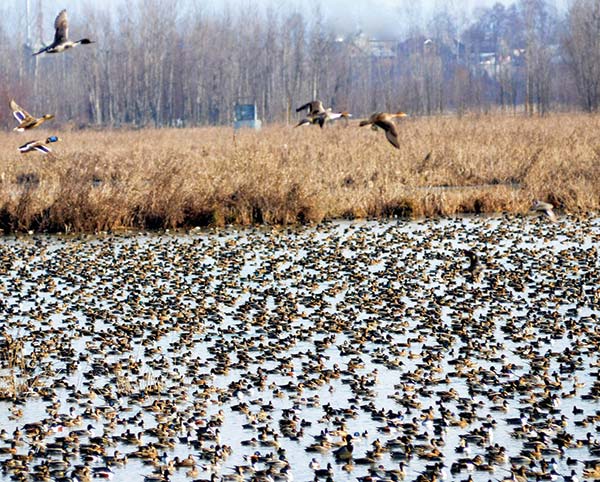
The event, held at one of the Union Territory’s most significant Ramsar Sites, unfolded amid winter sunlight, expansive reed beds and the seasonal congregation of thousands of migratory birds, turning Hokersar into a platform for dialogue connecting science, culture, memory and local livelihoods.
This year’s global theme, “Wetlands and Traditional Knowledge: Celebrating Cultural Heritage,” resonated strongly with Kashmir’s ecological and cultural landscape, where wetlands have historically supported agriculture, fishing, fodder collection and food security.
The programme began with a welcome address by Altaf Hussain, Wildlife Warden, Wetlands Division, who greeted participants from diverse sectors, including NGOs, local residents, bird photographers, students, researchers, eco-guide trainees and Wildlife Department officials.
Highlighting Hokersar’s ecological significance, Hussain described the wetland as a critical wintering ground for migratory birds and a natural flood buffer that protects Srinagar from inundation, besides serving as a repository of rich biodiversity. He said conservation cannot succeed through enforcement alone and stressed the need for community participation, research collaboration and awareness-based strategies, particularly as wetlands face mounting pressure from urbanisation, pollution and climate change.
Veteran environmentalist Nazir Benazir recalled a time when Srinagar’s interconnected lakes, marshes, canals and springs were embedded in everyday life. He cautioned that the degradation of wetlands represents not only an ecological crisis but also the loss of cultural memory, traditional livelihoods and historical continuity.
Delivering a key address, Dr Shaikh Ghulam Rasool, Co-Founder of the School for Rural Development and Environment (SRDE) and Chairperson of the J&K RTI Movement, emphasised that wetlands should be seen as living cultural landscapes rather than mere ecological units.
He said these ecosystems have been sustained for generations through indigenous wisdom, customary practices and community stewardship. “Conservation succeeds when people are recognised as custodians rather than excluded as intruders,” he noted.
Tracing the evolution of wetland conservation since the 1972 Ramsar Convention, Rasool said global policy has increasingly acknowledged that wetlands cannot be conserved without traditional knowledge and local participation. Recalling Hokersar as it existed over three decades ago, he described it as a pristine ecosystem that supported communities through fishing, fodder, aquatic vegetables and medicinal plants.
He added that Hokersar’s Ramsar status is rooted not only in its biodiversity and migratory bird populations but also in its historic role in flood regulation, agriculture and food security. Advocating participatory governance and recognition of customary rights, he warned that exclusionary conservation models ultimately fail both people and ecosystems.
Addressing misconceptions around farming practices, Rasool clarified that traditional paddy cultivation complements wetland ecology, as post-harvest residue serves as an important food source for migratory birds.
The event also showcased the Nature Tourism and Eco-Guide initiative, jointly conceptualised by SRDE and the Nature Conservancy Alliance (NCA), with trained eco-guides present at Hokersar to demonstrate how community-based ideas can translate into institutional practice.
Organisers highlighted SRDE’s work in documenting 48 wetlands across Jammu and Kashmir, including several unnotified sites of ecological and livelihood importance. The presence of Prof Bilal Bhat, President of SRDE, added academic and policy depth to the discussions. The Nature Conservancy Alliance, a collective of 72 organisations working on nature conservation and climate justice, was recognised for its regional advocacy efforts.
Moderated by wildlife researcher and conservationist Aquib Hussian Pal, the programme saw participation from representatives of SRDE, the Wildlife Conservation Fund, Wildlife Trust of India, Himalayan Brown Bear Trust, Wildlife SOS, represented by Aliya Mir, as well as noted conservationist Rahi Reyiaz, alongside local communities, NGOs and wildlife enthusiasts.
During the concluding session, Hussain, Benazir and Pal publicly acknowledged Rasool’s contributions to community-led conservation, particularly his work in Tosamaidan and Wullar, and his advocacy for transparency and participatory ecological governance.
World Wetlands Day at Hokersar concluded with participants reaffirming that wetlands are living heritage systems whose future depends on restoring the relationship between people, nature, knowledge and institutions, with communities positioned as the primary stewards of these shared ecological commons.