SUV buyers today are far from a single, uniform group. Some prioritise space, comfort, and long-distance touring, while others look for compact dimensions, urban convenience, and easy manoeuvrability. The Maruti Suzuki Victoris and the Hyundai Venue illustrate how manufacturers address these different expectations within the broader SUV category.
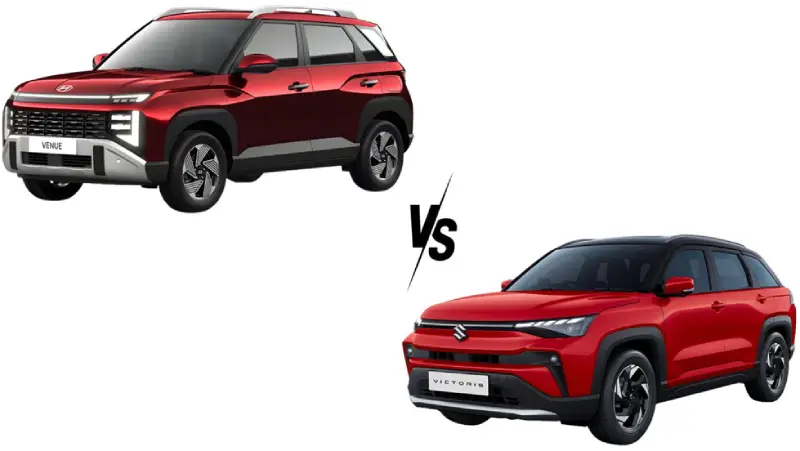
Although both vehicles fall under the SUV umbrella, they are designed to serve very different types of buyers. Understanding these differences helps prospective owners choose a model that aligns more closely with their lifestyle and driving needs.
Segment Positioning and Buyer Intent
The Maruti Suzuki Victoris sits firmly in the mid-size SUV segment, targeting buyers who desire a larger vehicle with a premium cabin, advanced safety features, and flexible powertrain options. The Victoris is positioned as an SUV that “has it all,” combining comfort, technology, and versatility for varied usage scenarios.
The Hyundai Venue, by contrast, operates in the compact SUV segment, where ease of driving, city-friendly dimensions, and feature-rich interiors are key priorities. The Venue focuses on modern technology, urban agility, and everyday practicality, making it particularly appealing to city-based buyers and first-time SUV owners.
Design and Road Presence
Design expectations differ significantly between these buyer groups. Victoris buyers often seek a commanding presence and a sense of premium appeal. The Victoris reflects this with a sweeping silhouette, sculpted body lines, and segmented rear LED tail lamps that create a strong visual identity on the road.
The Hyundai Venue, on the other hand, adopts a more compact and youthful design language. Features such as quad-beam LED headlamps, horizon LED positioning lamps, and R16 diamond-cut alloy wheels give it a bold yet approachable look without the physical bulk of a larger SUV.
For buyers, this translates into a choice between presence and compact confidence.
Interior Space and Comfort Priorities
Interior expectations are another area where these two SUVs diverge. The Maruti Suzuki Victoris is designed for buyers who prioritise space and long-distance comfort. The SUV comes with features such as a panoramic sunroof, plush leatherette seats, 64-colour ambient lighting, and an 8-way powered driver seat. A longer wheelbase also contributes to a more relaxed cabin environment, especially for highway travel.
The Hyundai Venue caters to buyers who want a premium feel within a compact footprint. Its cabin features dual 12.3-inch curved panoramic displays, a dual-tone interior, and rear seat reclining with a 60:40 split folding function, making efficient use of available space. While smaller than the Victoris, the Venue’s interior is designed to feel modern and tech-forward rather than expansive.
Technology and Digital Experience
Technology plays an important role for both buyer groups, but in different ways. The Victoris focuses on creating an immersive, comfort-oriented digital environment. It features the SmartPlay Pro X infotainment system, Infinity premium sound system with Dolby Atmos, and Alexa Auto on board with over 40 voice-enabled features, supported by Next-Gen Suzuki Connect with more than 60 connected services.
The Hyundai Venue places greater emphasis on connectivity and daily convenience. It features ccNC (Connected Car Navigation Cockpit) with wireless Android Auto and Apple CarPlay, over-the-air (OTA) updates, and Hyundai Bluelink connected technology. These features appeal strongly to buyers who value constant connectivity and smartphone-style integration.
Safety and Driver Assistance Expectations
Safety expectations have increased across all SUV segments, but how they are implemented reflects buyer priorities. The Maruti Suzuki Victoris offers six airbags as standard and Level 2 ADAS, including adaptive cruise control with curve speed reduction, lane keep assist, automatic emergency braking, and blind spot monitoring. This suits buyers who frequently drive on highways or undertake longer journeys.
The Hyundai Venue also delivers a comprehensive safety package, featuring six airbags as standard across all variants, all-wheel disc brakes, and Hyundai SmartSense Level 2 ADAS, which offers up to 16 advanced safety features, including forward collision avoidance, lane following assist, and high beam assist. These features are particularly valuable for urban driving and congested traffic conditions.
Powertrain Choices and Usage Patterns
Powertrain flexibility further highlights how these SUVs cater to different buyers. The Victoris offers a wide range of options, including mild hybrid petrol, strong hybrid with e-CVT, factory-fitted S-CNG, and ALLGRIP Select all-wheel drive on select variants. This range appeals to buyers seeking efficiency, touring capability, or varied terrain usage.
The Hyundai Venue focuses on efficient and responsive engines suited for city and mixed-use applications, including a 1.2-litre petrol, a 1.0-litre turbo-petrol, and a 1.5-litre diesel, paired with multiple transmission choices such as manual, automatic, and DCT.
Who Each SUV Is Best Suited For
In practical terms, the Maruti Suzuki Victoris is better suited to:
- Buyers seeking a larger, more premium SUV
- Families prioritising space and long-distance comfort
- Users interested in hybrid or AWD options
- Drivers who value touring capability and cabin ambience
The Hyundai Venue is more appropriate for:
- Urban and city-focused buyers
- First-time SUV owners
- Drivers prioritising compact dimensions and easy handling
- Users who value connected tech and daily convenience
Conclusion
The Maruti Suzuki Victoris and Hyundai Venue demonstrate how SUVs can cater to very different buyer expectations within the same broad category. The Victoris aligns with buyers looking for space, comfort, and versatility, while the Venue appeals to those seeking compact practicality and urban-friendly technology.
Rather than competing directly, these two SUVs address distinct needs, allowing buyers to choose based on lifestyle, usage patterns, and long-term priorities. Understanding these differences ensures a more informed and satisfying SUV ownership experience.