by Dr Suhail A Naik
A premature Kashmiri infant survives NICU struggles, reunites with family, and later becomes a compassionate paediatrician healing vulnerable newborns nationwide.
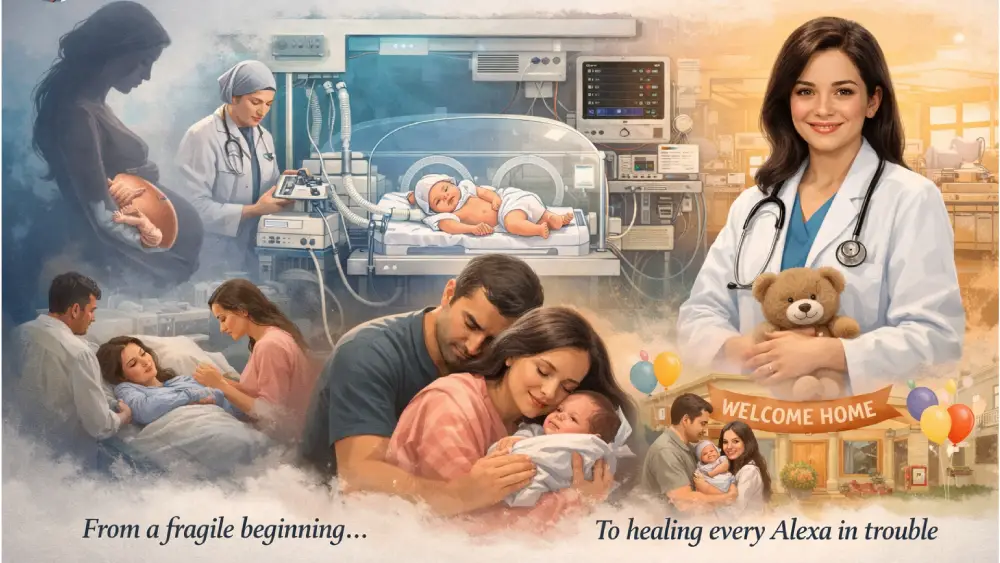
My name is Alexa, and I was living a wonderful life in the womb of my mother. Everything was available around the clock, and my fragile organs were at rest and developing. I was enjoying the day with swings, while my mother was doing her routine chores.
Unfortunately, one day my Mom developed premature rupture of membranes and got admitted to a Maternity and Child Hospital. The water level in the womb was falling, and it was constricting around me.
My parents were anxious. The hospital environment was suffocating, choking, full of misery and tragedies.
My mother revealed the history of leaking.
I heard doctors telling my Mom that this was not good news. The baby in the womb was premature with immature organs, particularly the lungs, and it would be difficult for the baby to sustain extra-uterine life. Therefore, they would try their level best to prolong my stay in the womb as long as possible, so that my organs could mature and I could survive after birth.
My mother was in distress; still, she was supplying all the essentials to me. I was not ready to come out of the heavenly womb, where my life was calm, composed, contented, and stress-free. But the real tragedy struck when my Mom developed an infection, which doctors called chorioamnionitis, and an emergency LSCS was performed to get me out of the womb to save both my Mom and me.
Soon after my birth, my life was full of tragedies and travesties, and everything turned topsy-turvy.
As soon as I was born, the doctors put me on a preheated warmer, positioned my neck, suctioned my throat, started gently rubbing my back, and connected my limbs to multiple wires. It was beeping all over, and I was not able to understand the situation. Everything happening was beyond my comprehension and imagination.
I was vehemently crying about all these unfortunate developments, but the team labelled me with a medical term: Cried Immediately After Birth (CIAB) and breathing well.
Unfortunately, some medical gadgets showed that my oxygen saturation was below prescribed targets, and immediately, some soft rubber tubes were inserted into my nostrils, fixed, and connected to a machine they called CPAP. They were discussing that it would inflate my low-compliance, atelectatic lungs.
Though it was all painful, I was happy that this machine would rescue me. I was very eager to meet my Mom, who was suffering from the pain of LSCS.
That day, nothing was in our favour. Just after twenty minutes, a senior doctor observed that the CPAP machine was not able to open my non-compliant, immature lungs. He labelled my disease as Respiratory Distress Syndrome (RDS) and advised the team to transport me to a nearby NICU.
I was labelled as a case of a female baby, LSCS born, first issue, preterm 30-weeker, 1200 grams, average for gestational age, with MRD No. XXXX48.
They transported me gently, tried to give me immense comfort with all tubes in place, providing me with warm and humidified oxygen.
Soon, I reached the NICU. There were several babies admitted, all in a state of deep sleep. Before elaborating further on the environment of the NICU, the doctors put a long rubber tube called an ET tube into my breathing pipe, the trachea, and immediately infused four vials of a white liquid solution known as surfactant into my lungs. They connected it to a big machine they called a ventilator.
Believe me, I felt relief from choking, breathlessness, and suffocation, but I was worried about my mother’s health. She was in pain and away from me. I was eager to meet her as soon as possible, missing her immensely.
A large number of wires were glued to my limbs, abdomen, and head. The monitors were beeping all over, and the team was observing me round the clock.
The story did not stop with tubes and wires. They inserted a small soft tube into my umbilical cord vein and were keen to give me proper nutrition and hydration. To my surprise, they took my blood sample to check for infection and other biochemical parameters. The experience is beyond my comprehension to explain.
Here came the first good news of the day: I was extubated from the ventilator after six hours and put on non-invasive ventilation. Now I was happy, elated, and keen to meet my family.
The next day, terrible news unfolded for me. My oxygen saturation was dipping, the X-ray showed new fluffy shadows, and immediately the team put me back on the ventilator and sedated me with a gentle, magical drug that dissociated me from the NICU world. I spent seven days on the ventilator and have no memories or recall, as I was sedated with a wonderful drug.
After seven long days, once again, they extubated me from the ventilator and put me back on non-invasive oxygen. A few days later, my health condition was improving, and the doctors shifted me to a nearby ward for Level 2 Nursery Care.
For the first time, I saw my father standing beside me, fatigued, sleep-deprived, and anxious. Both of us were confused about our final destination, but he stood beside me like a rock.
Soon, a team of doctors came and told my father that they were elated that Alexa had struggled a lot and successfully come out of invasive ventilation. However, there were apprehensions that she might develop or suffer from ROP, PVL, IVH, NEC, BPD, and late disabilities like CP and hearing impairment.
The scientific terminologies were horrible to listen to and felt like pure medical jargon. This confused our family, and we were not able to understand where our final destination lay.
The team conducted screening tests for the eyes, brain, and abdomen, and it became clear that there was no evidence of ROP (retinopathy of prematurity), PVL (periventricular leukomalacia), IVH (intraventricular haemorrhage), or NEC (necrotising enterocolitis).
Regarding BPD, they told us that it stands for bronchopulmonary dysplasia and is labelled if a baby requires oxygen or respiratory support at 36 weeks of gestational age, while I was just 32 weeks by gestational age. I thought, who has seen the future? Let us forget about this horrible term, BPD.
Meanwhile, my Mom, who was recuperating from LSCS, was allowed to see me and was asked to put me on her abdomen for Kangaroo Mother Care (KMC). I will never forget that wonderful moment of life, full of blessings, when my mother put me on her abdomen for the first time for skin-to-skin touch. May God save every Alexa to enjoy such moments of life.
At that moment, my mother was weeping, and tears were falling over her face and neck, but no one noticed my little tears drying in my eyes.
I was allowed to take breast milk, but through a plastic tube inserted into my stomach, as my suck and swallow were weak. Every second in the hospital was a harsh struggle for our family. We were fatigued, energy-less, clueless, and unaware of when we would leave for home.
After a lot of struggle and hustle and bustle, I started gaining weight, and my father started losing weight, turning weak day by day. We had only one hope: that one day we would leave this hospital and live as a happy family.
After a lot of hustle and bustle, ups and downs, at 34 weeks of gestational age, the doctors allowed me to take feeds directly, and oxygen support was slowly removed. A battery of screening tests was conducted, and my discharge from the hospital was planned.
I was thriving well, gaining weight, eating on time, and my mother was confident to take care of me at home.
We were finally discharged after one and a half months of hospital stay. As soon as we reached home, our family celebrated, and my father immediately did a lot of charity and congratulated the team of doctors.
After witnessing this trouble in the early days of my life and struggling a lot for my survival with the tremendous efforts of doctors, I decided to become a medical doctor.
Today, I am Dr Alexa, Consultant Paediatrician, serving the nation and healing every Alexa in trouble.
(The author is a Senior Consultant, Assistant Professor, Department of Paediatrics, GMC Srinagar. Ideas are personal.)