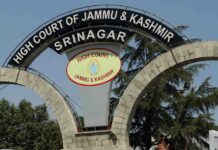
SRINAGAR: The High Court of Jammu and Kashmir and Ladakh has upheld charges framed under the Unlawful Activities (Prevention) Act (UAPA) against two Srinagar residents accused of working as associates of the banned outfit The Resistance Front (TRF), ruling that the prosecution has produced sufficient prima facie material to justify a trial and dismissing both their criminal appeals.
A Division Bench of Justice Rajnesh Oswal and Justice Sanjay Parihar, in a judgment reserved on June 4, 2026 and pronounced on July 3, 2026, affirmed the July 12, 2025 order of the Additional Sessions Judge (Designated Special Court under the NIA Act), Srinagar, which had framed charges against Adnan Bashir Bangroo and Mohammad Manan Dar.
The appeals arose from the trial court’s decision to frame charges under various provisions of the UAPA.
Bangroo was charged under Sections 13, 18 and 39 of the UAPA along with Section 506 of the IPC, while Dar was charged under Sections 13, 18, 39 and 40(2) of the UAPA besides Section 506 IPC.
Before the High Court, the appellants argued that the charges under Sections 18 and 39—and, in Dar’s case, Section 40(2)—were unsustainable because they rested primarily on alleged confessional statements made before an Executive Magistrate without independent corroboration. They contended that no recovery had been made pursuant to the disclosure statements, rendering them legally inadmissible for framing charges.
Bangroo’s counsel, advocate Shariq Jan Reyaz, confined his challenge to the charges under Sections 18 and 39, arguing there was no material linking his client to conspiracy or support for a terrorist organisation beyond the alleged confession.
Representing Dar, advocate Danish Majid Dar adopted those submissions and additionally claimed his client had been illegally detained by the Special Operations Group on March 16, 2024—three days before the official arrest shown by police. He relied on a habeas corpus petition filed in March 2024 to argue that the prosecution case was fabricated.
The Union Territory was represented by Senior Additional Advocate General Mohsin Qadiri, assisted by Maha Majeed.
The case stems from FIR No. 11/2024 registered at Police Station Shaheed Gunj on March 18, 2024, after police received information that TRF had circulated a threatening message through a Telegram channel called “Kashmir Fight(s)” warning Booth Level Officers engaged in the forthcoming parliamentary elections. The message suggested that the outfit possessed details of election personnel and warned that it was monitoring them.
The next day, police intercepted the two appellants while they were travelling on a motorcycle at Jehangir Chowk during a routine naka checking. According to the prosecution, Manan Dar was found carrying 14 posters allegedly issued by TRF along with Rs 1 lakh in cash concealed beneath his clothing, while Adnan Bashir Bangroo was allegedly carrying another 25 similar posters and a bottle of glue. Both were arrested on the spot.
During the investigation, police alleged that the two accused disclosed before an Executive Magistrate that they had been in contact with a Pakistan-based handler who had recruited them to work for TRF. According to the prosecution, the handler directed them to collect posters, adhesive and Rs 1 lakh from an unidentified person in Qamarwari on March 14, 2024. Investigators alleged the posters were meant to be pasted across Srinagar to discourage public participation in the parliamentary elections, while the cash was intended to be delivered to alleged TRF militant Momin Gulzar, who was later killed.
The prosecution further relied on technical and forensic evidence to support its case. Mobile phone location records allegedly placed both accused together at Qamarwari at the time they claimed to have collected the material. Forensic examination of Dar’s mobile phone allegedly recovered a photograph of Momin Gulzar which investigators said was not available on any public platform, besides records showing contact with several virtual numbers allegedly operated by Pakistan-based handlers. Investigators also claimed that although the two accused had exchanged more than 100 WhatsApp calls, there were no conventional cellular voice calls between them, suggesting they communicated exclusively through internet-based platforms. Financial investigation further indicated that Dar had no known source of income capable of explaining the Rs 1 lakh recovered from his possession and that neither accused had withdrawn such an amount from their bank accounts.
The Bench held that the trial court had correctly applied the settled principles governing framing of charges, observing that courts at that stage are only required to determine whether a prima facie case exists and are not expected to conduct a detailed evaluation of evidence.
Relying on Supreme Court precedents including State of Andhra Pradesh v. Golconda Linga Swamy, Sajjan Kumar v. CBI, and State of Orissa v. Debendra Nath Padhi, the Bench reiterated that defence evidence cannot be examined while deciding whether charges should be framed.
The court noted that the appellants themselves had not challenged the charge under Section 13 of the UAPA, which relates to unlawful activities, but had focused on the more serious allegations carrying stricter bail restrictions under Section 43D(5) of the Act.
Rejecting their challenge, the Bench held that the prosecution material went beyond the alleged confessional statements. It observed that the investigation pointed to alleged contact with a Pakistan-based handler, recovery of propaganda posters, unexplained cash, technical evidence corroborating the accused’s movements, digital communication records and forensic material linking one accused to the slain militant Momin Gulzar.
The judges said these materials were sufficient at the preliminary stage to support charges under Section 18 of the UAPA relating to conspiracy and preparatory acts for terrorist activities.
The court further held that recovery of posters, glue and cash, coupled with the alleged digital links to the Telegram channel associated with TRF, provided sufficient prima facie material to sustain the charge under Section 39, which concerns support to a terrorist organisation.
Regarding Section 40(2) against Dar, the Bench found that the prosecution had produced sufficient material showing he possessed Rs 1 lakh without any legitimate explanation.
The High Court also rejected Dar’s reliance on the earlier habeas corpus petition alleging illegal detention before his formal arrest.
The judges held that allegations contained in pleadings filed in the habeas corpus proceedings did not amount to evidence of “sterling quality” capable of disproving the prosecution case at the stage of framing charges.
The Bench observed that such contentions constitute a defence to be established during trial and cannot justify quashing charges at the preliminary stage.
Dismissing both appeals, the High Court held that the trial court had committed no legal error or infirmity in framing charges.
The Bench clarified that all observations made in the judgment are tentative and confined solely to deciding the legality of the order framing charges. It directed that the trial court shall independently assess the evidence during trial without being influenced by any observations contained in the judgment.