SRINAGAR: Jammu and Kashmir has a network of 24,137 schools, including 18,724 government schools and 5,413 schools under other management, according to The Economic Survey 2025-26. During the academic year 2024-25, total student enrolment from pre-primary to Class XII stood at 26,17,817, reflecting inclusivity, innovation and holistic development aligned with the National Education Policy (NEP) 2020.
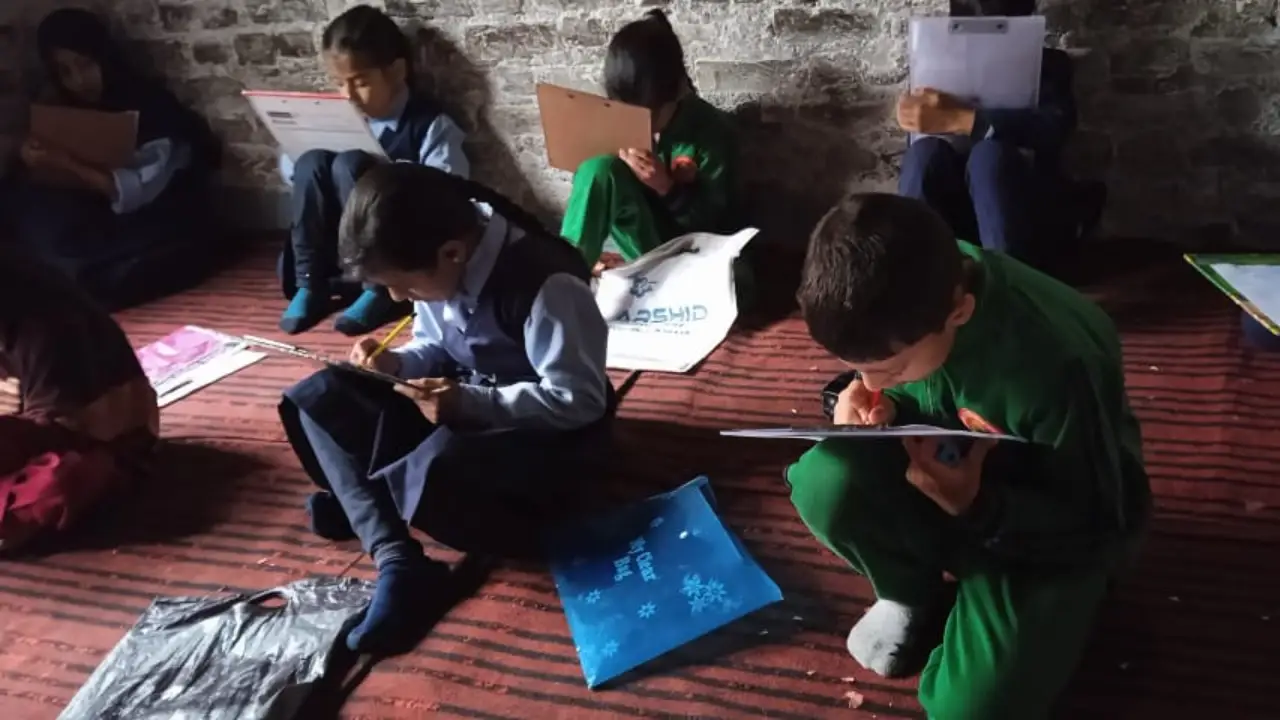
The Gross Enrolment Ratio (GER) of girls has improved over the past five years. In 2024-25, the GER of girls stood at 114.5 per cent at the primary level, 80.0 per cent at the upper primary level and 67.50 per cent at the secondary level. These figures are higher than the composite GER of 113.7 per cent at the primary level, 77.3 per cent at the upper primary level and 66.10 per cent at the secondary level, indicating the impact of the Beti Padhao campaign in Jammu and Kashmir.
Declining dropout rates in recent years indicate improving retention levels. In 2019-20, the dropout rate for boys and girls combined was 5.86 per cent at the primary level, 5.14 per cent at the upper primary level, and 18.48 per cent at the secondary level. In 2024-25, these figures declined to 1.50 per cent at the primary level, 3.20 per cent at the upper primary level and 12.9 per cent at the secondary level.
Infrastructure development has remained a key priority. In 2019-20, 86.35 per cent of schools had girls’ toilets, 84.06 per cent had boys’ toilets, 64.07 per cent had library or reading facilities, and 64.23 per cent had electricity. By 2024-25, these figures improved to 90.84 per cent for girls’ toilets, 88.49 per cent for boys’ toilets, 75.10 per cent for library or reading facilities, and 91.44 per cent for electricity.
Implementation of schemes such as Samagra Shiksha, PM Poshan (Mid-Day Meal), PM Shri and NILP (ULLAS) has led to notable milestones. These include a shift of pre-primary students from private to government schools, introduction of vocational education in 1,350 schools, creation of over 11,000 youth clubs, establishment of 3,000 kindergartens and plans to establish 3,500 more during 2025-26.
The JK Attendance App has been introduced, while 3,008 ICT and CAL labs have been established. Plans are underway to set up an additional 2,036 ICT labs and 4,272 smart classrooms during 2025-26 to promote experiential learning.
The Higher Education Department is also undergoing transformation in line with NEP 2020. The Union Territory currently has 151 government degree colleges, including six engineering colleges. Of these, 51 colleges were established after 2019.
Jammu and Kashmir has 74 NAAC-accredited colleges, with 16 more under process, indicating institutional restructuring and accreditation as priorities.
Over the past several years, IIT Jammu and IIM Jammu have been made functional, while 51 new colleges have been added. Five new college buildings — GDC Samba, GDC Baramulla, GDC Reasi, GDC Hyderpora and GDC Eidgah — have been completed, and three more buildings are expected to be completed in 2026.
At present, three colleges in the Union Territory have been granted autonomous status. Both the University of Jammu and the University of Kashmir have been accredited with NAAC Grade A++. SMVDU, IUST and BGSBU have been accredited with Grade B+, B+ and B respectively.
A three-tier feedback mechanism has been introduced under NEP 2020, including student feedback for institutions, student feedback for teachers, faculty feedback for institutions, and faculty evaluation and feedback.