SRINAGAR: Jammu and Kashmir is preparing to welcome the world of cinema for its maiden International Film Festival, with around 1,100 entries from nearly 80 countries and an elaborate four-day programme planned across Srinagar, Jammu and Gulmarg.
At almost the same time, however, a section of the region’s established film and television fraternity is asking a more immediate question: where are the work opportunities for the artists and technicians who have spent decades producing programmes for the public broadcasting system?
The two developments belong to separate institutional domains. The International Film Festival of Jammu and Kashmir (IFFJK-2026) is being organised by the Jammu and Kashmir Government, while Doordarshan and All India Radio are public broadcasters under the Government of India. Yet they converge around the same creative ecosystem: actors, singers, writers, directors, producers, technicians and other professionals whose skills constitute much of Jammu and Kashmir’s indigenous cultural capital.
The contrast has become particularly visible as preparations gather pace for the September 7-10 festival while members of the local Film and Television fraternity have raised concerns over what they describe as a prolonged contraction of production opportunities at DD Srinagar and DD Kashir.
The first IFFJK is being projected by the J&K Government as a major cultural and cinematic initiative. Chief Secretary Atal Dulloo, who reviewed preparations on Wednesday, has called for the inaugural edition to establish a benchmark for future festivals and said the event is intended to become an annual affair.
The festival will screen films on seven screens in Srinagar, Jammu and Gulmarg. The proposed venues include the Sher-i-Kashmir International Convention Centre and INOX Cinemas in Srinagar and Waves Cinema in Jammu, besides selected sessions in Gulmarg. The opening, closing and award ceremonies are proposed at SKICC.
Beyond screenings, the programme is to include masterclasses, workshops and roundtable discussions involving filmmakers, industry professionals, artists and students. The festival is also intended to showcase J&K as a filming and tourism destination, with curated tours, craft safaris and heritage experiences planned for visiting participants.
The scale of the preparations is substantial. The administration has been working on hospitality, protocol, transport, security, publicity, traffic management and airport facilitation, while the Information Department has launched a dedicated application and publicity campaign. The J&K Academy of Art, Culture and Languages has also been asked to organise live performances by local artists at suitable locations.
At a recent interaction with the local film fraternity, Commissioner Secretary Information R Alice Vaz described the festival as an opportunity to open a new chapter in J&K’s cultural and creative journey. Director Information Shreya Singhal said the festival would seek to connect young filmmakers and artists with established professionals and help them develop skills and professional networks.
The department has also launched an Emerging Filmmakers Competition exclusively for aspiring filmmakers from J&K, with the deadline for submission of original short films set for August 26.
But while the government is seeking to create a new platform for emerging talent, established members of the region’s creative fraternity say an older ecosystem has been allowed to wither.
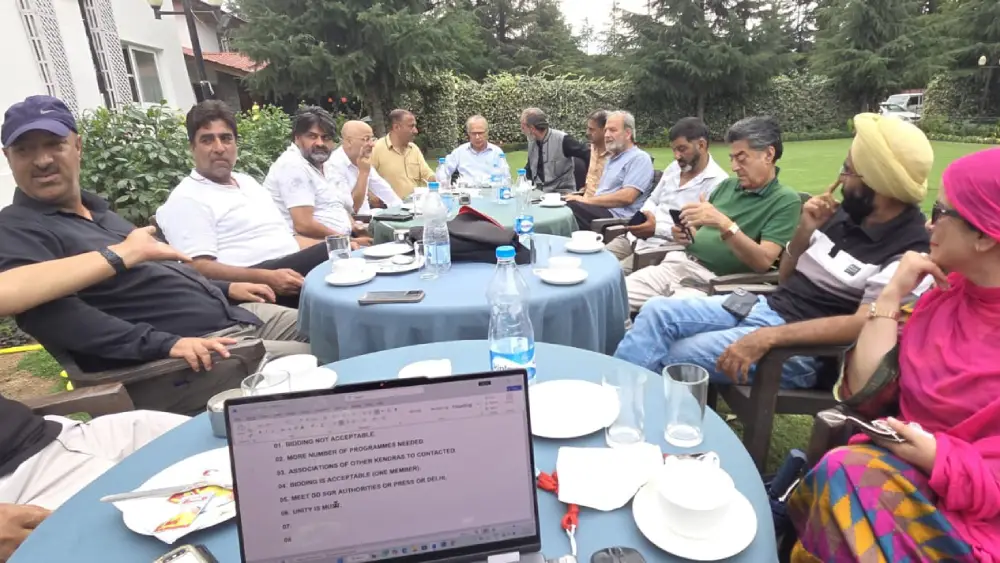
At a gathering in Srinagar on Thursday, actors, singers, writers, producers, directors, technicians and equipment owners discussed what they described as the growing hardships confronting the Film and Television industry.
Among those attending were Mushtaaque Ali Ahmad Khan, Dr Ayash Arif, Mushtaq Bala and Shahzad Rasool.
The participants expressed concern over what they described as the decline of DD Srinagar and DD Kashir as commissioning and production centres. For decades, the broadcasters provided regular opportunities to local artists and technical professionals, besides producing programmes rooted in the region’s language, culture and social life.
According to the fraternity, the reduction or discontinuation of commissioning and in-house productions has deprived a large number of professionals of regular employment and left considerable local expertise underused.
The issue has acquired another dimension with a recent proposal for outsourcing programmes through a bidding process. The proposed mechanism covers formats such as travelogues, documentaries, fiction and musicals.
The Film and Television fraternity has opposed the proposed bidding system, arguing that programme production is a creative and professional activity and should be assessed on artistic merit, professional competence and broadcasting standards rather than treated primarily as a conventional procurement exercise.
The participants resolved to approach the concerned authorities and seek intervention to restore production and commissioning opportunities.
Their argument is not simply about employment. They contend that regular production by local professionals also provides a mechanism for preserving the region’s stories, languages, cultural memory and artistic traditions.
That concern gives the arrival of the international festival a significance beyond the four days for which it is scheduled.
There is no direct institutional link between IFFJK and the functioning of DD Srinagar or DD Kashir, and the festival cannot, by itself, resolve the problems confronting the public broadcasting system. Nor can an international film festival substitute for a sustained production ecosystem.
But the two developments raise a larger question about how Jammu and Kashmir uses and sustains its own creative workforce.
The government is spending considerable effort to bring international cinema, filmmakers and industry professionals to J&K and to present the region as a destination for filmmaking. It is simultaneously asking its own cultural institutions to showcase local artists during the festival.
For the artists who have already spent years working in the region’s film and broadcasting industry, the issue is whether such visibility can translate into sustained professional opportunities.
The emerging filmmakers’ competition, masterclasses and workshops may provide a route into the industry for a new generation. The older fraternity, meanwhile, is asking for something more basic — a functioning production system in which their accumulated experience can continue to be used.
The challenge, therefore, is not necessarily to merge two distinct government responsibilities, but to recognise that both operate within the same creative economy.
Jammu and Kashmir’s first international film festival may succeed in attracting global attention. The more enduring measure of its success could ultimately be whether the region’s own artists, technicians and storytellers find a stronger place in the creative ecosystem that the festival seeks to showcase.