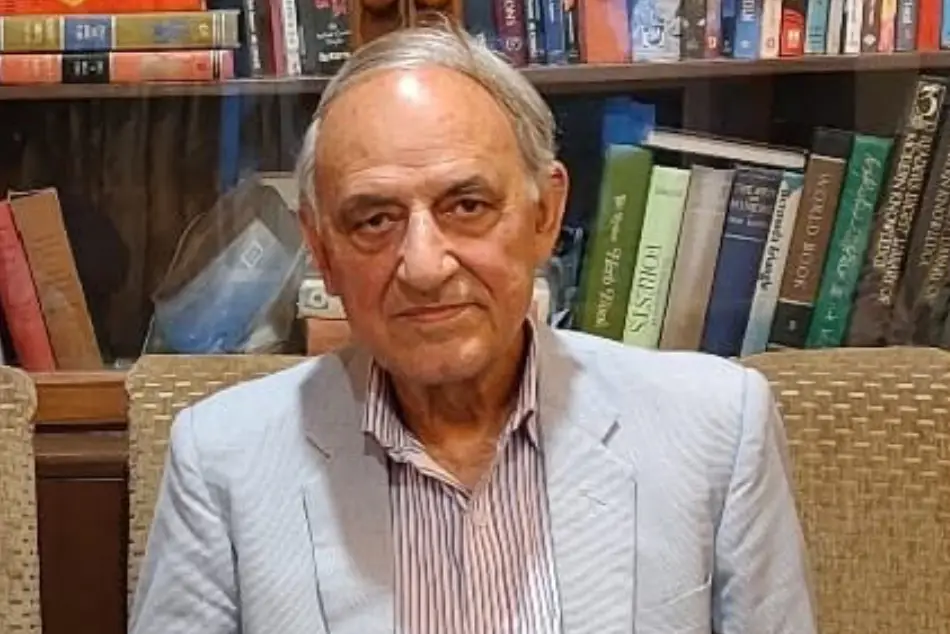
SRINAGAR: Ghulam Hassan Kangoo, widely regarded as one of the pioneers of modern forestry and soil and water conservation in Jammu and Kashmir, has passed away, leaving behind a legacy that extends well beyond the Forest Department he served for decades. He was 91.
A distinguished forester, conservationist, scholar and environmentalist, Kangoo was instrumental in introducing modern concepts of soil and water conservation, watershed management and scientific project planning to Jammu and Kashmir. His work helped shape the institutional architecture of soil conservation in the region and contributed to the restoration of degraded landscapes across Kashmir and Jammu.
One of his most enduring contributions was the establishment of the Department of Soil and Water Conservation in 1978. Kangoo was appointed its first Director and remained associated with the department for several years, guiding its formative years and helping establish its institutional and technical foundations. He was the only officer to serve continuously in the department for eight years, from 1978 to 1986, before returning as its Director from July 1987 to January 1990.
The department itself emerged largely from Kangoo’s efforts to institutionalise soil conservation. In the 1970s, he was appointed member secretary of the Soil Conservation Board, which had been established to examine anti-soil-erosion measures and the conservation of flood-catchment areas. Within a few meetings, the government accepted his proposal for a separate Soil Conservation Department, which was created in 1978.
Kangoo’s expertise had developed through a combination of field experience and specialised training. After completing his BSc in Agriculture from Government Agriculture College, Ludhiana, in 1956, he joined the Agriculture Department for a brief period before qualifying for the Superior Forest Service examination conducted by the J&K Government.
He was subsequently sent to the Forest Research Institute and College, Dehradun, for specialised forestry training. He studied there for three years and was among a generation of Kashmiri foresters who went on to occupy senior positions in the Forest Department.
On returning to Kashmir in 1959, Kangoo was appointed Assistant Conservator of Forests in the Pir Panjal Forest Division, which then covered Gulmarg, Tangmarg, Budgam and Shopian. In an era when forest officers had little access to vehicles, he travelled extensively on foot through the upper reaches of these areas, developing an intimate understanding of Kashmir’s forests, watersheds and mountain landscapes.
Forestry, for Kangoo, was more than a government posting. It was a vocation. He would recall telling colleagues that the government was effectively paying them to experience nature and travel through forests, reflecting the passion with which he approached his work.
That field orientation later combined with his interest in scientific planning. In the late 1960s, he was posted to the Project Planning Division, a responsibility that suited his particular interest in preparing development proposals. In 1969, he was selected for a Colombo Plan scholarship in the United Kingdom, where he spent a year studying project planning, watershed management and soil conservation. He returned to Kashmir in 1970 with specialised knowledge that would profoundly influence his subsequent work.
His contribution became particularly important in the fight against soil erosion and land degradation. Apart from stabilising degraded and denuded areas, Kangoo worked on the difficult problems of soil and water conservation in the Kandi areas of the Kashmir Valley and several parts of the Jammu region.
As Director of Soil Conservation, he developed watershed projects at Rangil, Zewan and Watnar in Kokernag and was credited with creating more than 50 micro-watersheds across Jammu and Kashmir.
His approach was not confined to conventional forestry. He helped establish Range Management, Agrostology and Remote Sensing units within the Soil Conservation Department, laying the groundwork for disciplines that subsequently acquired wider institutional importance in the administration of natural resources. The Remote Sensing Centre was later transferred to the Department of Ecology, Environment and Remote Sensing when that department came into existence in 1987.
Kangoo’s conservation work also extended to Jammu’s forests. At Birpur, he developed a sisal farm, while his intervention in resin tapping from Chir trees helped significantly reduce damage caused by excessive extraction. The annual extraction, which had reportedly reached about 33,000 tonnes through private operations, was brought down to around 13,000 tonnes, helping protect thousands of Chir trees from further damage.
His professional interests went beyond trees and watersheds. Kangoo was deeply interested in nomadic communities, their traditional migration routes and the relationship between pastoral communities, forests and mountain ecosystems. He studied the routes followed by the Bakerwals from Rajouri towards Gurez, Drass, Kargil and other parts of the region and wrote extensively on nomadic studies and pasture development in the north-western Himalayas. His writings appeared in national and international publications, and he participated in conferences on forestry, pasture development and environmental issues.
His work increasingly acquired an international dimension after his retirement. Kangoo retired from active government service in 1993 after rising to the position of Principal Chief Conservator of Forests. But retirement did not mark the end of his engagement with conservation.
International agencies subsequently sought his expertise. He worked as an evaluator for the Desert Development Scheme in Ladakh and for a watershed project in Indonesia under the Asian Development Bank. He was also associated with a soil conservation project appraisal team in China and worked as an independent consultant for the World Bank’s Integrated Watershed Development Project.
His association with watershed development also brought him into contact with World Bank-assisted projects in the region, further extending the application of the approaches he had helped introduce within Jammu and Kashmir.
Even after leaving government service, Kangoo remained engaged with environmental awareness and conservation. He shared his experience with researchers, students and civil society groups and continued to be associated with environmental initiatives. He was the founder-trustee of the People’s Environmental Council and was also associated with the Green Citizens Council and the Group of Concerned Citizens.
Born in Sopore in 1935, Kangoo lost his father, Abdul Gani Kangoo, when he was only 11. He was brought up in a joint family, with his uncle Wali Mohammad Kangoo taking responsibility for his education and that of his two siblings.
After matriculating in 1950, he moved to Srinagar, studied at SP College and subsequently went to Ludhiana to pursue agricultural education. His professional journey from agriculture to forestry, and eventually to soil conservation, watershed management and environmental planning, reflected a career that evolved with the changing understanding of natural-resource management.
Kangoo’s generation of foresters worked at a time when Kashmir’s forests were still largely managed through traditional forestry practices and when concepts such as integrated watershed management, remote sensing, agrostology and landscape-level soil conservation were only beginning to gain institutional recognition.
His lasting contribution was to connect these disciplines and place them within the framework of public policy and field-level conservation. He helped shift the focus from forests as merely sources of timber and revenue towards a broader understanding of forests as protectors of soil, water, pastures and ecological systems.
For Jammu and Kashmir, his legacy therefore lies not merely in the offices he held or the projects he supervised, but in the conservation institutions and practices he helped create. The Soil and Water Conservation Department, the watershed projects, the micro-watersheds, the work on degraded landscapes and his writings on nomadic communities and pastures collectively represent the imprint of a forester who saw the environment as an interconnected system.
G H Kangoo’s career spanned a transformative period in Jammu and Kashmir’s environmental administration. His work brought together forestry, agriculture, watershed management, soil conservation, pastoralism and environmental planning at a time when these fields were still largely treated separately.
He leaves behind the memory of a forester who regarded the protection of land and water not as a narrow departmental responsibility but as a long-term obligation to the region’s ecology and its people