A crackdown on underage driving across Kashmir, triggered by the deaths of two teenagers in a road accident, has led to the seizure of thousands of vehicles and better rule-compliances and has generated a debate too, reports Aiman Fayaz
Amid Srinagar’s ceaseless hum of traffic and daily bustle, a quiet enclave at Pratap Park had long served as a haven for a group of teenagers. Every afternoon, they would gather there, their school bags strewn across the grass. Their faces, alight with the vitality of youth, reflected the concerns unique to adolescence. On this particular day, their talk circled a subject that had upended their routines—the new ban on bikes and scooters.
“No more bikes or scooters,” one of them muttered, prompting a shared groan from the group. The restriction had not only disrupted their daily commutes but also stripped away a cherished sense of freedom.
Ahmad, 15, with the faint shadow of a moustache, sat cross-legged, his voice steady but tinged with frustration. “I hope they announce the winter break soon,” he said, glancing at his friends. “It is bad enough taking buses to school. At least at home, we would not have to miss riding our bikes.”
For them, bikes and scooters had always been more than a means of transport—they were emblems of independence, a small but significant rebellion against the monotony of school life. As the sun dipped lower in the sky, shadows stretched across the park, and the group’s chatter quieted. One by one, they collected their bags and made their way to the nearest bus stops, each determined to reach home before nightfall enveloped the city.
An Accident
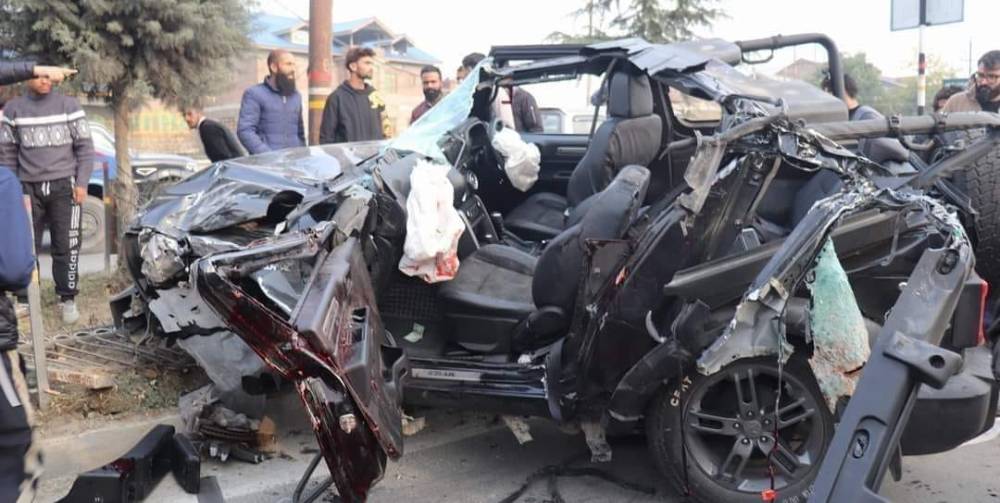
It began with a horrific accident in the city outskirts, on November 14, 2024, when a Thar SUV, carrying three minors, crashed on the busy bypass road—an outer ring connecting Srinagar to Jammu and Baramulla. It claimed the lives of two Class 11 students, Hamaad and Aseem Sofi, one of whom was driving.
Footage from surveillance cameras showed the boys speeding recklessly, attempting to overtake another car before crashing into a parked truck. The impact caused the vehicle to overturn. The disturbing video soon went viral, sparking widespread discussion.
Sources revealed that the boy driving the SUV was only 17, having completed his tenth standard a year earlier. To mark this achievement, his father had gifted him the Black Jaguar-coloured Thar—a symbol of pride and success. But the celebratory gift, intended as a reward for his son’s hard work, became the instrument of his death.
“The minors are very stubborn,” a traffic policeman on duty at Srinagar’s Lal Chowk, said. “They often ride their scooters at dangerously high speeds and sometimes break traffic signals. We have detained several for such violations, but their age becomes a limiting factor, making it challenging for us to take strict action.” Parents, the cop said often equate their children’s physical growth with maturity, but an increase in height does not mean they are ready to handle responsibilities like driving.
Unhealed Stories
The Tengpora tragedy brought the horrors of earlier similar cases to the fore.
In 2021 autumn Sheezaan and his friend, Aariz, decided to ride to the outskirts of Ganderbal town. Both were twenty. For them, their bike symbolised a promise of freedom. Aariz had returned home from Amity College for the holidays, making the trip feel even more special.
Fate had other plans. As they took a curve in the road, a truck appeared suddenly, speeding and out of control. Before they could react, it crashed into them. In an instant, everything changed. What began as an ordinary day of adventure and interaction ended in tragedy.
“We did not even recognise my brother when they brought him home… dead,” Baseerat, Sheezaan’s sister, whispered, her voice breaking. “He left that morning with a smile, looking so handsome, combing his hair so carefully. But who knew the hair he caressed in the morning would be covered in blood before the dusk.” Neither of the boys had a driving licence.
“This pain… it is unbearable,” Baseerat continued, her voice distant. “Every time someone visits our house, my mother only asks one question: ‘Did you see Sheezaan anywhere? Please tell him his mother is waiting at home. She will die without him.’ Every single time. And no one has the heart to tell her that he is never coming back.”
A different story unfolded in Khanyar, where tragedy struck in 2018 summer. Rayan, 15, the only son of Mehraj ud Din and his wife, was killed in a bike accident on the Boulevard Foreshore Road. Born after nine years of marriage, Rayan was the couple’s greatest joy. “He was stubborn from the very beginning,” Mehraj recalled, his voice heavy with sorrow. “We always tried to give him everything he wanted. But when he asked for a bike, I refused. I never imagined he would go behind my back and do something that would shatter my heart forever.”
Rayan was fascinated by adventure and speed. On that summer day, he joined his friends on the Foreshore Road for a stunt session. Riding pillion on a bike, he was surrounded by others in the group. As the boys raced down the road, a Scorpio approaching from the opposite direction swerved into their path. The collision was instantaneous and brutal.
The impact hurled both boys into the air, sending them flying ten feet. The crash was so severe that their brains spilt onto the road, and the bike—torn apart—lay in scattered pieces on the pavement. Both Rayan and his friend died on the spot.
More than five years have passed since that day, but for Mehraj and his family, the trauma remains raw. “It feels like it happened yesterday,” he said, his voice choking with grief. “Every day I live with the thought that he will never come back. My son, my only son, was taken away in the blink of an eye. I do not know how to live without him.” The pain of that moment still lingers as a wound that time has failed to heal.
The Crackdown
Srinagar, often seen as the educational hub of Kashmir, hosts numerous tuition centres where students gather in large numbers for studies. However, the parking areas near these centres and nearby high schools are frequently crowded with two-wheelers, many of them ridden by minors. Every day, students under 18 ride their scooters to these institutions, often unaware that they are breaking the law.
The long-standing issue gained renewed attention after Tengpora. In quick follow-up, authorities launched a crackdown on underage and stunt driving, seizing hundreds of vehicles, primarily two-wheelers. Schools and coaching centres were also issued advisories, urging them to prevent minors from driving to their institutions as part of a wider effort to address the problem.
“I have directed my staff to prioritise addressing this specific violation—minors driving vehicles,” said Muzaffar Shah, SSP Traffic for Srinagar City. “This issue cannot be resolved unless parents and society collectively take responsibility. Losing young lives in such preventable circumstances is both heartbreaking and unacceptable.”
Unlike the past, Shah said, there is sufficient cooperation from society and parents. “We have now recalibrated our approach to specifically target underage drivers and two-wheelers.”
Now petrol pumps refuse fuel to minors. Even the pillion rider has now started using a helmet. “The alarming rise in underage driving is endangering lives on our roads. As a business community, we feel we must contribute to a safer environment,” Mohammad Yaseen Khan, president of the Kashmir Traders and Manufacturers Federation (KTMF), said.
Key Statistics Overview
Over the years, Kashmir’s roads have become dangerous. In 2012, the region recorded 6,709 accidents, resulting in 1165 deaths and 9755 injuries, according to traffic department data. Despite advances in car technology and improvements in infrastructure—such as expanded highways and new bypasses—the numbers remain high. In 2024, so far, Jammu and Kashmir has reported 4,990 accidents, leading to 703 deaths and 6820 injuries.
Srinagar, the summer capital, has borne a significant share of the impact. In 2023, the city recorded 476 accidents, resulting in 55 deaths and 493 injuries. This year, 394 accidents have been reported, with 50 fatalities and 411 injuries.
A particularly worrying trend is the rising number of pedestrian fatalities in Srinagar. “Unfortunately, a pattern is emerging where pedestrians make up the majority of accident victims. The 40 per cent fatality rate is notably higher than the national average,” said Shah. This increase reflects a broader violation of traffic rules, as seen in the surge of fines issued across the region. According to official figures, more than 12 lakh challans have been issued this year, with Srinagar alone accounting for 3.37 lakh.
With around half a million registered vehicles, Srinagar faces daily traffic congestion, compounded by tourists and inter-district commuters. Experts warn that the city’s infrastructure is ill-equipped to manage the growing volume of vehicles, increasing the risk of accidents.
Chaos and Pleading
The Traffic Police’s Polo View headquarters is a scene of chaos and frustration. Seized vehicles are jammed in tight rows, parked bumper to bumper, while over 100 people—parents, drivers, and onlookers—gather daily to plead and protest for the return of their impounded vehicles. More than 50 confiscated cars and bikes now clutter the compound, making it difficult for even senior officers to navigate through the crowded space.
Over the past two weeks, thousands of vehicles driven by minors have been seized across Srinagar. In tandem, the Regional Transport Office (RTO), Srinagar, has significantly strengthened its enforcement measures. Authorities have revoked hundreds of driving licences, fined more than 2,000 violators, and collected penalties amounting to several lakhs. These actions form part of a broader initiative to curb dangerous driving practices and improve road safety in the city.
Road Ahead
The follow-up to the accident has left a lasting impact on Srinagar’s roads, prompting a shift in both driving habits and the enforcement of traffic laws. There is, however, the other side of the story.
Yaseen Ahmad, whose son’s scooter was confiscated, is proposing reducing the legal driving age from 18 to 16. He and many others suggest that at 16, teenagers could be allowed to take a driving test. “If they are tested and licensed, they will be more responsible,” Ahmad said.
Many parents who had invested in offering their student kids freedom of transport are now lamenting over the lack of adequate public transport. “My son leaves the tuition centre at 6 pm and there is no bus around, neither red nor grey,” one frustrated mother said. “Where shall we go?”