SRINAGAR: Looms of Ladakh Women Cooperative Ltd has contested several aspects of a recent report on the organisation, saying its institutional journey has been centred on creating a women-led, producer-owned cooperative rather than building a private craft enterprise. It said the grant support received over the years was used as part of a longer process of developing local skills, governance, manufacturing and market capabilities.

In a detailed response, the cooperative said it was deliberately registered under the Jammu and Kashmir Self Reliant Cooperative Act, 1999, to preserve its democratic character and create an elected board representing producer members. It said the then Deputy Commissioner, who was also the Registrar of Cooperatives before the abrogation of Article 370, and his wife Abhilasha Bahuguna were co-founders rather than members or shareholders because the legislation restricted membership to people domiciled in Jammu and Kashmir and Ladakh.
According to the cooperative, the choice of legislation was intentional. It said the objective was to give agency to producer-artisans in Ladakh, with Bahuguna subsequently working in a pro-bono capacity to help the cooperative develop manufacturing capabilities.
The organisation said the distinction between founders and members was important because the cooperative’s ownership was intended to rest with the producer members. It said its elected governance structure and subsequent leadership changes were part of an effort to progressively transfer operational responsibility to the women members.
The cooperative has also sought to place the grants it received in a longer institutional timeline, arguing that a focus only on the amounts received obscures the four-year preparation period after its foundation during which it worked towards becoming capable of receiving and using institutional support.
Its accompanying executive summary describes a trajectory beginning with foundation and pilot work in 2015-16, followed by cooperative institution-building in 2017-18, advanced technical capability in 2019 and a further phase of institutional consolidation in 2020. It says the early years were devoted to establishing governance, bookkeeping, accounting, inventory and sales systems, developing peer trainers, and building basic spinning, knitting and weaving capabilities.
The cooperative’s account is that the grants were consequently not simply financing the production of finished products. They supported what it describes as institution-building: creating governance systems, training artisans, developing professional management, acquiring production equipment, improving quality, building market linkages and eventually establishing physical manufacturing infrastructure.
By 2019, the cooperative says, advanced weaving, knitting, stitching, design, dyeing and sizing had become focus areas, while support from institutions including EXIM Bank of India, the National Handloom Development Corporation and Usha Silai School helped expand technical and product capabilities. The Handloom School, it said, also provided advanced training to participating women after course fees were waived.
The cooperative says the next stage was aimed at making those capabilities institutional rather than dependent on individual projects. It describes 2020 as a phase of democratic leadership renewal, professional management, quality-management systems and planned financing, with support for a Yarn Bank and quality-improvement equipment. It argues that the result was a transition from basic training and product development towards an organisation with its own governance, manufacturing and financial systems.
Grants to Credit
One of the central clarifications offered by Looms of Ladakh concerns its financial trajectory.
The cooperative said it has now moved from dependence on grants towards institutional credit, securing a bank loan in 2026. It describes this transition in its ninth year as an important milestone because, in its assessment, it demonstrates that the cooperative has reached a stage at which it can access conventional institutional finance rather than rely exclusively on grant support.
Documents sent in response similarly places the move to institutional credit in 2026 at the end of a longer progression from the initial 2013 vision of artisan ownership, through the 2015 community opportunity and 2017 cooperative formation, to skills development, infrastructure creation and regional expansion.
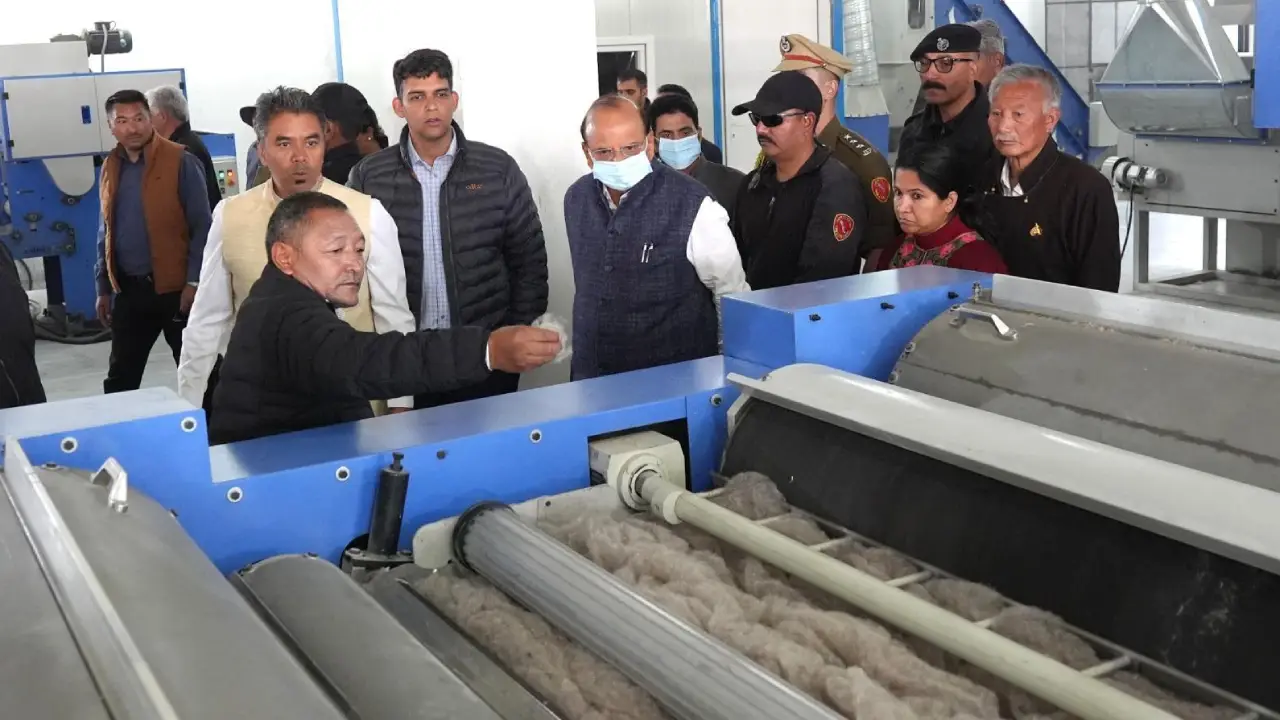
The organisation says the significance of the funding architecture should therefore be judged by what each intervention was intended to establish. ICICI Bank CSR support in 2021-23, for example, is described as having helped construct the Central Atelier, which the cooperative regards as a permanent manufacturing and institutional platform. NABARD support during 2022-24 was used for advanced skilling, marketing and a decentralised work studio at Chushul in Changthang. Royal Enfield Social Mission support from 2023 to 2026 was aimed at scaling the Leh model across Changthang, Kargil and Leh, while WWF Leh/Charles Darwin Initiative support in 2024-25 involved handloom consultancy for pastoralist communities in eastern and south-eastern Ladakh.
The cooperative says the funding pattern also explains why its present capabilities cannot be assessed simply by looking at the amount of money received. Its argument is that different partners addressed different bottlenecks, from training and yarn quality to infrastructure, management and decentralised production.
Building Manufacturing
A major part of the cooperative’s response is devoted to its technical work.
It says its initial weaving capability was based around 2/20-count yarn but that it subsequently developed the ability to work with considerably finer local fibres. Between 2022 and 2024, it says, it undertook research and development and handholding of the first generation of Ladakh Textile Cluster weavers working with 1/56-count local Ladakhi sheep-wool and pashmina yarn, while also working with 2/56-count yarn.
The cooperative argues that this represents a manufacturing-capability change rather than simply a change in product design. It says decentralised manufacturing and product innovation were subsequently expanded between 2023 and 2026.
The documents put its stated fine-count manufacturing capability at about 400 metres a month, or 4,800 metres a year. At an illustrative weaving rate of Rs 1,000 per metre, the document calculates a potential annual weaving value of Rs 48 lakh if the full capacity were produced and sold at that rate. The document expressly describes this as a capacity-based illustration, not a claim of actual annual sales or earnings.
The cooperative says this is part of a larger objective: retaining more of the higher-value processing, manufacturing and product-development chain inside Ladakh instead of limiting local participation to supplying relatively basic textile labour.
That philosophy is also central to Bahuguna’s explanation of why the cooperative was established.
In the interview supplied by the organisation, she traces the idea to 2013, when she said she witnessed an aggressive bargaining exchange involving a Kashmiri pashmina trader and became increasingly concerned about the gap between the reputation of pashmina and the position of the artisans producing it. She said she began thinking about an “Amul-like model” in which artisans would collectively own the institution through which their fibre and labour reached the market.
She said that when she subsequently began working closely with women artisans in Ladakh, the idea became more concrete: paying artisans better, in her view, would not fundamentally alter a system in which someone else owned the institution, controlled the brand and made the major decisions.
“A wage recognises labour. Ownership recognises the person behind the labour,” she says in the interview, arguing that agency includes the ability to influence what is produced, how it is produced, the standards adopted and what happens to the value created when the product reaches the market.
Herders to Consumers
Looms of Ladakh says its longer-term ambition is therefore to connect herders, artisans and consumers rather than treating pashmina, sheep wool and other mountain fibres simply as commodities.
Bahuguna said she was influenced in part by Nepal’s Chyangra Pashmina experience but believed that backward linkages, including herders, fibre quality, local processing and manufacturing, needed greater attention in Ladakh.
Her concern, she said, was that Ladakh could otherwise become a place where products are marketed around the identity of pashmina while much of the actual manufacturing, research and development take place elsewhere. The cooperative says its objective is to build those capabilities locally, including processing, manufacturing, product development and R&D.
Traceability is another component of this model. Bahuguna said the cooperative was working towards QR-based traceability for woven products. She also said that, while serving on the UT Administration’s Pashmina Pricing Committee, she had advocated barcode identification and sample grading of individual herders’ annual fibre yields so that animal health and fibre quality could be reflected in prices.
The cooperative’s stated production mix in 2023-24 was 85 per cent of value and 20 per cent of volume from pashmina, 7 per cent of value and 66 per cent of volume from sheep wool, and 8 per cent of value and 14 per cent of volume from other materials.
Income and Local Team
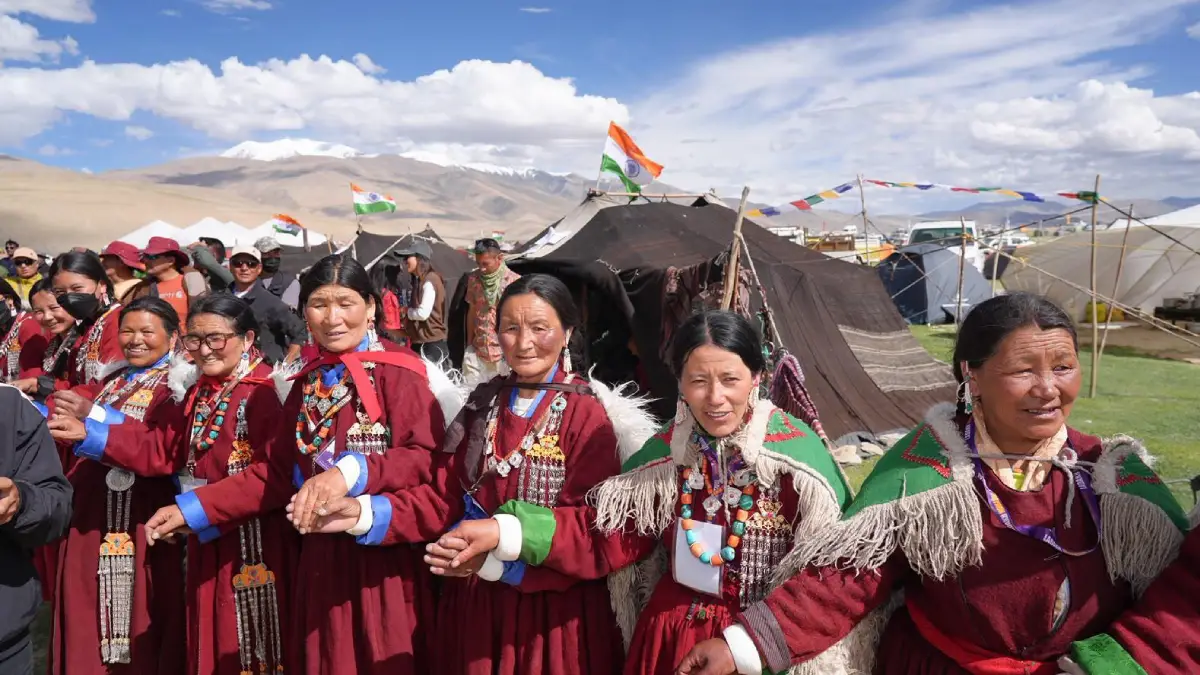
The organisation also points to what it describes as measurable livelihood gains. Its executive summary says average earnings reported by members had risen to about Rs 15,000 a month, from Rs 3,000 earlier, by September 2024.
It says it has simultaneously attempted to build a local management structure instead of making the cooperative dependent on outside professionals.
The current structure described in the document includes two to three elected artisan leaders with indicative monthly earnings of Rs 12,000 each; three to four local rural graduates or young professionals earning approximately Rs 15,000 to Rs 22,000; an external trained designer earning Rs 50,000; and two to three specialised trainers engaged at about Rs 40,000 when required. The organisation says the purpose is to combine elected artisan leadership with local professional capacity and limited external expertise.
It also emphasises the role of Bahuguna herself, describing her contribution as full-time work on strategy, fundraising, partnerships and on-the-job handholding of local artisans and graduates without an honorarium. The stated objective, according to the document, is to progressively transfer responsibility from the pro-bono founder to the cooperative’s members.
The cooperative’s account thus presents its grant history as part of a deliberate attempt to build local institutional capacity rather than as a series of isolated projects. It says the co-founders’ role was to identify capability gaps, mobilise specialised partners, embed the resulting knowledge within cooperative systems and progressively transfer responsibility to elected members.
Two Clarifications
Looms of Ladakh has also disputed a point concerning G Prasanna Ramaswamy, saying he was transferred to the Delhi Government under an order dated August 13.
It has separately drawn attention to Brand Ladakh, describing it as a District Administration initiative dating to 2019, and saying that its retail presence in Delhi is now being privatised. The cooperative referred to an auction announcement supplied along with its response.
Taken together, the material supplied by Looms of Ladakh portrays the organisation less as a conventional craft label and more as an attempt to build a producer-owned manufacturing institution around Ladakh’s indigenous fibres. Its stated model is based on three linked propositions: that artisans should have ownership and a role in governance; that more of the manufacturing and technical value chain should remain in Ladakh; and that grant-funded capability building should ultimately lead to an institution capable of sustaining itself through markets and conventional finance.
The cooperative’s latest claim is that the transition from grants to institutional credit in 2026 marks that progression, from establishing a producer institution, to building technical and manufacturing capacity, and finally towards financing its operations through credit rather than remaining dependent on grants.