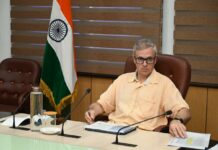
SRINAGAR: Chief Minister Omar Abdullah on Wednesday called for locally suited and economically viable biomass solutions to help Jammu and Kashmir reduce its dependence on fossil fuels and move towards a more sustainable economy.
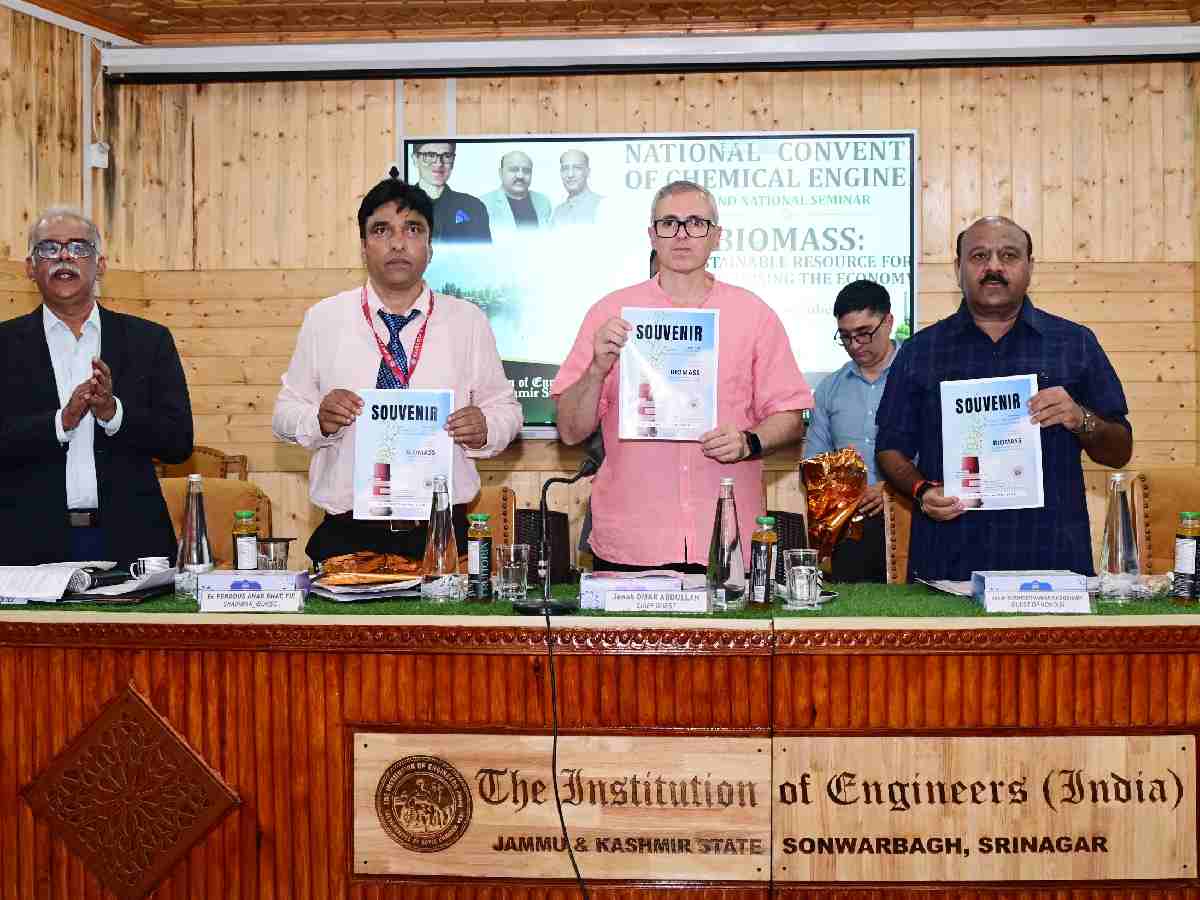
Addressing the inaugural session of the 41st National Convention of Chemical Engineers and National Seminar on “Biomass: A Sustainable Resource for Decarbonizing the Economy” at the Institution of Engineers (India) (IEI) J&K State Centre, Omar said J&K had abundant biomass resources but lacked economically sustainable models to convert waste into energy.
The two-day event has been organised by the Chemical Engineering Division Board of IEI in association with the Department of Chemical Engineering, NIT Srinagar.
Omar said biomass generated from agriculture, horticulture, forests, municipal waste and growing consumption could be utilised to address both waste management and energy requirements.
“We are sitting on a wealth of biomass whether we like it or not,” he said, adding that the challenge was to develop effective mechanisms to convert the resource into useful energy.
The chief minister said J&K had so far struggled to establish a workable waste-to-energy model, mainly because of questions surrounding its economic viability.
He said alternative energy solutions must be economically sustainable and capable of competing with relatively cheaper sources such as solar and hydropower.
At the same time, Omar said economic considerations alone could not determine waste-management and energy policies, stressing that the growing volume of organic waste and legacy waste would have to be addressed.
“We will have to do it,” he said, referring to the need to develop sustainable waste-to-energy solutions.
Omar also recalled efforts during his previous tenure to explore the possibility of converting plant material removed from Dal Lake into biofuel in collaboration with higher education institutions, including the agricultural university.
He said such ideas needed to move beyond discussions and be pursued through practical experimentation.
Highlighting the impact of climate change, Omar pointed to the retreat of glaciers in the Himalayan region, citing the Thajiwas glacier near Sonamarg as an example.
He said the visible shrinking of glaciers underscored the environmental consequences of continued dependence on fossil fuels and the urgency of developing cleaner alternatives.
The chief minister also urged scientists, engineers and academic institutions not to be discouraged by failed experiments, saying innovation required sustained efforts and a willingness to learn from unsuccessful attempts.
“Let us not be afraid of failure,” he said.
Omar stressed that solutions developed for biomass utilisation in J&K could not simply be replicated from other parts of the country because of differences in geography, climate and the nature of available resources.
“The biomass of Jammu and Kashmir will not be the same as the biomass of Maharashtra, will not be the same as the biomass of Tamil Nadu,” he said, calling for localised and indigenised solutions.
He urged participants to use the convention to develop concrete recommendations and practical projects addressing J&K’s specific requirements.
“We need to commit the awesome brain power that is present in this room… to arrive at workable, sustainable, economically viable projects,” Omar said.
He said the deliberations should result in actionable recommendations that could be considered by the J&K Government and shared with other governments and the Centre.
The chief minister said the objective should be to develop technologies that simultaneously address waste management, energy generation, environmental sustainability and economic viability.
“Let us arrive at localized, sustainable, economical solutions,” he said.
Omar also said the ultimate goal should be to gradually reduce carbon dependence while ensuring a more sustainable planet for future generations.
The convention was attended by Deputy Chief Minister Surinder Kumar Choudhary, University of Kashmir Vice Chancellor Prof Nelofer Khan, NIT Srinagar Director Anurag Mishra, IEI J&K State Centre Chairman Ferdous Ahad Bhat, Chemical Engineering Division Board Chairman Prof G Madhu, besides engineers, academicians and experts.
The chief minister noted that the national convention was being held in J&K after several decades, with the last such IEI convention in the region having been held in early 1989.