by Syed Shadab Ali Gillani
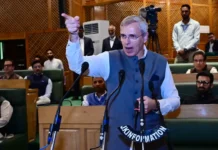
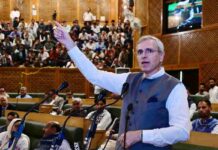
SRINAGAR: On the morning of Independence Day, the Chief Minister of Jammu and Kashmir stood again at Bakshi Stadium. 11 years ago, he had addressed the people as the elected head of a state. Today, he stood as the Chief Minister of a Union Territory.
This time, he did not speak of development, or progress, or celebration. He opened with an announcement. A signature campaign.
“For the next eight weeks,” he said, “we will travel across all 90 constituencies. We will go to every village, every area. We will ask for one thing the restoration of statehood.”
The campaign, he said, was not about power or position. “If we fail, I will accept that,” he told the gathering. “But I believe people want their state back. We will take these signatures to Delhi, to the court. Only then will I rest.”
Kishtwar Tragedy
He began the speech by referring to the cloudburst in Kishtwar. Over 60 people have died. More than 100 are injured. Rescue efforts are going on.
He offered condolences and said the government will help the victims. But he added that the administration will look into whether there was any failure. “We owe that to the people,” he said.
A Different Chair
“This was not going to be a government speech,” he said, about halfway through. “I was confused about what to say.”
He had stood on the same stage in the past. That time, he said, he was the Chief Minister of a state. The Assembly was elected, the Cabinet made decisions, and those decisions were implemented. “We had our flag, our constitution, our own laws.”
He paused. “Today, I am the Chief Minister of a Union Territory.”
He said the change is not just in name. It is in how things move or don’t move. Cabinet decisions are passed, he said, but many don’t get cleared. Some files don’t return. Some disappear.
He said people had told him the shift to a Union Territory would be manageable. “They said the papers are ready. But I was not ready to give up the chance to try.”
Now, after eight months in office, he said: “It is more difficult than I thought.”
The Broken Chain
He referred to a recent observation by the Supreme Court. “The Court said bureaucracy is accountable to the government, and the government to the people,” he said. “But here, that chain is not working.”
The officials, he said, are not answerable to the elected government. As a result, the gap between people and administration has grown.
“This UT system cannot function in its current form,” he said. “If the government is elected, then it must have the right to govern.”
On Pahalgam
The recent hearing in the Supreme Court on Statehood, he said, included a reference to the Pahalgam attack.
“We were told the Pahalgam incident cannot be ignored,” he said. “I agree. But should we be punished for it again?”
He said those who attacked were already dealt with through Operation Sindoor. “Now that same attack is being used to delay statehood.”
He added that it was not the elected government’s fault. “It didn’t happen because of our governance. When I was Chief Minister, or many previous governments we reduced such incidents. Not by chance, but by work.”
He said the people stood with the victims, not with the attackers. “This should not be used as a reason to keep delaying our rights.”
Assembly vs Authority
He said his government has passed resolutions on issues including Article 370, youth schemes, development funds, and local governance.
“Some progress has happened in health and education too,” he said.
But he made it clear that without full authority, these steps have limited impact. “We are accountable to the Assembly, the MLAs are accountable to people. But where is the accountability of the administration?”
Again, he did not raise his voice.
No Celebration
He said some people had told him that there may be a positive announcement from the Centre on this 15th August. “Even I hoped. But nothing came. Again.”
He said hope remains, but is growing weak.
He asked the audience: “Are we better now? After six years of silence, are we?”
There was no reply.
Moving Forward
He ended the speech with a plan. The campaign for signatures will be taken to all 20 districts. He said his party workers and public representatives will be on the ground, asking people to sign.
“We have tried everything letters, meetings, resolutions,” he said.
Now I along with my colleagues, will visit every Legislative Assembly segment and do on a door-to-door campaign across Jammu and Kashmir to collect public signatures and thumb impressions in support of restoring the Union Territory’s statehood.
Omar said, “The Supreme Court has given eight weeks, and we will not let them go to waste. We will reach every segment and ensure no household or individual is left without endorsing this cause.” He added that the campaign would also record thumb impressions of those unable to sign during the eight-week period.
The speech ended.