SRINAGAR: Environmental activist Dr Raja Muzaffar Bhat said that the Karewa landscape of Pulwama and Budgam has been subjected to “loot and plunder” on a scale far greater than the quantities reflected in official records. This, he said, after a joint committee constituted by the National Green Tribunal (NGT) documented extensive excavation and alteration of the terrain at Zadoora, Gowherpora and Rangeen Kultreh.
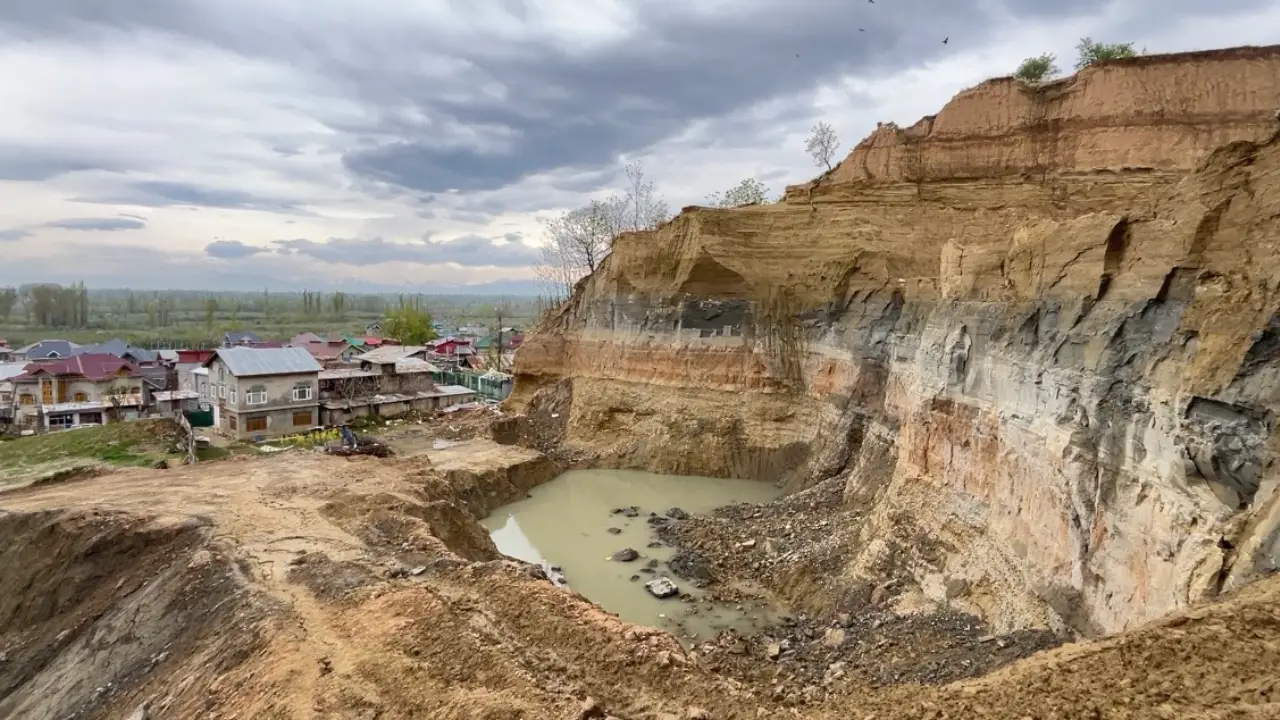
“Out of 18 lakh MTs , 130500 MTs of material has been excavated from Gowherpora and Rangeen Kultreh villages of Chadoora Budgam and around 5 lakhs MTs from Zadoora village of Pulwama in Hastikhud area,” he said.
Bhat, who is the petitioner in the case before the NGT, said the government could not use the abrogation of Article 370 and the COVID-19 pandemic to explain away large-scale excavation during 2019-2024, arguing that curfews, lockdowns and heavy security restrictions made the movement of earth-moving machinery and mined material difficult.
“The case is now crystal clear,” Bhat said, referring to the reports placed before the tribunal on Monday. He said the findings of the NGT’s joint committee and the Jammu and Kashmir Pollution Control Committee had exposed illegal mining in the Karewas of Pulwama and Budgam and demanded identification of the officials who allowed the excavation.
The NGT is hearing Bhat’s Original Application No. 93 of 2026 against the Union Territory of Jammu and Kashmir and others. The matter was listed on August 17, when both the government counsel and the petitioner sought time to file their responses. The case has now been listed for November 4.
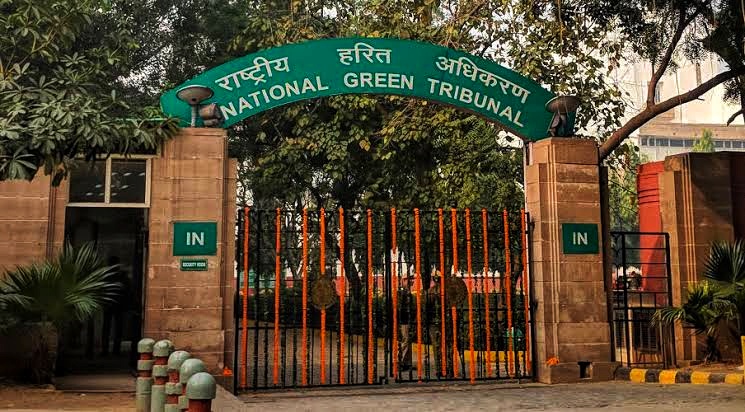
The joint committee report, prepared pursuant to the NGT’s February 6, 2026 order, provides the most detailed official account so far of the excavation at the two locations. The committee comprised senior officials from the Ministry of Environment, Forest and Climate Change, the Central Pollution Control Board, the J&K Pollution Control Committee and the Deputy Commissioners of Budgam and Pulwama. Its mandate included determining the quantity of clay and bajri extracted, identifying those responsible for illegal extraction and examining the status of environmental clearances.
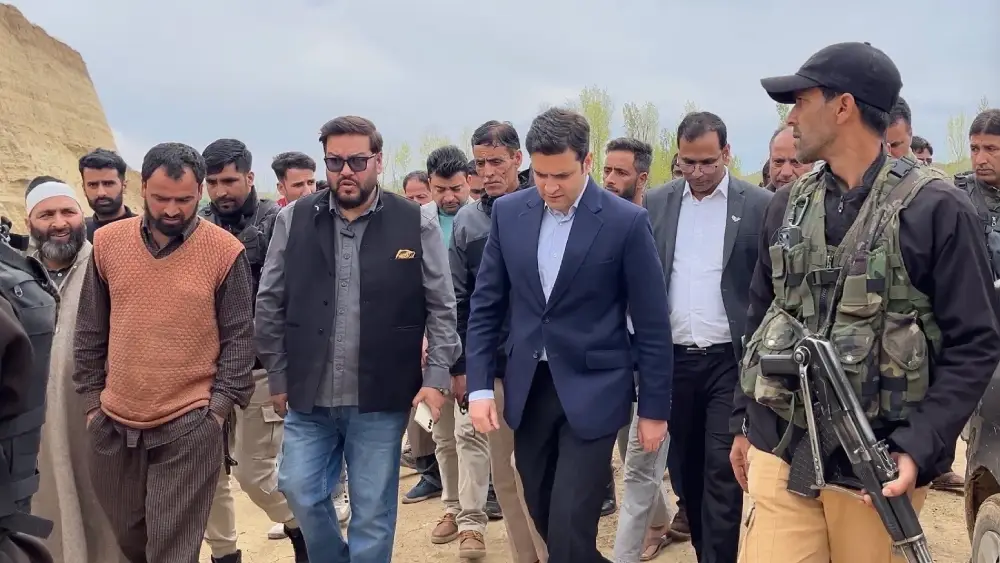
The committee conducted its joint visit on April 7, 2026 to Zadoora in Pulwama and Rangeen Kultreh and Gowherpora in Budgam. The report says officials from Mining, Revenue, Pollution Control and Horticulture departments participated in the inspection.
At Zadoora, the committee found extensive excavation of Karewa land and sought an assessment of the soil and clay removed from the area. The report records that the district Mineral Officer informed the committee that no lease or permission for large-scale commercial mining operations had been granted by the Mining Department in the area.
The committee was told that approximately 2.996 lakh cubic metres of material had been excavated from the Zadoora site.
The official explanation for part of the excavation was that, during the period from 2019 onwards, the Valley experienced an intense law-and-order situation followed by the COVID-19 pandemic, creating extraordinary administrative and security challenges. The District Mineral Officer also told the committee that some landowners had excavated soil from their private holdings without following prescribed procedures.
The report, however, makes clear that the pandemic and law-and-order situation did not provide a blanket legal sanction for excavation.
According to the committee, the Tehsildar Pulwama had issued disposal permits from 2021 onwards covering approximately 51,272 cubic metres of excavated material, while an amount of about Rs 23.11 lakh had been collected towards royalty and DMFT contributions. The report says the remaining excavated material, particularly a major portion of the excavation dating from 2019 to 2021, had been removed during the period of heightened restrictions.
The committee also recorded that the District Mineral Officer had informed it that adjoining landowners had not raised objections or complaints regarding soil excavation during the relevant period. It nevertheless noted that instances of unauthorised excavation after 2021 had been dealt with through enforcement action, including seizure of heavy earth-moving machinery and registration of FIRs.
The enforcement figures included in the report show 246 vehicle/machinery seizure cases during 2021-22 to 2025-26, involving recovery of about Rs 51.76 lakh, along with 28 on-spot/dump cases involving another Rs 10.90 lakh.
The committee’s physical inspection also revealed the consequences of excavation. A primary health centre and playground had been constructed at one of the inspected locations, but steep portions of the area had been excavated to varying depths without adequate bench formation or slope stabilisation. The committee warned that such steep and unprotected excavated slopes posed risks of landslides, soil erosion and instability.
It consequently recommended benching and terracing of excavated areas, retaining and toe walls, gabion structures, erosion-control and bio-engineering measures, drainage arrangements, periodic monitoring and progressive restoration of the excavated land. It also called for necessary permissions and statutory clearances to be obtained before excavation and for continuous vigilance by the Mining Department to prevent further unauthorised extraction.
The findings from Budgam are even more detailed.
The committee visited Rangeen Kultreh and Gowherpora and examined the records of the Department of Geology and Mining. Officials told the committee that clay extraction at Kuzwera had commenced during construction of the Qazigund-Baramulla railway line and National Highway-44, while extraction at Gowherpora had commenced during execution of the Srinagar semi-ring road project.
The records supplied to the committee show 415,000 metric tonnes of clay extraction at Kuzwera and 890,000 metric tonnes at Gowherpora, making a combined 13.05 lakh metric tonnes in the table placed before the committee. No quantity is entered against the Rangeen/Kultreh row in that table. The recorded payments under royalty, DMFT and other heads total approximately Rs 3.33 crore.
This is an important clarification to the broader figure of “more than 18 lakh metric tonnes” cited in the material accompanying the case. The joint committee report itself records 13.05 lakh metric tonnes for the Budgam entries in its table, while the Zadoora quantity is expressed separately as 2.996 lakh cubic metres, not metric tonnes.
The report also records that, according to the District Mineral Officer, disposal permits had been issued during the preceding five years. The officer stated that such permits did not require prior Environmental Clearance in terms of the applicable exemption provisions for certain specified projects.
But the committee raised an important qualification.
It noted that exemption from the requirement of prior Environmental Clearance did not mean exemption from compliance with other statutory or procedural conditions. In particular, the committee observed that it did not have documentary evidence showing whether the concerned project proponents had informed the J&K Pollution Control Committee at least 14 days before commencement of mining or extraction, where such prior intimation was required under the applicable MoEF&CC memorandum.
The committee further found that the Standard Operating Procedures prescribed by the Ministry of Environment, Forest and Climate Change for extraction, sourcing or borrowing of ordinary earth had not been fully followed. These procedures include safeguards relating to preservation of topsoil, reuse for plantation, benching and cutting of drains, among other requirements.
The report also records that, between April 1, 2021 and March 31, 2026, 113 seizures of vehicles/machinery involved in illegal mining were made in Budgam, resulting in recovery of approximately Rs 25.25 lakh in compounding charges. Fourteen FIRs were registered against habitual offenders during the same period.
The District Mineral Officer and district administration again linked part of the unauthorised excavation to the COVID-19 pandemic and the August 5, 2019 transition period, saying that certain landowners had taken advantage of the circumstances to facilitate excavation from their holdings without following prescribed procedures.
The committee, however, recorded a broader environmental concern at the Budgam site. It observed that excavation of clay had not taken place only at the level of the adjacent road and local habitation. In some areas, land had been excavated substantially, including near existing horticultural land. It also observed that some of the excavated land had subsequently been reclaimed and utilised for government schools, a Panchayat Ghar and private high-density horticulture plantations.
The committee specifically noted the absence of proper benches and sustainable conservation measures at some locations, warning that the lack of adequate measures could expose adjoining areas to slope instability, soil erosion, landslides and damage to neighbouring properties.
It recommended that remaining steep mounds be stabilised through engineering and biological measures and, where feasible, re-graded and levelled. It also recommended retaining walls, erosion-control measures, drainage arrangements, periodic monitoring and progressive restoration of the excavated areas.
The J&K Pollution Control Committee’s own report, submitted separately to the NGT, reinforces several of these findings.
Its inspection at Zadoora recorded extensive excavation of Karewa land, use of heavy machinery indicating mechanised mining, disturbance of natural land contours, degradation of land quality and significant alteration of the topography through extraction of soil strata. It also found no visible environmental safeguards such as slope stabilisation or restoration measures. At Gowherpora-Kultreh, the committee found evidence that mining had continued over an extended period and noted the absence of proper demarcation or boundary pillars.
More significantly, the J&K PCC report records that at the Gowherpora site, where NKC Projects Pvt Ltd was involved in excavation, Environmental Clearance had not been obtained before commencement of mining activities. The report states that the earth mining was carried out without an approved mining plan, consent from the Pollution Control Committee, an Environmental Management Plan and Environmental Clearance.
The company’s presence in the regulatory record is not incidental. The J&K Environment Impact Assessment Authority’s records show several environmental clearances issued in the name of NKC Projects Pvt Ltd for mining blocks in Budgam in 2021-22.
The apparent contradiction between permissions subsequently issued or recorded and the PCC’s finding that mining commenced without prior Environmental Clearance is likely to be one of the important regulatory questions before the tribunal.
The satellite record adds another dimension to the case because it provides an independent historical chronology of the physical expansion of the excavation.
The Department of Ecology, Environment and Remote Sensing analysed high-resolution archived imagery for the Karewa deposits. At the Kultreh site, imagery from 2013 and 2014 showed limited spatial expansion of mining. By 2016, the mining area had expanded laterally, while noticeable mining activity and increased disturbed surfaces were visible in 2018. Imagery from June 2020 and May 2022 showed significant expansion. The images from 2023, 2024 and 2025 showed continued mining and substantial enlargement of excavation areas, with previously separated zones increasingly interconnected.
At Zadoora, the earliest available high-resolution imagery, dated October 8, 2011, already showed an excavation pit. Subsequent imagery showed the appearance of new pits, expansion of existing ones and continued excavation. The government’s spatial analysis estimated the total mining area at approximately 6.06 hectares as of April 6, 2025.
The chronology becomes particularly striking from 2018 onwards. A new pit appeared in August 2018; by March 2019 two further excavation features had developed. The second pit expanded in 2020, another pit appeared in 2021, and by April 2022 all three identified pits showed noticeable mining activity. Subsequent imagery from September and October 2022 showed continued excavation and the emergence of additional pits. By 2023-25, previously separated pits had progressively merged into larger continuous excavation zones.
The historical satellite analysis at the larger Kultreh site estimated the mining area at approximately 42.9 hectares as of April 6, 2025.
The satellite evidence therefore does not support a simple explanation that the damage began only after the abrogation of Article 370 or during the COVID-19 lockdown. It shows excavation activity predating 2019 at both locations, followed by varying degrees of expansion over the subsequent years.
At the same time, the joint committee report does acknowledge the exceptional administrative conditions of 2019-21 and records the Mining Department’s explanation that some private landowners took advantage of the circumstances to undertake excavation without following prescribed procedures. The report also records enforcement action after 2021, including seizures and FIRs.
For Bhat, however, this explanation does not answer the central question of how such a large quantity of earth could be removed from Karewa formations without the knowledge or intervention of the regulatory machinery.
“The case is now crystal clear,” he said, asserting that the reports had established illegal mining in the Karewas. He has demanded environmental compensation against NKC Projects Pvt Ltd and sought action against the company, alleging that it had already faced environmental compensation proceedings in connection with the Shaliganga case.
Bhat has also called for a high-level investigation into the role of government officials and said he would pursue the matter before the NGT as well as anti-corruption agencies.
The reports now before the tribunal leave several questions for adjudication: the precise quantity of material removed from each site; the distinction between permitted extraction and unauthorised excavation; whether the exemptions claimed by project proponents were accompanied by compliance with all other statutory conditions; whether environmental safeguards were followed; and who was responsible for excavation that the official satellite record shows expanding across the Karewa landscape.
The joint committee itself has recommended restoration, slope stabilisation, drainage and continuous monitoring. It has also called for statutory permissions and clearances to be obtained before future excavation and directed the Mining Department to maintain continuous vigilance against unauthorised extraction.
The matter will return before the NGT on November 4. By then, the competing claims over the quantities extracted, the legality of the permissions and the responsibility for the environmental damage are expected to be formally addressed by the parties.