SRINAGAR: The Jammu and Kashmir government on Monday said that works worth over Rs 15.03 crore have been executed for the preservation, conservation and beautification of Brari Nambal Lagoon, while a fresh Detailed Project Report (DPR) is being prepared for further development.
The information was provided in response to a starred Assembly question raised by Shamim Firdous.
According to the reply, the Jammu and Kashmir Lakes Conservation and Management Authority (LCMA) has completed two major projects in and around the lagoon.
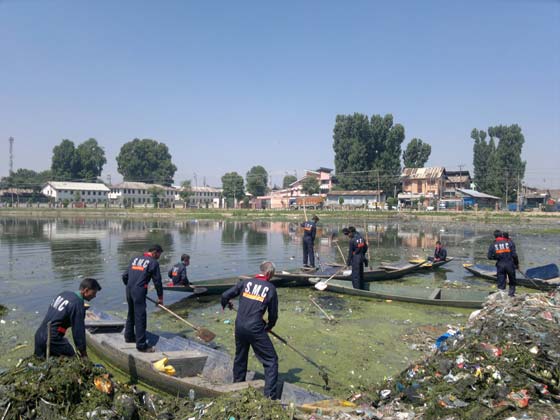
Under the Atal Mission for Rejuvenation and Urban Transformation (AMRUT), works amounting to Rs 8.76 crore were carried out. These included dredging of the main water body and connected channels such as Rainawari and Nowpora, construction of a 1000-metre walkway with slope stabilisation, improvement works at a temple, removal of solid waste, restoration of damaged electric poles, renovation of grill fencing, and installation of aerators.
In addition, under the Prime Minister’s Development Package (PMDP), projects worth Rs 6.27 crore were executed. These comprised construction of a food court near MP School, installation of a fountain near Shehri Khas Gate, development of a central verge, construction of a jetty, laying of inner and outer pathways, and provision of ornamental grill fencing.
The government further informed that a DPR for additional beautification and development of Brari Nambal is being planned, with the Request for Proposal (RFP) set to be floated in the next financial year.
On measures to tackle pollution and encroachment affecting the Dal Lake ecosystem, the government said the Jammu and Kashmir Pollution Control Committee is conducting monthly monitoring of water quality, analysing key parameters including dissolved oxygen (DO), biochemical oxygen demand (BOD), chemical oxygen demand (COD), pH levels, and faecal and total coliform.
It added that around 3,108 families have been relocated from within the lake area as part of conservation efforts. Continuous de-weeding and cleaning operations are being undertaken throughout the year, both manually and mechanically.
The government said sewage management infrastructure has been strengthened with the construction of sewage treatment plants (STPs) having a total capacity of 36.73 MLD to treat domestic waste from adjoining areas. Additionally, 721 houseboats have been connected to STPs to prevent direct discharge of sewage into the lake.
Other measures include installation of bio-digesters on a pilot basis in the Tailbal area, creation of oxidation and detention ponds along the lake periphery, and ongoing upgradation of STPs at Brari Nambal and Nallah Amir Khan under AMRUT 2.0 to meet National Green Tribunal norms.
A new 30 MLD STP is also being constructed at Guptganga to capture sewage from uncovered areas, the reply said.
The government further stated that 3 to 5 metric tonnes of solid waste is collected daily from houseboats, hamlets, open water surfaces, inflow and outflow channels, and associated water bodies.
Afforestation efforts have seen the plantation of nearly two lakh trees in recent years, while fencing works have been undertaken in catchment areas. Maintenance and development of inflow channels and nallahs are also being carried out to reduce silt load.
The lake boundary was demarcated for the first time in 2019-20 through the Survey of India, while regular anti-encroachment drives are being conducted. No new construction is permitted within the lake area and a 200-metre buffer zone, as per High Court directions.
Enforcement measures include demolition drives, registration of cases, and routine checks to prevent illegal transportation of construction material.
On water quality, the government said that monitoring conducted between April and December 2025 across 21 locations in Dal Lake showed that none met the primary water quality criteria for faecal coliform, although parameters such as BOD were within permissible limits at several sites.
The reply also noted that an Integrated Management Plan for conservation of the Dal-Nigeen lake ecosystem has been taken up under PMDP, with a DPR prepared by Indian Institute of Technology Roorkee at a cost of Rs 212.38 crore for a five-year period. The plan focuses on sewerage for internal hamlets, catchment management, and reduction of silt inflow.
The response was put on record by the Chief Minister, who holds charge of the Housing and Urban Development Department.