by Fiaz Pampori
SRINAGAR: The Chenab Valley has witnessed an unprecedented spell of weather-related destruction over the past 48 hours, with three separate flash flood incidents striking Doda and Kishtwar districts, damaging homes, shops, roads and vehicles, disrupting traffic on the strategic Doda-Kishtwar highway, and inundating the under-construction 540 MW Kwar Hydroelectric Project. While no loss of life has been reported, the back-to-back disasters have exposed the vulnerability of the mountainous region to extreme weather events during the monsoon.

The latest incident occurred on Tuesday when flash floods triggered by heavy rainfall swept through the upper reaches of Thathri town in Doda district, carrying boulders, mud and debris into residential and commercial areas.
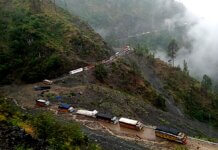
Several houses and shops suffered partial damage, while a number of vehicles parked along the roadside were buried under debris. Local residents claimed that some vehicles were swept into the Chenab River, although officials were yet to verify the extent of the damage.
The flash floods also blocked the Doda-Kishtwar highway at Thathri, disrupting traffic until restoration teams launched clearance operations.
The incident marked the third major flash flood in the twin districts within two days.
A day earlier, intense rainfall had triggered flash floods and landslides across Doda and Kishtwar, causing extensive damage to infrastructure, including a major stretch of National Highway-244 near Prem Nagar and the under-construction 540 MW Kwar Hydroelectric Power Project in Kishtwar.
At the Kwar project site, floodwaters carrying mud, rocks and boulders entered the Tail Race Tunnel area, burying several heavy vehicles, dumpers, dozers and construction machinery under debris. Authorities said project infrastructure remained largely intact despite the inundation, and no casualties were reported.
Union Minister Jitendra Singh said he had spoken to Jammu Divisional Commissioner Ramesh Kumar immediately after receiving information about the incident.
“Fortunately, there has been no loss of life or property. Some project machinery was shifted safely, and all components of the under-construction project remain intact,” the minister said.
The Doda-Kishtwar highway also suffered extensive damage after landslides and flash floods deposited huge quantities of mud and boulders across the road near Prem Nagar, forcing suspension of traffic for several hours.
Road restoration teams, assisted by heavy machinery, worked throughout the day to clear debris and reopen the highway.
Officials said the latest incidents followed continuous heavy rainfall across the Chenab Valley, one of Jammu and Kashmir’s most landslide-prone regions.
Deputy Commissioner Doda Krishan Lal said the district administration responded promptly to all rain-related incidents and restored affected roads after deploying men and machinery.
He said roads in Prem Nagar, Chiralla and Bagna were cleared shortly after debris accumulated following heavy rain.
The Deputy Commissioner, however, appealed to the public not to describe every rain-triggered incident as a cloudburst.
“These are episodes of heavy rainfall which often bring mud and stones down hill slopes in hilly districts. The administration remains fully alert and is responding immediately wherever such situations arise,” he said.
He urged residents to verify information through the District Control Room instead of relying on rumours circulating on social media.
The Meteorological Department had earlier warned of heavy rainfall, thunderstorms, flash floods and landslides across vulnerable areas of the Jammu region between July 6 and July 8.
According to the department, Samba recorded the highest rainfall in the region with 90 mm during the previous 24 hours, followed by Kathua (66.2 mm), Katra (44.4 mm), Doda (42 mm), Jammu (41.8 mm), Udhampur (40.6 mm), Bhaderwah (33.6 mm) and Kishtwar (24 mm).
The weather office has cautioned that intermittent heavy showers may continue over vulnerable parts of the Chenab Valley and the Pir Panjal range, with the possibility of localized flash floods, mudslides and landslides.
Authorities have advised people living near streams, nallahs and landslide-prone slopes to remain vigilant and avoid unnecessary travel during periods of intense rainfall.
The latest spell of extreme weather comes less than a year after the devastating Chisoti cloudburst in Kishtwar, one of the worst natural disasters in the region’s recent history, and has once again raised concerns over the increasing frequency of intense rainfall events in the fragile Himalayan terrain.